
The decision in 30 seconds
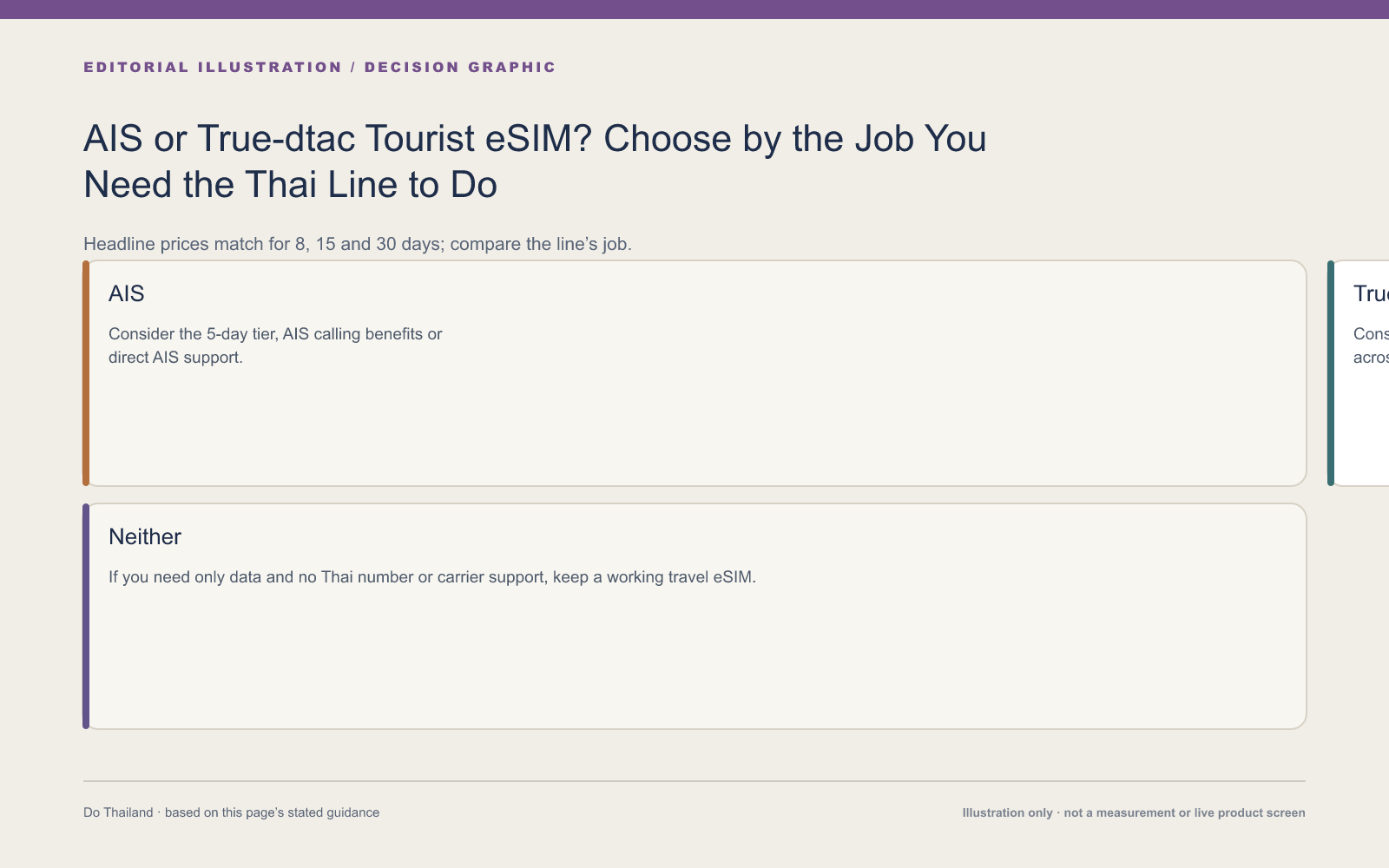
Pick AIS Lucky Tourist eSIM if a 5-day local-carrier package fits your trip, you want a Thai carrier line with AIS calling benefits, or you simply prefer to deal directly with AIS.
Pick True-dtac Tourist eSIM if you want the current 10-day data-only lane or if an Infinite plan with local calls across Thai networks is more useful than free calls mainly inside one carrier network.
Do not buy either just because “local must be better.” If your existing Thailand eSIM already works and you do not need a Thai number, outgoing local calls or walk-in carrier support, replacing it can add registration and profile-management work without improving the trip.
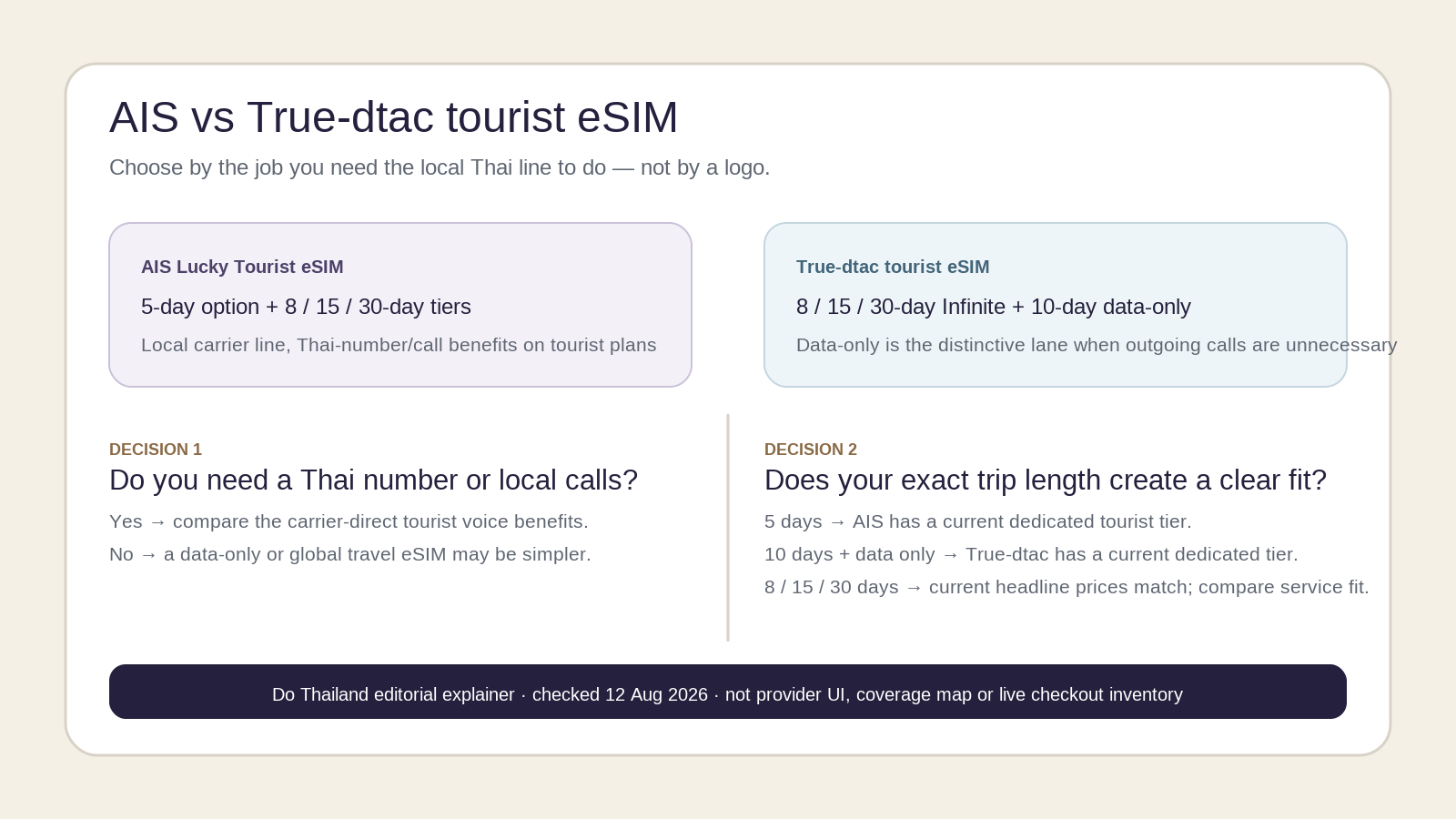
This guide starts after the broader decision in our Thailand eSIM vs airport SIM guide. There, the main question is whether you want data working before you leave arrivals or prefer a Thai carrier setup. Here, you have already chosen the local-carrier route and need to decide which Thai tourist eSIM actually fits.
The surprising part: the main 8-, 15- and 30-day prices currently match
Checked on 12 August 2026, AIS lists Lucky Tourist eSIM/SIM plans at 499 THB for 8 days, 699 THB for 15 days and 1,199 THB for 30 days. True-dtac currently lists its Tourist Infinite products at the same 499 / 699 / 1,199 THB headline prices for 8 / 15 / 30 days.
That matters because it removes the easiest lazy comparison. For those durations, the decision is not “which one costs less?” at the headline level. It becomes: which calling structure, duration, registration path and support relationship actually matches your trip?
Price parity changes what you should compare
If you are travelling for 8, 15 or 30 days, do not spend an hour hunting for a theoretical winner from the same headline price. Check the exact current package terms, then choose by the job the line must do: local calls, a Thai number, data only, carrier support, trip length and any route-specific coverage concern.
Current tourist eSIM shelf: where the real differences appear
| Decision point | AIS Lucky Tourist eSIM | True-dtac Tourist eSIM | Editorial read |
|---|---|---|---|
| 5-day trip | Current 5-day tourist tier: 399 THB, marketed with unlimited max-speed 5G/4G data plus tourist-plan calling benefits. | No matching 5-day headline tourist tier is shown on the current main tourist page checked. | AIS has the cleaner duration fit if you specifically want a local carrier for five days. |
| 8 days | 499 THB. | 499 THB Infinite plan. | Headline price does not decide it. Compare calls, support and the exact network setup you prefer. |
| 10 days | The current tourist shelf does not show a dedicated 10-day headline tier. | Current 10-day data-only tourist option: 349 THB. | True-dtac has a distinct data-only lane when outgoing local calls are unnecessary. |
| 15 days | 699 THB. | 699 THB Infinite plan. | Again, choose on service fit rather than headline price. |
| 30 days | 1,199 THB. | 1,199 THB Infinite plan. | For a month, support, number/call use and exact plan terms matter more than a same-price headline. |
| Local calling | Current tourist page advertises free calls within AIS plus 100 THB bonus for other Thai networks/international calls via the stated AIS route. | Current Infinite plan advertises local calls across Thai networks; the terms checked limit free calls to 15 minutes per call before out-of-bundle rules apply. | People who will actually call Thai businesses, drivers or hotels should compare this row carefully. |
| Data-only | No equivalent 10-day data-only headline product was shown on the current main tourist shelf checked. | The 10-day data-only product disables normal outgoing voice/SMS but supports data and receiving voice/SMS/MMS under the current terms. | Useful when you want a local carrier but do not want to pay for a voice-heavy bundle you will not use. |
If the trip-length question is actually more important than the carrier, use the exact-duration guides instead: 5-day Thailand eSIM data, 10-day Thailand eSIM data, or the broader Thailand data allowance guide. Those pages help decide the amount of data before you decide which logo should sell it.
A Thai number is the best reason to care about local-carrier plans
Most leisure travelers can book rides, message hotels, use maps and keep WhatsApp or LINE working on a data-only travel eSIM. A Thai phone number becomes useful when the workflow itself depends on ordinary local calls, SMS, carrier services or a business that is easier to reach by phone.
If you are not sure whether that applies to you, read Do you need a Thai phone number? before paying for a local line. The point is not that a Thai number is useless. It is that many travelers buy one without ever using the feature that made the local-carrier setup more complicated.
When I would actively prefer a local Thai carrier eSIM
I would choose AIS or True-dtac over a generic data-only travel eSIM when at least one of these is true: you expect to call Thai hotels, drivers, restaurants or clinics; you want carrier-direct customer service; you will stay long enough that a local prepaid relationship is useful; or you simply want a Thai number as part of the setup rather than treating the phone as a data-only travel device.
For most couples, keep the home SIM job separate
Whichever Thai carrier you choose, do not let the new local line accidentally replace the job your home number still needs to do. If bank or account verification codes still arrive on the home number, use the setup in our home SIM + Thailand eSIM OTP guide: keep the home line available for the number, but make the Thailand line the mobile-data line.
Then check which SIM should have Data Roaming on. The correct roaming setting depends on the exact line and provider instructions; the important thing is that automatic data switching does not quietly hand the data job back to your home carrier.
Your messaging identity is a separate layer again. If you are worried that a new Thai line will change the account people use to reach you, our WhatsApp, LINE and iMessage guide explains why changing the data line does not automatically mean you should re-register the messaging account.
Both local-carrier routes involve identity registration
A local Thai tourist eSIM is not the same thing as a frictionless anonymous travel-data profile. The current carrier guidance requires identity registration around the tourist SIM/eSIM relationship.
AIS says tourist SIM users must register before use in Thailand and notes the Thai regulatory identity-verification rules that apply to tourist SIMs. AIS also documents online eSIM purchase/installation and identity-verification flows for supported customers.
True-dtac's current tourist terms require a valid passport for tourist SIM service and limit registrations to no more than three SIMs per person per brand. Its support material also documents passport-based tourist-SIM registration and facial/selfie verification flows.
Include the registration and identity-verification steps when comparing Thai carriers. If your priority is simply “I want maps and Grab working after landing,” you may prefer the lower-friction route in our pre-travel eSIM vs local tourist SIM decision.
Do the compatibility check before you compare networks
A carrier plan cannot rescue an incompatible or locked phone. Run the Thailand eSIM compatibility and carrier-unlock check before checkout. If your device cannot use the local eSIM as intended, a physical tourist SIM may be the sensible answer.
Do not turn a remote-resort concern into a nationwide claim
Carrier marketing pages naturally present their own networks in the strongest possible light. That does not mean a site-wide “AIS wins coverage” or “True-dtac is faster” verdict is responsible for every traveler.
If your itinerary is Bangkok, Chiang Mai and Phuket city, you are asking a different question from someone staying at a secluded beach, driving through rural provinces or working from a remote villa. For a route with several islands, read the Thailand island-hopping eSIM guide and test the connection at each meaningful handoff instead of buying a second profile because one speed test looked weak inside a concrete hotel room.
If the connection fails, use the repair order in Thailand eSIM not working. Do not jump straight to manual APN edits; our Thailand eSIM APN guide explains why you should only enter a manual APN when the exact carrier or provider instructions require one.
Which one would I choose for common Thailand trips?
AIS is the cleaner fit
The current 5-day tourist tier removes the awkwardness of buying a much longer local-carrier package for a short trip. If you only need data and not a Thai number, still compare it with a pre-travel data eSIM before buying.
No automatic winner
Both current headline tourist shelves are 499 THB. Choose the calling model and support relationship you actually value, then confirm the exact checkout terms on the carrier site.
True-dtac has the obvious local-carrier lane
The current 349 THB 10-day data-only option is a distinct fit if you do not need outgoing voice. If you do need calls, do not buy the data-only product just because the duration is neat.
Compare the call structure, not the headline price
With matching current headline prices at 15 and 30 days, the practical difference is the service package: who you call, what carrier support you want, and how the exact current terms fit your stay.
Arrival-day setup: test the line before you depend on it
If you install the local eSIM before leaving the airport, do one real cellular test after turning airport Wi-Fi off. Open a live map, load a fresh webpage, send a message and check that the correct line is carrying mobile data. At Suvarnabhumi, the workflow in our BKK eSIM exit test is designed for exactly this handoff.
Do not delete the profile during the first sign of trouble. Local-carrier recovery rules can differ from global eSIM providers, and deleting an eSIM can create extra replacement work. The general principle in our delete vs reinstall guide still applies: disable, verify and troubleshoot before removing a paid line.
The no-buy answer is valid
If you already have a working Thailand travel eSIM, do not need a Thai number, do not plan to make ordinary local calls and are not solving a real support or coverage problem, you may not need an AIS or True-dtac tourist eSIM at all.
The cleanest setup is often the one with the fewest profiles and the fewest opportunities to route data through the wrong line. Buy a local carrier eSIM because it solves a specific need.
Bottom line
AIS is the cleaner local-carrier choice for a five-day trip; True-dtac has the more distinctive ten-day data-only option; and neither automatically wins the common 8-, 15- or 30-day comparison on headline price because those current prices match.
For those matching durations, choose by the work the Thai line must do: local calls, a Thai number, carrier support, exact trip length and the route where you will actually use it. If none of those creates a meaningful advantage, keep the working eSIM you already have.