

The late-arrival rule
Save the destination before you test the connection. A working travel eSIM makes a late CNX arrival easier, especially for Grab, maps and hotel messaging. But the phone setup should improve the last mile, not become the only way you know where you are going.
This is a narrower decision than our Chiang Mai Airport after 10 PM transport guide. That page decides between Grab, airport taxi and a prebooked transfer. This one asks a different question: what must already be on your phone so whichever ride you choose still works after dark?
If you have not chosen the connectivity setup yet, move one step back to Thailand eSIM vs airport SIM. If you already bought an eSIM, make sure the phone passes the eSIM capability and carrier-unlock check before the travel day. Buying a plan for a locked or unsupported device creates the wrong problem at the worst time.
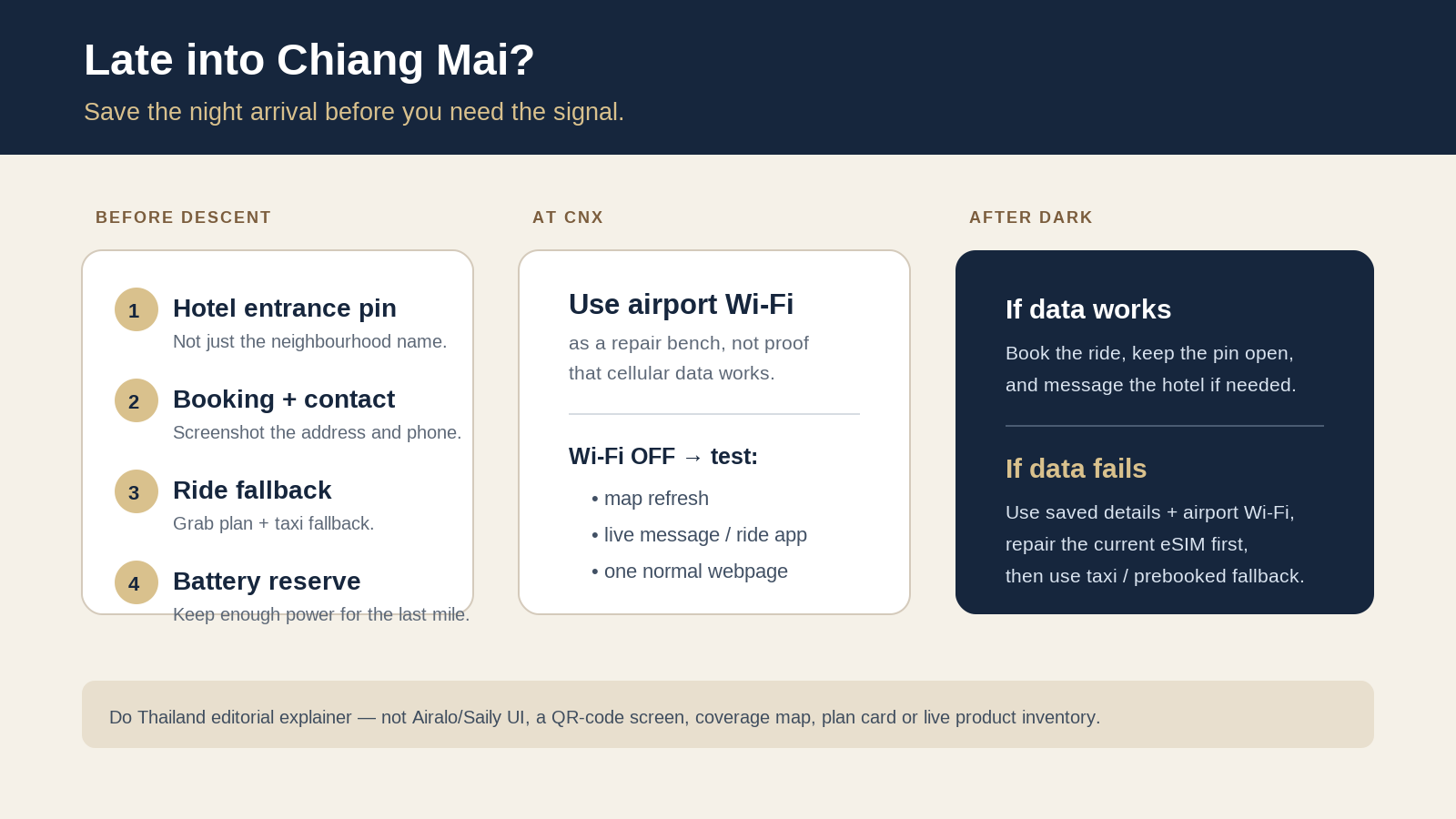
Before descent, save four things that do not need mobile data
Late arrivals are surprisingly easy until the final few hundred metres. “Old City” or “Nimman” is useful for planning a neighbourhood; it is not enough when a driver stops on the wrong side of a moat road, the hotel has a small side entrance, or reception wants you at a specific door.
Exact hotel pin
Save the exact entrance pin; a neighbourhood or hotel name may be too broad. Take one screenshot showing the nearby street pattern.
Written destination
Keep the hotel name and street address in text so you can show it to a taxi desk or driver without reopening a booking app.
Booking + phone
Screenshot the confirmation number and hotel contact. If reception sent a late-check-in instruction, save that message too.
One ride Plan B
Know what you will do if the app does not load: official airport taxi, a prebooked pickup, or the transport arrangement already attached to your booking.
If you are still choosing a Chiang Mai base, the Old City vs Nimman guide helps with the bigger neighbourhood decision. For arrival night, though, the useful information is much smaller: the exact entrance and how you will reach it. The same logic becomes more important in rain, which is why our Chiang Mai rainy-season hotel guide treats the last metres and sheltered arrival as real hotel features.
CNX has official Wi-Fi: use it as a repair bench, not as the test
Chiang Mai International Airport's current official Wi-Fi page tells passengers to connect to AOT Airport Free Wi-Fi by NT. The airport currently describes the session as 60 minutes after login. That is useful if you need to reopen provider instructions, message the hotel or repair a setup mistake before leaving the terminal.
What airport Wi-Fi cannot prove is that your travel eSIM works. A phone can look perfectly connected while every useful app is still riding on Wi-Fi. The decisive test starts by turning Wi-Fi off.
Use this exit order before the ride depends on data
- Finish anything that needs stable Wi-Fi first. Open the eSIM app, load the provider's installation/connection instructions and save any hotel message you still need.
- Turn airport Wi-Fi off. If the phone does not switch cleanly, turn airport Wi-Fi off in settings.
- Confirm the travel eSIM is the active mobile-data line. If you are keeping your home SIM active for bank texts, the home-SIM + OTP setup explains how to separate identity from travel data.
- Refresh a map, load one normal webpage and send or receive one live message. Three ordinary tasks are more useful than staring at signal bars.
- Only then open the ride handoff. If you are using Grab, set the hotel pin while you are still in a calm part of the terminal rather than discovering a data problem at the curb.
Airports of Thailand currently lists a Grab service counter at the domestic passenger terminal, Building 2, first floor, Gate 14, and marks it as closing at midnight. Check which ride options are operating near your arrival and test mobile data before leaving the airport.
Your night plan changes depending on how the ride is arranged
If you plan to request Grab after landing
Live data matters more. You need the app to load, the pickup instructions to appear, and the hotel destination to remain available while the car is being assigned. Test cellular data before leaving Wi-Fi, keep the hotel entrance pin open, and avoid burning the last phone battery on unnecessary video or background syncing while you wait.
If the app still will not work, the airport currently lists both airport-taxi and metered-taxi services. A direct airport taxi with the written hotel details can be the correct no-eSIM fallback.
If a driver is already expecting you
The connection becomes useful rather than mission-critical. Save the driver's name, meeting instruction, hotel address and booking reference before descent. If live messaging fails after landing, you still have something concrete to show an airport desk or the pickup representative. A prebooked transfer is especially valuable when the purpose of paying more is to remove the late-night app handoff.
For the transport decision itself — including when Grab, a taxi or a prebooked car makes more sense — use the late-arrival transport guide. Connectivity should support that choice, not quietly change it into “buy another eSIM because the ride app is inconvenient.”
If the eSIM fails, repair the current line before shopping again
The repair order should be short because this is arrival night, not a telecom project. Airalo's current help guidance tells travelers to follow the specific connection instructions for their installed eSIM, including the correct APN and whether data roaming should be on or off. Saily's current activation guidance says the Saily eSIM should be enabled and data roaming enabled for its profile.
| What you see | Check first | What not to do yet |
|---|---|---|
| eSIM appears installed but no data moves | Confirm the travel eSIM is selected for mobile data; then check the provider's current roaming/APN instructions. | Do not delete the profile as an opening troubleshooting step. |
| Phone keeps using the home line | Check the default data line and automatic data-switching setting. | Do not assume keeping the home SIM on for OTP means it should also carry data. |
| Signal exists but apps still fail | Toggle airplane mode briefly, retry the provider's documented network/APN steps, and test a simple webpage again. | Do not judge the connection only from the number of signal bars. |
| You are tempted to delete and reinstall | Read the provider-specific recovery rule first. | Do not remove a paid profile until you know whether it can be restored. |
| The ride can leave without working mobile data | Use the saved hotel details plus airport taxi/prebooked fallback. | Do not buy twice purely because the arrival feels urgent. |
For the full sequence, use Thailand eSIM not working. If deletion is already on your mind, read delete vs reinstall before touching the profile. If the original purchase itself may be refundable, the refund and support guide sets the support-versus-replacement boundary.
Reserve battery for the final transfer and the last 20 minutes after landing
Late-arrival connectivity is partly a power problem. Navigation, ride apps, brightness, messaging and repeated network troubleshooting all arrive at the same moment. If the battery is low, stop background streaming and non-essential syncing, lower brightness, and keep the phone available for the tasks that cannot be replaced by a paper address: live ride assignment, driver contact and hotel messaging.
This is also why a huge data allowance is not the first Chiang Mai arrival decision. If your normal trip needs mostly maps, messages and transport apps, the Thailand data-allowance guide is a better place to size the plan than buying “unlimited” as emotional insurance.
When should you buy the replacement before leaving CNX?
Only when three things are true at once: the existing line cannot be recovered quickly, live data materially improves the ride you are about to take, and the fallback without data is worse for your actual arrival. That is a much narrower threshold than “my eSIM did not connect on the first try.”
If your home carrier already gives you useful Thailand roaming, use it if that is the cleanest rescue path; the eSIM vs roaming-pass guide explains the trade-off. If the airport taxi or your prebooked driver can get you to a saved hotel address without live data, get to the hotel and troubleshoot from a calmer connection. And if you have not installed the plan yet, the installation and activation timing guide can prevent this exact arrival-night setup rush.
The no-buy state is a successful outcome
Do not buy another eSIM at CNX if your current line works, your home roaming already solves the arrival, or your transport can reach the saved hotel without mobile data. The goal is a reliable late-night arrival, not the maximum number of connectivity products on the phone.
Need a replacement data line? Compare the live Thailand plan before checkout
Check the exact current allowance, validity, activation instructions, supported network details and roaming/APN requirements on the provider page. Do not buy from a remembered screenshot or an old price table.
Once the first night is solved, use the Chiang Mai destination hub for the next stay, transport and itinerary decisions. Connectivity should disappear into the background again — which is exactly what a good setup is supposed to do.