
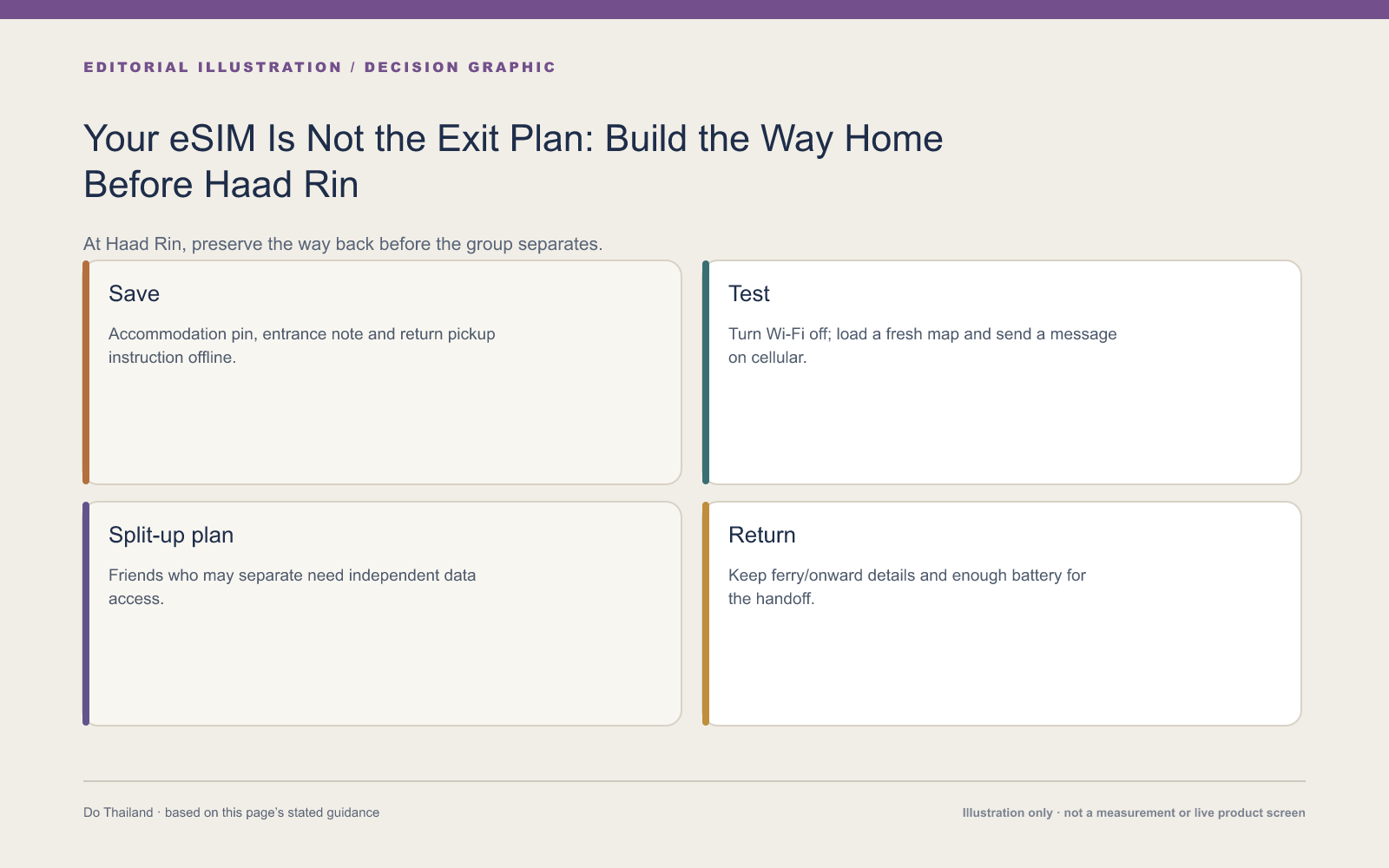
Do these four things before leaving your room
1. Save the exact accommodation pin. Screenshot the map, property name and any entrance or road note your host has given you.
2. Save the return handoff. If a hotel, driver or transfer has given you a pickup location, keep that exact instruction offline instead of assuming you will search for it later.
3. Test the phone on cellular data. Turn Wi-Fi off, load a fresh map result and send a message. A signal icon alone is not a useful test.
4. Decide who needs independent data. If two friends may leave at different times, one person's hotspot is not a resilient group plan.
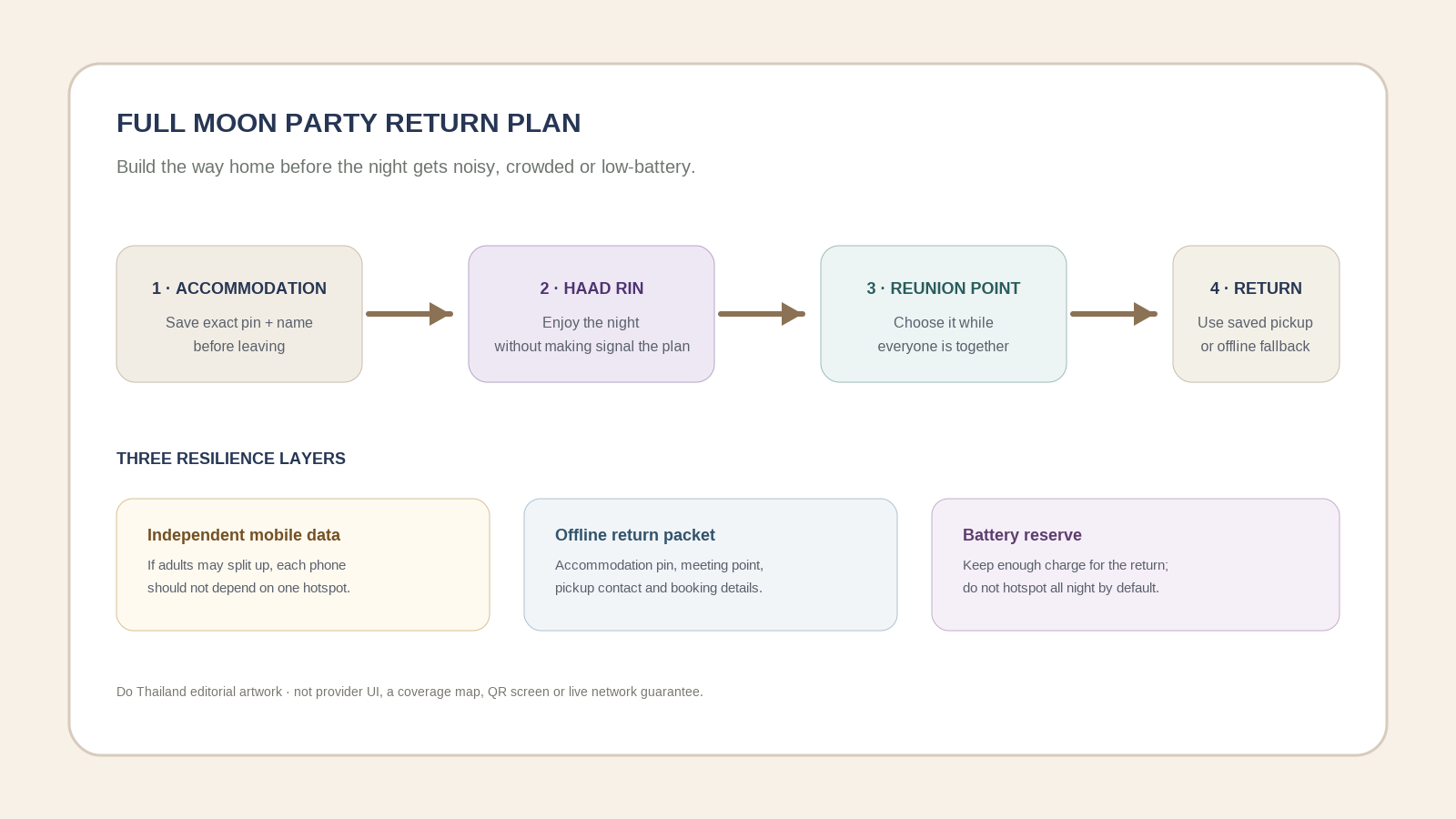
The Tourism Authority of Thailand describes Ko Pha-ngan as especially well known for its monthly Full Moon Party; its Thai-language destination page specifically identifies Haad Rin as the regular Full Moon Party location. That makes this a different connectivity problem from an ordinary beach day: the important question is not how many bars of signal you can photograph, but whether your phone can still help you reunite, identify the exact place you are staying and complete the return handoff when the group is tired and no longer moving together.
Koh Phangan is also an island journey. Lomprayah's current 2026 timetable continues to link Koh Phangan with Gulf routes including Koh Samui and Koh Tao, while the operator warns that schedules can change. Keep the ferry or onward-travel details you actually booked available offline too. If your trip also includes Koh Tao, the Koh Tao pier connectivity guide handles the separate ferry-arrival problem.
One hotspot is efficient only while everyone stays together
The temptation is obvious: one person buys a large data plan, everyone else connects to her phone, and the group saves money. That can be reasonable during a transfer or café stop. It becomes fragile on a night where people may separate.
| Party setup | Connectivity I would use | Main weakness |
|---|---|---|
| Solo traveler | One tested Thailand eSIM or other working mobile-data line, plus a complete offline return packet. | Your phone is the only live connection, so battery discipline matters more than buying a huge data bucket. |
| Two people who genuinely stay together | Two independent plans are cleaner, but one phone hotspot can work if both accept the battery and separation risk. | If the hotspot host leaves, loses charge or loses data, the second phone loses its live connection too. |
| Friends who may split up | Independent working data on each adult's phone. | Costs more than one shared plan, but removes the single-person dependency. |
| Group with mixed eSIM compatibility | Give compatible phones their own data; make sure every person still has the accommodation and meeting point saved offline. | Do not make the least-prepared phone the only device holding the return information. |
This is the same independence principle explained in our one big eSIM vs two separate eSIMs guide, but the Full Moon Party changes the consequence. A couple sharing data while sitting next to each other is one thing; friends trying to reconnect later should not discover that the person with the hotspot is somewhere else.
The useful data jobs after dark are small but important
Reunion messages
WhatsApp, LINE or iMessage can help a separated group coordinate, but only if the app identity you already use still works. Installing a travel eSIM does not need to become an account migration. Check the Thailand eSIM messaging-identity guide before changing numbers or prompts you do not understand.
Exact accommodation location
A map pin is more useful than remembering a beach or neighborhood name. Save the exact property entrance, plus any message from the host explaining which road or gate to use.
Pickup coordination
If your accommodation or a driver has already given you a pickup point, treat that as valuable trip data. Screenshot it. Do not assume a generic search result will reproduce the same handoff later.
Onward travel proof
Keep tomorrow's ferry ticket or booking reference offline. Lomprayah's current 2026 timetable covers Koh Phangan but tells passengers to recheck schedules, so a screenshot of the booking you actually hold is more useful than memory.
None of those jobs requires an enormous data allowance. For most leisure travelers, the broader Thailand data-allowance guide is a better way to size the plan than buying unlimited purely because one night feels important. Reliability architecture and data quantity are different decisions.
Build a return packet that survives zero signal
Before leaving for Haad Rin, put these items somewhere you can reach without mobile data: the accommodation name, exact map screenshot, road or entrance note, host contact, a fixed reunion point, any confirmed pickup instruction, and the next ferry or transfer booking that would be painful to reconstruct later. If the property supplies a Thai-language name or address, keep that too rather than trying to generate your own translation.
If you are staying somewhere that requires a specific late-night pickup rather than a simple walk, the packet matters even more. Use the exact late-night fare, pickup point and availability confirmed by your property or operator.
Set the travel eSIM up before party night, not in the crowd
Provider instructions differ. Airalo's current iPhone guidance tells users to select the purchased eSIM as the mobile-data line, apply an APN only when the exact eSIM instructions require one, set Data Roaming according to those instructions and turn Cellular Data Switching off. Saily's current activation guidance tells users to install the eSIM with internet access beforehand, enable Data Roaming on the Saily profile, then disable the personal SIM and mobile-data switching on arrival to reduce unintended home-line roaming.
If you need to keep a home number alive for bank or login texts, do not mechanically turn it off just because a generic article says so. Use the dedicated home-SIM and OTP setup and the Dual-SIM roaming-routing guide to decide which line stays active and which line is allowed to carry data.
The principle is simple: test a known-good configuration before you need it. If you are still deciding when to install the profile, the Thailand eSIM installation and activation timing guide separates installation from the provider's actual validity trigger.
A 90-second test is more useful than staring at the signal bars
Do this at your accommodation before leaving:
- Turn Wi-Fi off.
- Confirm the travel eSIM is selected for mobile data.
- Open a map and search for a place you have not already loaded.
- Send one ordinary message to the person you are traveling with.
- Open one new web page.
If those actions work, stop changing settings. If they do not, use the Thailand eSIM troubleshooting order. Do not jump directly to deleting the profile. If APN is the suspected issue, follow the APN decision guide and enter a manual value only when the exact provider instructions supply it.
Battery is part of the connection plan
A second data plan does not help if the phone you need for the return is flat. Charge before going out, bring a power bank if you normally need one, and avoid running a hotspot for hours simply because it is available. If two people can use their own data, independent lines also stop one phone from doing all the radio, navigation and tethering work for the group.
For a solo traveler heading back alone, preserving enough charge for maps, messages and the accommodation contact is more useful than spending the final part of the night on background video uploads.
If data fails at Haad Rin, repair the plan in this order
- Use the offline packet first. It should already tell you where you are returning and where the agreed reunion point is.
- Check the selected mobile-data line. A Dual-SIM phone can be configured correctly one hour and changed accidentally the next.
- Check the provider-specific roaming setting. Airalo says to follow the exact eSIM instruction; Saily requires Data Roaming on its profile.
- Try the least-destructive reconnect. Airplane mode off/on or a phone restart is a safer early step than deleting a paid eSIM.
- Only touch APN when instructed. An invented APN is not a troubleshooting technique.
- Do not delete the eSIM just to “start again.” Read the delete/reinstall caveat guide first because recovery rules can differ by provider.
If you entered Thailand through Samui and still have another pickup or pier handoff there, our Koh Samui Airport eSIM pickup guide applies the same idea to the airport side of the trip. The distinction matters: airport connectivity is about proving the line before a transport handoff; this Full Moon Party page is about keeping the return usable after the group may split.
Should you buy a separate eSIM just for the Full Moon Party?
Usually no. If your existing Thailand eSIM or Thai SIM already passes the cellular test and has enough remaining data, buy nothing. A second plan does not automatically create better coverage and it adds another profile to manage.
A purchase becomes reasonable when you currently have no mobile-data plan, when the only connected phone belongs to someone you may separate from, or when your current plan is genuinely unusable and provider support cannot recover it before you need independent connectivity. Before paying twice, use the support-versus-replacement guide. If you have not bought anything yet, the Thailand eSIM vs airport SIM decision is the broader starting point.
The no-buy state is a good outcome
You already have working Thailand mobile data, each person who may split can reach the return information, the accommodation and reunion point are stored offline, and battery is under control. Stop shopping. The useful work is done.
Check a live Thailand eSIM before the night starts
Airalo and Saily both currently list Thailand eSIM options. Recheck the exact allowance, validity, activation rule, roaming instruction and any fair-use terms on the live provider page before checkout. Do not buy from a saved screenshot of an old plan table.
If your Thailand trip also crosses other countries, do not assume a Thailand-only plan follows you: use the Thailand-only vs Asia regional eSIM guide. And if your phone cannot use eSIM at all, solve device compatibility and carrier unlock before comparing providers.
The rule to remember
Save the way home, make the phones independent where separation is plausible, and prove cellular data while you are still somewhere calm enough to fix it. At the Full Moon Party, plan a reliable way back and choose a data package for your actual usage.
Sources checked
- Tourism Authority of Thailand — Ko Pha-ngan, plus TAT's Thai destination page identifying Haad Rin as the regular Full Moon Party location.
- Lomprayah — 2026 timetable and current Koh Phangan route information.
- Airalo Help Center — iOS connection instructions and current Thailand storefront.
- Saily Help Center — activation and roaming setup and current Thailand storefront.
Connectivity and transport conditions can change. Recheck the exact eSIM instructions and the ferry or transfer you actually booked before travel.