

A tested data line plus the exact hotel entrance pin is usually enough. Confirm the booked drop-off point.
Plan for the operator’s published Pattaya stops and your onward hotel ride; save both details before boarding.
Keep it. Keep the working eSIM through a brief signal wobble; add another plan only if service keeps failing.
My recommendation: prepare the hotel entrance before you leave Bangkok or Suvarnabhumi. If you booked the standard airport-to-Jomtien bus, save its stop and your onward ride; Roong Reuang Coach also lists separate shared hotel-drop and private door-to-door options, so confirm which service and exact endpoint are on your ticket. Then test your eSIM away from Wi-Fi once, keep the phone charged, and stop shopping for connectivity unless the line actually fails.
If you are still choosing the journey itself, start with the BKK to Pattaya bus-versus-private-transfer guide. This page starts one step later: you already know how you are getting to Pattaya, and you want the phone to stay useful through the last mile.
The Pattaya problem is the handoff, not the distance
A private car or taxi can normally take you straight to the property. For the standard Suvarnabhumi-to-Jomtien bus, Roong Reuang Coach lists two intermediate Pattaya drop-off points—on Sukhumvit Road between North and Central Pattaya, and opposite Big C South Pattaya—before the main station. The same operator separately advertises shared hotel-drop and private door-to-door services on specified routes. A ticket labelled simply “Pattaya bus” is not enough to know whether it ends at a roadside stop, the station or your hotel; check the service and endpoint shown on your booking.
That distinction matters when you are tired, arriving after dark, carrying luggage, or traveling alone and do not want to stand on a roadside trying to reconstruct the hotel location from memory. Your mobile plan is useful here, but the safer strategy is not “buy more data.” It is “remove as many live-data dependencies as possible before the handoff.”
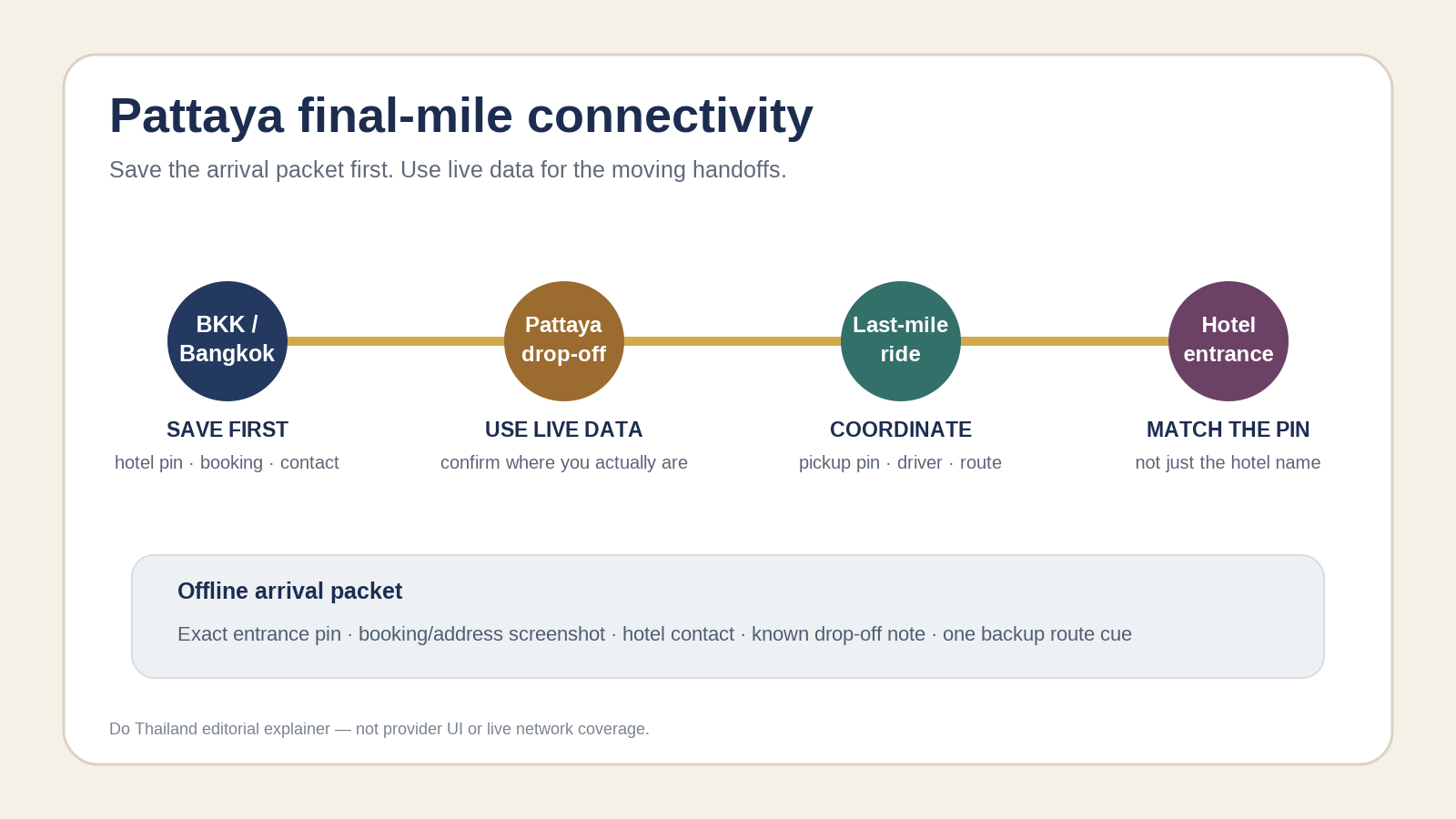
Save this five-part arrival packet before the ride starts
- The exact hotel entrance pin. Do not stop at the hotel name. Large resorts, side-street properties and buildings with multiple driveways can have an entrance that is not obvious from the main road.
- A booking screenshot with the address. Save the property name, address and reservation name in one image. If your hotel supplies a Thai-language address or map card, save that too.
- The hotel contact you will actually use. Keep the in-app hotel chat, messaging contact or phone number somewhere you can reach without searching through old emails.
- Your known drop-off note. If you are on the airport bus, screenshot the operator information you relied on. If you are in a private transfer, save the driver/meeting instructions instead.
- One backup route cue. A simple screenshot showing the drop-off and hotel relative to each other is enough. The goal is not offline turn-by-turn navigation; it is to avoid becoming completely location-blind if mobile data disappears for a few minutes.
This is especially useful if you keep your home number active for bank messages. The home-SIM + Thailand eSIM setup shows how to separate the “number I still need” from the “line that should carry mobile data.”
Standard bus and hotel-drop transfer need different arrival plans
Direct taxi or private transfer
Your connectivity job is simple: keep the hotel pin available, keep the driver/hotel contact reachable, and use live maps to notice a wrong turn or entrance mismatch. If your travel eSIM already loads a map and sends a message, there is usually nothing else to buy.
Standard airport bus + final local ride
You have an extra moving part. Identify the booked stop, choose a local ride, send the destination pin and confirm the hotel entrance. A working data line helps with those live handoffs. If you booked one of the operator’s separate shared hotel-drop services, use the hotel endpoint on your ticket instead.
If you expect to use ride-hailing locally, read the Pattaya baht bus vs Grab decision too. The best local transport choice can change by exact origin, destination and how much you value a point-to-point pickup.
Reserve live data for three moments
Confirm the drop-off
As you arrive, compare the live blue dot with the location you expected. Do this before walking away with luggage. A bus stop, roadside drop-off and a named terminal are not interchangeable when you are ordering the next ride.
Coordinate the final ride
Use data for the part that genuinely needs to be live: requesting the ride, receiving a driver message, sending the hotel pin or telling the hotel you are close. A data-only eSIM is fine for this when your coordination happens through internet messaging and ride apps; if your trip genuinely requires ordinary Thai calls or SMS, see the Thai phone-number decision guide.
Match the entrance
Near the hotel, stop trusting the property name alone. Compare the moving map with your saved entrance pin and the booking screenshot. If the driver is approaching a service lane or the wrong side of a large property, this is the moment when a small amount of live data has more value than another gigabyte of unused allowance.
Test the eSIM before Pattaya becomes dependent on it
You do not need a speed test. You need proof that the travel line can perform the arrival tasks. Before leaving reliable Wi-Fi, switch Wi-Fi off and check three things: load a fresh map, open a new web page, and send a message over cellular data. If all three work, stop adjusting settings.
If you have not installed the profile yet, use the Thailand eSIM installation and activation timing guide before departure rather than trying to solve installation from the bus. If you are still choosing between a travel eSIM and buying a tourist SIM after landing, the eSIM vs airport SIM guide is the better decision page.
For current provider behavior, Airalo’s help center instructs travelers to select the installed eSIM as the data line and follow the exact connection instructions for network, APN and data roaming rather than inventing generic values. Saily’s current activation guidance similarly requires the Saily eSIM to be enabled and documents its roaming/setup steps before automatic destination use.
If data is flaky at the drop-off, do not start with deletion
A momentary weak signal is frustrating, but it is not evidence that the eSIM is permanently broken. Work through the low-risk checks first:
- Confirm Wi-Fi is off so you know what you are actually testing.
- Confirm the travel eSIM is turned on and selected for mobile data.
- Apply the provider’s exact roaming instruction to the travel line.
- If your provider tells you to use a specific supported network, check that instruction rather than randomly hopping networks.
- Only touch APN when the exact eSIM instructions provide the value. The Thailand eSIM APN guide explains when to leave automatic configuration alone.
- Toggle airplane mode once, wait, then test a fresh page again.
If that does not restore service, move to the full Thailand eSIM troubleshooting sequence. Do not delete the paid profile as an early experiment: eSIM deletion and reinstallation rules vary by provider and recovery may be more complicated than simply switching a line off and on.
Keep enough battery for the final 30 minutes
The connectivity plan can still fail if the phone is almost dead when the bus arrives. Navigation, bright-screen map checking, ride-hailing, messaging and weak-signal searching all draw power at exactly the same time. The fix is boring and effective: board with enough charge, keep a power bank accessible rather than buried under the coach, and avoid spending the whole road journey streaming if you are arriving late.
Data sizing matters less than people think for this specific problem. Maps, messages and one ride request do not justify an oversized plan on their own. If you are unsure about the whole trip, use the Thailand data-allowance guide rather than sizing the plan around one arrival night.
Do not accidentally wake the home carrier for data
Dual-SIM convenience can create a separate problem: the phone silently falls back to the home line when the travel line struggles. If your home carrier charges for roaming, that “helpful” switch can be expensive. Keep the intended travel eSIM selected for mobile data and review automatic data switching before the trip. If your home roaming plan is already included or competitively priced, compare it honestly in the Thailand eSIM vs home-carrier roaming guide; buying a separate eSIM is not mandatory.
When the correct answer is to buy nothing
Buy nothing if your current line already passes the arrival test. If a map loads on cellular, a message sends, the hotel pin is stored, and the battery is healthy, you have solved the Pattaya arrival problem. A larger plan will not make the entrance easier to find.
Also buy nothing simply because the signal indicator briefly falls. Move a short distance, let the phone reconnect, and repeat a real-world task. If the line remains unusable and the provider’s recovery steps fail, then you have a support or replacement decision—not a “Pattaya requires two eSIMs” rule. The refund/support guide can help if the plan you already paid for is genuinely not usable.
Where this fits in a Pattaya trip
For the broader destination decision, use the Pattaya guide hub. If you are arriving from Bangkok or Suvarnabhumi, pair this connectivity page with the BKK to Pattaya transport guide. If Koh Larn is next, plan that separately after check-in rather than making the first-night arrival carry another transport dependency.
Sources checked
- Roong Reuang Coach — current passenger FAQ, checked 12 October 2026 for standard Suvarnabhumi-to-Jomtien stops and listed Pattaya hotel-drop service.
- Roong Reuang Coach — current door-to-door and shared hotel-drop routes, checked 12 October 2026; route, schedule and hotel endpoint depend on the selected service.
- Airalo Help Center — internet connection guidance, checked 12 October 2026 for data-line, network, APN and roaming workflow.
- Saily Help Center — eSIM activation guidance, checked 12 October 2026 for pre-travel activation and roaming/setup behavior.
Connectivity products and technical instructions can change. Re-check your exact eSIM’s in-app/provider instructions before travel. Do Thailand does not invent APN values, network partners, speed claims or activation rules.