
The practical answer
Build a tiny offline arrival packet before the boat, then treat live data as a convenience layer rather than the only way you can finish the transfer. Railay is reached by boat, and Thailand’s official tourism sources list Ao Nang and Ao Nam Mao among the access points. Once the road portion ends, your phone should already know where you are sleeping and how to identify the correct side of Railay.
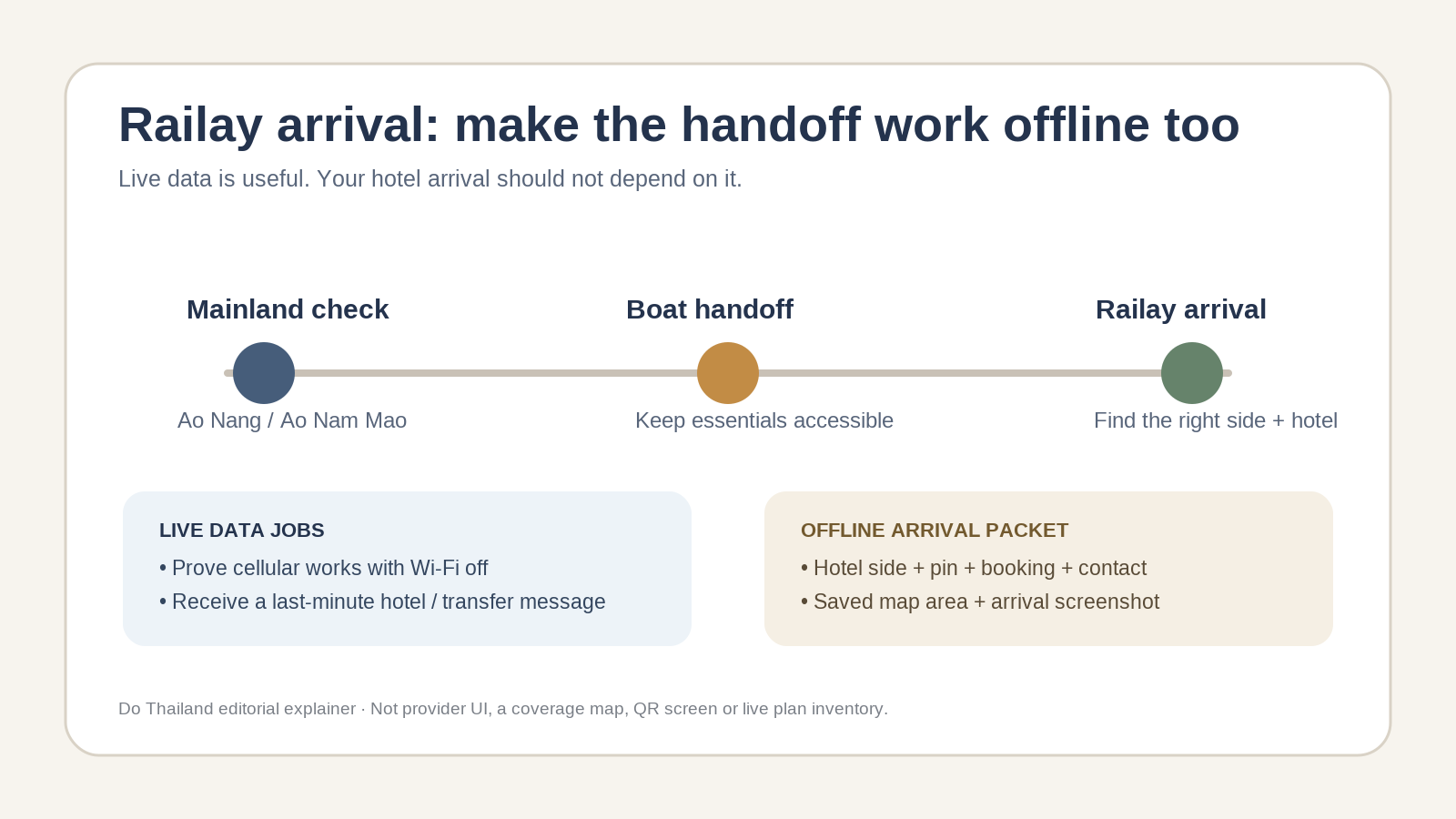
This is not another article about whether an eSIM is better than an airport SIM. If you are still buying connectivity, use the broader Thailand eSIM vs airport SIM decision. This guide is for the next stage: you already have a working line, or think you do, and you are about to make a boat handoff where searching everything again on demand is an unnecessary dependency.
Railay changes the phone problem because the road stops first
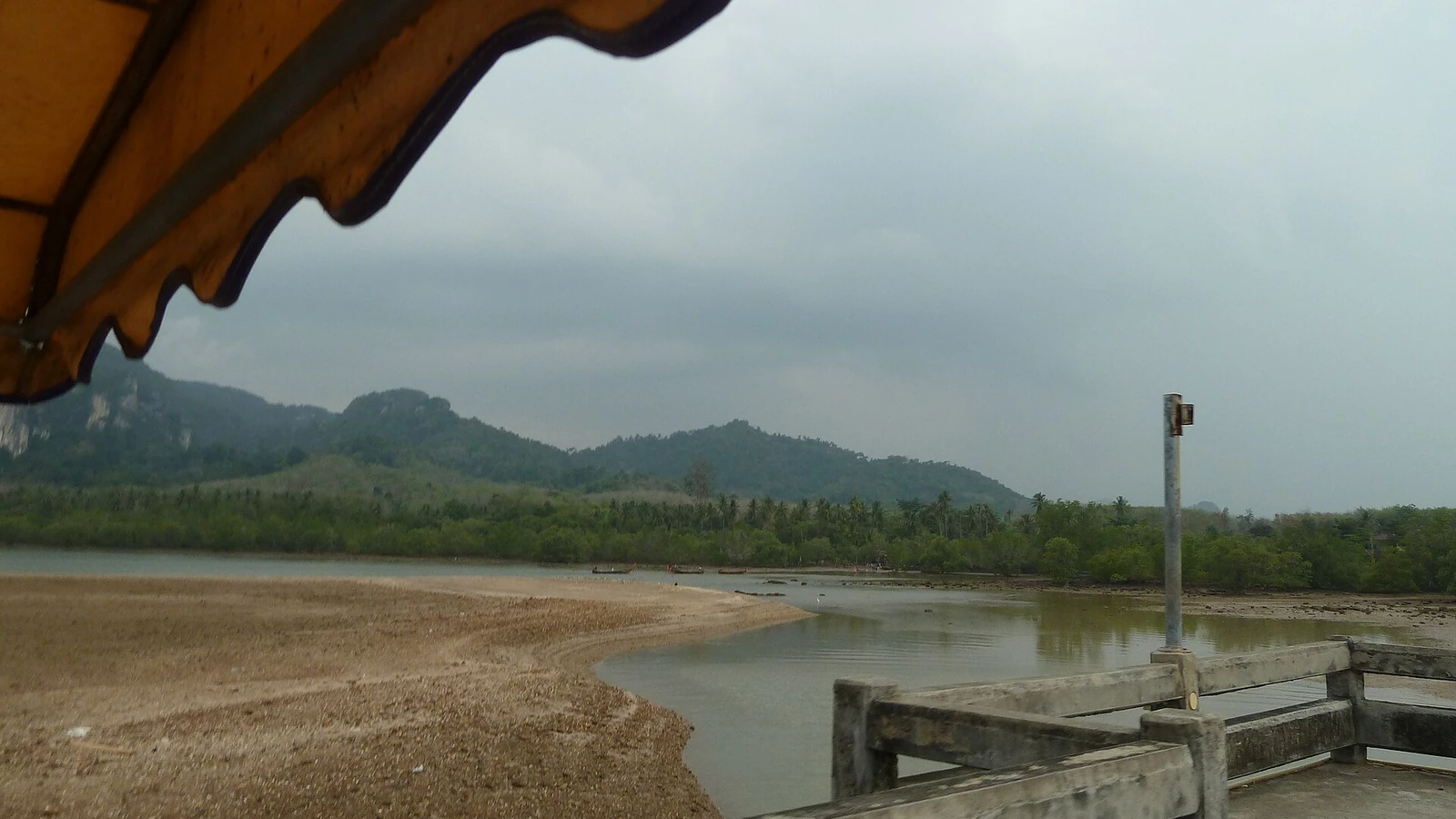
Tourism Authority of Thailand describes Ao Nang as a major launch point for boats to the isolated beaches around Phra Nang Cape, including Railay. Thailand’s government travel portal is more explicit: Railay is reached by boat, with Ao Nang Beach and Ao Nam Mao Beach listed as boarding points.
That means the last part of your arrival is not a normal taxi-to-hotel sequence. Your driver cannot simply follow a map pin to a lobby. The useful phone information is the information that survives the switch from road transport to boat, then from boat to a walking or property-arranged final handoff.
If you have not yet decided which part of Railay you are staying on, read Railay East vs West. If you are still deciding whether to stay on Railay at all, the more useful comparison is Ao Nang vs Railay.
Your six-item Railay offline packet
Google’s current Maps help confirms that you can download an area to use when the internet is slow or unavailable. There is an important limitation for Railay: Google also says walking directions are not available offline. Use the offline map as a saved location reference; Google walking directions remain unavailable offline, so save screenshots of the route and hotel pin.
Save an offline map of the area, plus screenshots of your hotel pin and arrival instructions.
Do one live-data test before you step into the boat queue
- Turn Wi-Fi off. Open a webpage or refresh a map on cellular data. Seeing signal bars is not the same as proving usable data.
- Confirm the travel eSIM is the data line. If you keep a home SIM active for bank codes, make sure the home line is not silently carrying mobile data. The separate home-SIM + OTP guide covers that setup.
- Open the hotel contact once. If you need to message the property about your arrival, do it before boarding rather than discovering an account/login problem after the boat lands.
- Check both battery and data before departure. Navigation, camera use, bright-screen beach conditions and repeated messaging can turn a healthy connection into an unusable phone if the battery is nearly gone.
If the cellular test fails, do not delete the eSIM in frustration. Start with the ordered Thailand eSIM troubleshooting guide. If you are tempted to remove the profile entirely, read the delete/reinstall warning first; provider recovery rules are not identical.
What still needs live data — and what should not
| Railay arrival task | Best state before boarding | Why |
|---|---|---|
| Knowing which Railay side/property entrance you need | Offline-ready | This should be known before the road-to-boat handoff begins. |
| Hotel booking number and guest name | Offline-ready | There is no benefit in making basic reservation proof depend on a fresh login. |
| Property-specific arrival message | Offline screenshot + live contact if needed | The screenshot handles instructions; data handles last-minute coordination. |
| Real-time message from the hotel or transfer operator | Live data useful | This is one of the few genuinely time-sensitive phone jobs. |
| Map orientation after landing | Offline map + saved pin | Google Maps can store an offline area, but offline walking directions are not available. |
| Social posts, video uploads and cloud photo backup | Wait | These are optional bandwidth and battery jobs, not arrival jobs. |
Railay East vs West also affects boat pickup and hotel access
If your booking says East, West or a specific pier/boat handoff, keep that wording with the reservation. The current Do Thailand East vs West guide explains why the two sides feel different but are still part of one compact peninsula. For connectivity, the point is simpler: the correct side gives a boat operator or hotel contact something operationally useful; a generic “Railay hotel” does not.
Do not use the boat ride as your activation window
If you bought a travel eSIM, install and test it before the point where you need it. Airalo’s current Thailand storefront says its Thailand eSIM must be on and selected for data when you are in the coverage area. Saily’s current activation guidance says the eSIM should be installed before travel, with data roaming enabled for the Saily profile, and that mobile-data switching should be disabled to avoid the phone moving data back to the home line.
Those are provider setup rules, not promises about one particular Railay beach spot. Coverage and performance can vary. The editorial goal is therefore not “buy a provider that guarantees Railay.” It is “make the arrival robust even if live data becomes temporarily unavailable.”
If your eSIM is not installed yet, the dedicated installation and activation timing guide is the better place to solve that problem. If you are deciding how much data to buy for the rest of Thailand, use the Thailand data allowance guide rather than oversizing the plan because of one boat transfer.
If data dies after the boat lands
Use the offline packet before you use your wallet
- Open the saved hotel pin and the property’s arrival screenshot.
- Use the booking name and exact Railay side to orient the handoff.
- If the phone has signal but no data, check that the travel line is selected for mobile data and that the provider-required roaming setting is correct.
- If you are traveling as a pair and the second phone still has data, use it as the temporary coordination device rather than immediately buying a duplicate plan. The two-traveler hotspot guide explains when sharing is a sensible fallback.
- Only move to a replacement plan after the existing line has failed a reasonable troubleshooting pass.
That sequence matters because arrival stress is very good at turning a settings problem into an unnecessary purchase. A second eSIM is useful when the first plan is genuinely unusable and you still need live coordination. It is not a first-line fix for every temporary connection wobble.
Skip a new eSIM if the arrival is already resilient
If cellular data works, the hotel details are stored offline and you can finish the boat-to-hotel handoff without reopening a dozen apps, buy nothing else. The best connectivity setup is the one that quietly disappears into the trip.
If you still need a working Thailand data line
Airalo and Saily both currently sell Thailand eSIM options. Compare the live validity, allowance, activation rule, supported device and any plan-specific terms before checkout. Do Thailand’s editorial preference here is not to buy twice: use this only when the existing line is genuinely unrecoverable or you have not bought Thailand data yet.
Where this fits in a Krabi trip
If Railay is only one phase of a longer Krabi stay, the connectivity decision should follow the itinerary rather than the other way around. The Ao Nang + Railay split-stay guide helps decide whether moving hotels is worth it. If you are coming directly from the airport and still deciding the mainland side of the trip, browse the Krabi decision hub before locking the transfer chain.
The recurring principle is simple: save the information that is expensive to lose at the exact moment you need it. A Railay arrival does not require unlimited data. It requires a working data line for the genuinely live pieces — plus enough offline preparation that the trip can keep moving without it.