
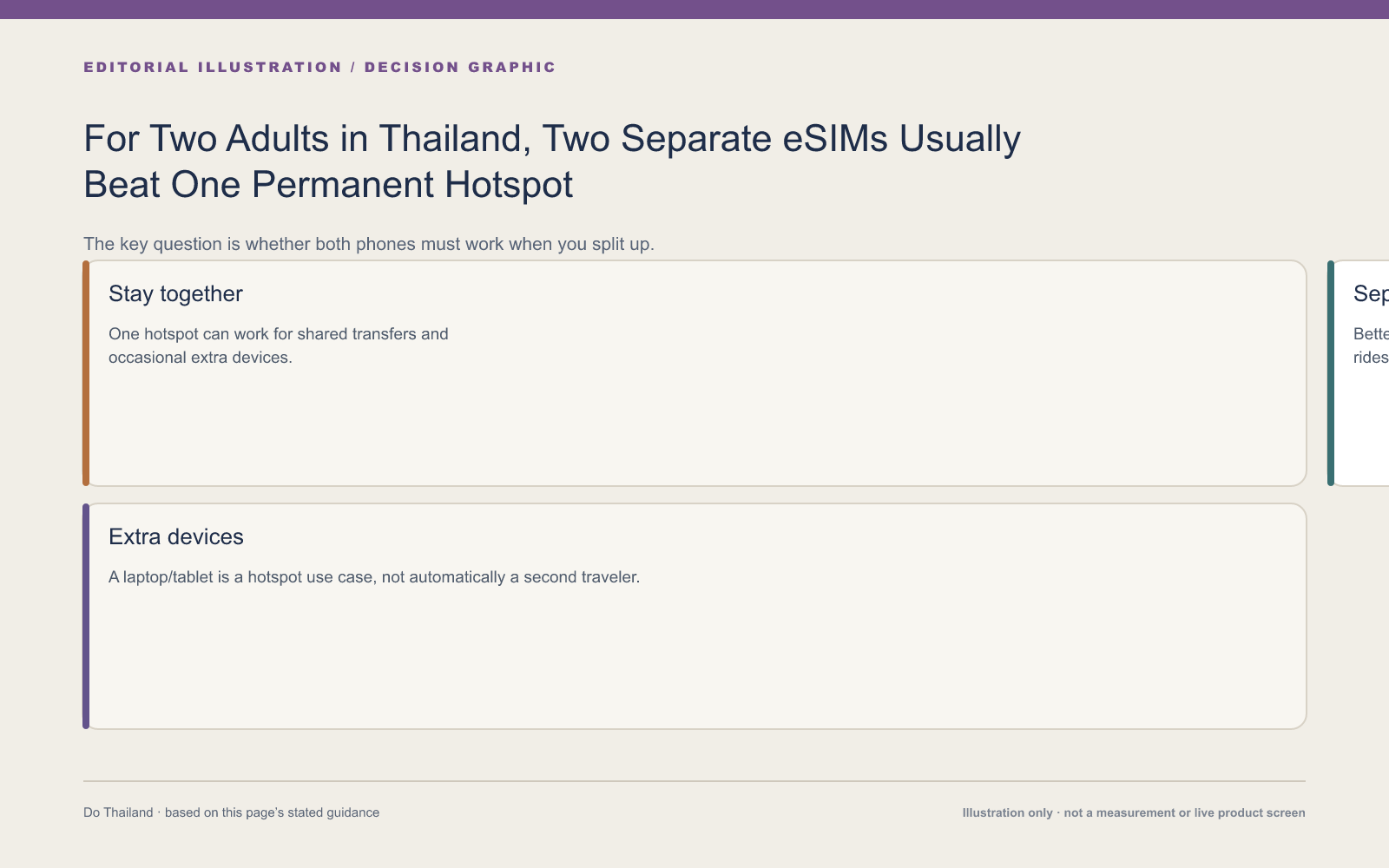
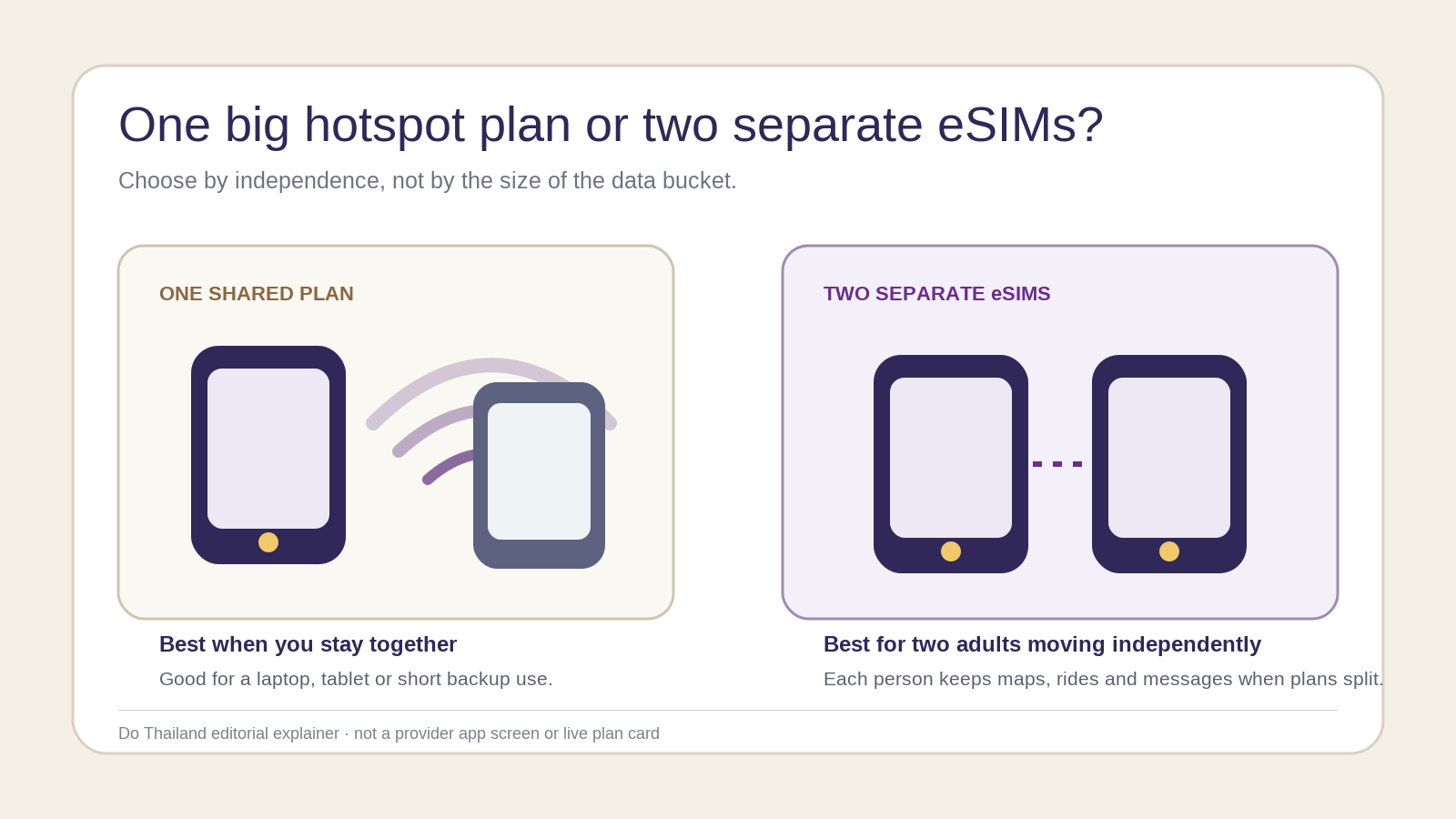
The 30-second rule: ask whether both phones must still work when you split up
Two separate eSIMs win when two adults may shop in different places, leave a market at different times, take separate Grabs, meet at a pier, or let one person return to the hotel while the other stays out.
One hotspot plan wins when the second connection is really a device problem — laptop, tablet, child’s device or occasional backup — rather than a second independent traveler problem.
Do not decide by total gigabytes first. Decide who must still have maps, messages and ride-hailing if the two of you are twenty minutes apart. Then size the data. Our Thailand data-allowance guide handles that second question.
A hotspot is a feature. It does not automatically make one plan the better travel architecture
Current Airalo help documentation says tethering or Personal Hotspot can be used with an eSIM when the device and network support it. It also notes that if a particular eSIM requires a manually entered APN, that APN may need to be entered for Personal Hotspot as well. Saily’s current help centre separately provides iOS and Android hotspot setup for its eSIM.
So the technical answer is reassuring: hotspotting is a real option. The more important travel answer is narrower. Who loses internet when the host phone walks away?
If the second traveler is your partner or friend and she needs her own Grab pickup, hotel chat, map pin or booking confirmation, the cost of dependence appears exactly when plans stop matching. That is why I would not build a two-adult Thailand trip around one permanent hotspot unless you already know you will move as one unit.
One plan can work
If you share every transfer, meal and evening plan, the hotspot is mostly a convenience question rather than a control problem.
Two plans get easier
The moment one person keeps the data host while the other walks away, the savings have to compensate for lost navigation and messaging independence.
Hotspot makes sense
A laptop does not need its own travel identity or ride app. This is where one larger plan is much easier to justify.
iPhone and Pixel both make the data-line choice matter
Apple’s current Dual SIM guidance says Personal Hotspot uses the line selected for cellular data. That is useful if you are also following our home-SIM-for-OTP setup: the home number can stay available for calls or SMS while the Thailand eSIM remains the data line that the hotspot shares.
Google’s current Pixel help says a phone hotspot shares the phone’s mobile-data connection, and Pixel can share data over Wi-Fi, Bluetooth or USB. Google also warns that some carriers may restrict or charge for tethering and recommends checking the provider. For Wi-Fi hotspot on Pixel, Data Saver must be off.
In other words, do not assume “the eSIM works” and “the hotspot works” are identical tests. If hotspot matters to the trip, test it before you need it for a work call or airport transfer.
The hidden price of one shared plan is not data. It is coordination
One large plan + hotspot
One phone becomes the data host. The second device works beautifully while it stays close and the hotspot stays on.
The trade-off appears when the host leaves, runs low on battery, disables hotspot, enters a weak-signal area or needs to troubleshoot its own connection.
Two separate eSIMs
Each person has a smaller, independent data line. You may pay for two plans instead of concentrating the allowance in one.
What you buy in exchange is independence: two map sessions, two ride-app pickups, two messaging paths and no need to keep the phones physically close.
This matters more in Thailand than a spreadsheet can make obvious because small transport handoffs often happen outdoors, away from hotel Wi-Fi. If one person is already in a car while the other is still finding a pickup point, “just connect to my hotspot” stops being a useful plan.
| Real trip situation | One shared hotspot | Two separate eSIMs | My lean |
|---|---|---|---|
| You always travel together | Simple and potentially economical | More redundancy than you may need | Shared can work |
| Two friends shop separately | One person loses the connection | Both keep maps and messaging | Two plans |
| One phone + one laptop | Natural use case for tethering | Laptop rarely needs its own travel eSIM | Shared hotspot |
| Separate ride-hailing pickups | Creates a dependency exactly when you separate | Each phone can manage its own pickup | Two plans |
| Creator / remote-work trip | Can be useful as laptop backup, but host phone becomes critical | Better phone redundancy; laptop can still borrow either hotspot | Two plans + hotspot backup |
| Parent + child tablet | Usually enough if the tablet is the secondary device | Separate plan often unnecessary | Shared hotspot |
Battery is where the “free router” idea starts to feel less free
Google recommends plugging devices in while tethering and turning the hotspot off when you are done. That is a practical clue about how I would use the feature on a holiday: as a tool, not as a permanent relationship between two adults’ phones.
The host phone is already doing the jobs that matter on a transfer day — navigation, messages, tickets and ride apps. Keeping a hotspot running for another person adds another reason that one battery now matters to both travelers.
This is especially annoying when you arrive late, are standing outside with luggage, or are trying to find a less-obvious hotel entrance. If your arrival itself is still unresolved, compare Thailand eSIM vs airport SIM and get the basic data line working first. If the eSIM is installed but refuses to connect, use the Thailand eSIM troubleshooting guide before blaming hotspot.
Use one shared plan only when you are comfortable with these four dependencies
- Distance: the second device needs to stay near the host phone.
- Battery: the host phone has to keep enough power for its own travel jobs and the shared connection.
- Settings: hotspot, APN and device/network support all need to behave correctly.
- Human coordination: if one person leaves, the other needs another route back online.
One big unlimited plan can also be a false economy
Current Airalo Thailand inventory includes both fixed-data and unlimited packages, while Saily currently sells Thailand fixed-data plans and unlimited options. That sounds ideal for sharing, but “unlimited” should never be read as “unlimited high-speed tethering under every condition.” Fair-use, speed-management and hotspot behavior can be package-specific and can change.
If one person mostly uses Maps, Grab and messages while the other watches video through the hotspot, the second user can also consume the allowance far faster than the first person expects. That is another reason to size the plan around behavior rather than simply pooling all data into the biggest bucket.
If you are still deciding between 5 GB, 10 GB and unlimited, read how much data you actually need in Thailand before deciding whether sharing is even necessary.
Where separate data becomes disproportionately useful
Night markets and shopping
Two friends can move at different speeds without turning one phone into the meeting-point infrastructure. This is one of the clearest cases for two independent plans.
Airport, pier and ferry handoffs
One person may be checking a booking while the other looks for a driver or luggage. Independent data removes one small but unnecessary dependency.
Resort + work trips
Two phone plans plus occasional laptop hotspotting usually gives more flexibility than one phone carrying every data job for both people and the computer.
The transport context can make this tangible. A Phuket Airport to Rassada Pier connection has more handoffs than a simple hotel transfer. On Samui, the final arrival choice in Samui Airport to Chaweng or Bophut still depends on an exact destination and pickup. Pattaya is another place where independent phones are useful when one person wants an app ride and another understands the route-based alternative in our baht bus vs Grab guide.
None of those routes consumes huge amounts of data. That is the point. The value is not megabytes. It is having the connection on the phone that needs it.
What I would buy for two people
Two adults on a normal Thailand holiday: I would usually buy two moderate data plans, then use hotspot as a backup when one person needs to connect a laptop or another device. That keeps the phones independent without banning tethering.
A couple who never separates and wants to minimize total plans: one larger plan can be reasonable if hotspot works on the chosen package/device and you are comfortable with the host-phone dependency.
One traveler carrying a laptop: one larger eSIM plus hotspot is often the cleanest setup. The laptop does not need separate ride-hailing, map or messaging independence.
Two people flying with work responsibilities: two phone data lines are easier to justify. Either phone can still hotspot the laptop, so you gain redundancy rather than concentrating everything in one device.
If two separate plans fit your trip, compare current Thailand packages before buying twice
Airalo currently lists Thailand fixed-data and unlimited options, and its help centre confirms hotspot use when supported by the device and network. Saily currently lists Thailand fixed-data and unlimited plans and publishes hotspot setup for both iOS and Android. Inventory and terms can change, so compare the current package you are actually about to buy rather than copying an old screenshot.
Test hotspot before the airport or ferry day
Do the setup while you still have stable Wi-Fi. If you have not installed the eSIM yet, our Thailand eSIM installation and activation timing guide explains why purchase, profile installation and plan validity are three different clocks.
Once the travel data line is active, connect the second phone or laptop for a few minutes. Open a normal webpage, send a message and confirm the host phone still has the right mobile-data line selected. If hotspot is missing or fails, follow the provider’s APN instructions rather than randomly changing network settings.
My final rule
For two adults, buy independence first and data volume second. Two separate moderate eSIMs are usually the smarter Thailand setup when both people need their own maps, ride apps and messages. Use hotspot as a useful feature on top of that.
Choose one large shared plan when the second connection is mainly a laptop, tablet or tightly coordinated travel companion. If the plan only works while both people behave like one traveler, make sure that is actually how you intend to travel.