
The short answer
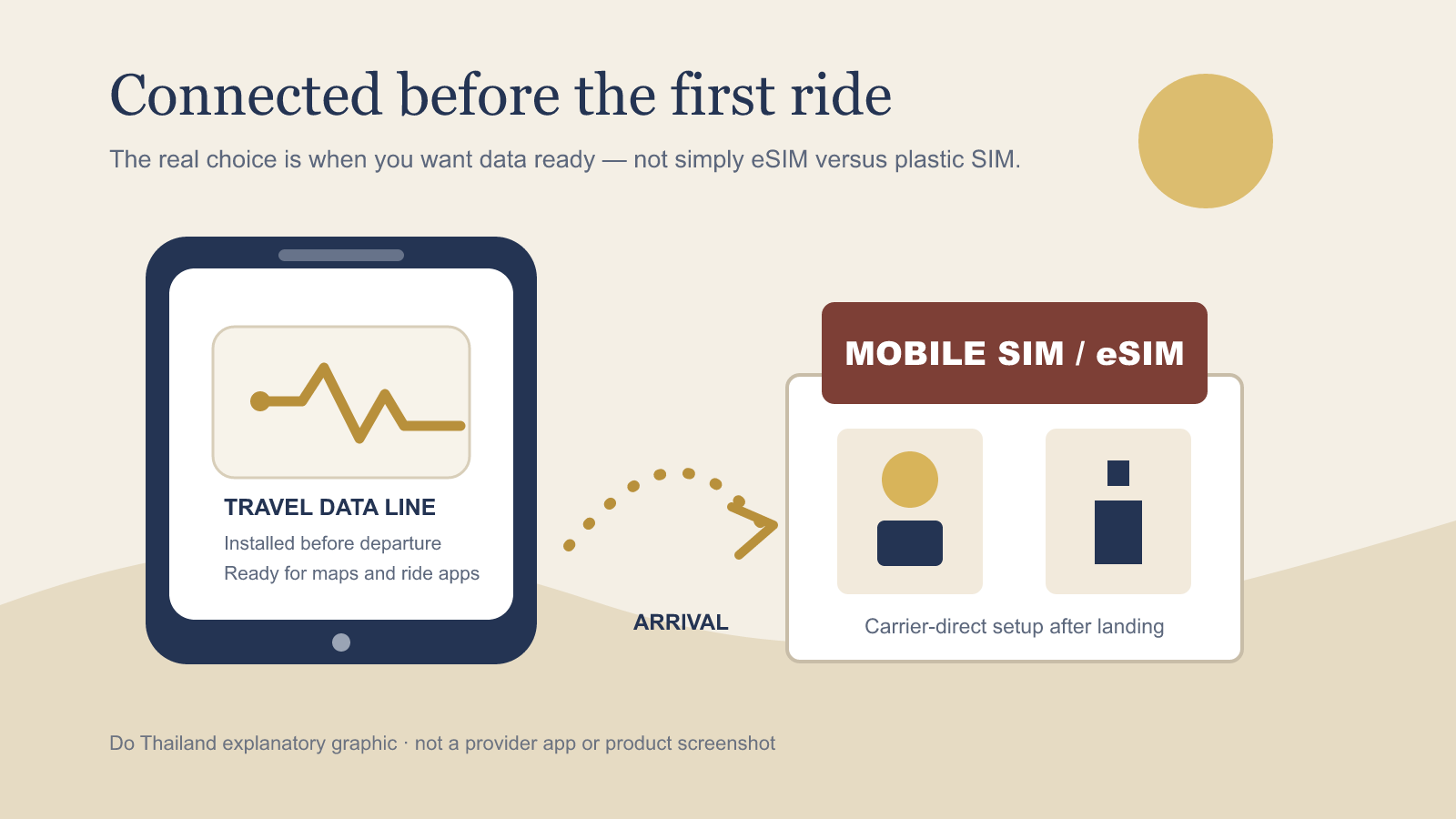
Choose a pre-travel eSIM if your first priority is getting online before you need to find a pickup point, message your hotel, open a map or request a car.
Choose a Thai carrier tourist eSIM or physical SIM after arrival if you want carrier-direct service, a local Thai number or a package with local calls and you do not mind spending part of the arrival process on setup.
Keep your home line active but do not let it handle travel data if you still need bank OTPs or messages to your usual number. Supported iPhones and Pixels can keep separate lines for home-number duties and travel data, but the exact dual-SIM options depend on the device and carrier.
This is no longer an eSIM-versus-plastic decision
A few years ago, “Thailand eSIM or airport SIM?” sounded like a technology choice. It is now mostly a timing and service choice.
AIS currently sells its Lucky Tourist plans as eSIM as well as physical SIM, and True-dtac currently offers tourist products in both formats. In other words, you can buy a Thai carrier plan without removing your home SIM if your phone supports eSIM. The alternative is a travel eSIM from a global provider such as Airalo or Saily, bought before you fly and designed mainly to remove arrival-day setup.
That changes the decision. Ask which of these three arrival experiences you want.
Travel eSIM before departure
Best when the first useful thing your phone must do in Thailand is open Maps, WhatsApp, Grab or a hotel message thread.
Thai tourist eSIM
Best when you want AIS or True-dtac directly but still want to leave your physical home SIM in the phone.
Physical tourist SIM
Still sensible when your device does not support eSIM, is easier to manage with one physical line, or you simply prefer counter assistance.
The first 20 minutes after landing are the real reason to buy before you fly
Pre-installing a travel eSIM does not make the entire Thailand trip better. It makes one small but important period easier: the handoff between airport Wi-Fi and the first real transport decision.
That is especially useful at the airports where the next step already has enough variables. If you land in Bangkok and still need to choose between two airports or work out the right city transfer, start with our BKK vs DMK guide. In Phuket, mobile data is useful when you are checking the exact Patong hotel pin against the options in our Phuket Airport to Patong guide. Krabi arrivals can involve another road-and-boat handoff, particularly if you are continuing to Railay; see Krabi Airport to Railay.
I would value pre-arrival data more highly if you are landing alone late, have a hotel down a small soi, are carrying luggage you do not want to drag between counters, or have a driver/host waiting for a message. None of those situations is dangerous by default. They are simply easier when the phone is already useful.
Use this arrival clock instead of comparing prices first
- Before boarding: install the travel eSIM while you still have reliable home Wi-Fi and keep the QR code or setup instructions accessible.
- After landing: turn on the travel line and the required data-roaming setting for that eSIM, then confirm it has connected before leaving the airport Wi-Fi area.
- Before requesting transport: verify your hotel pin and pickup zone. For a late Chiang Mai arrival, our Chiang Mai Airport after 10 PM guide is designed around that exact curbside handoff.
- Only then decide whether you still need a local carrier SIM: many travelers do not. Others may still want one for local calls, longer stays or carrier-direct support.
When I would deliberately wait and buy from AIS or True-dtac
A global travel eSIM is not automatically the smarter purchase. I would wait and buy a Thai carrier tourist plan if one of the following is true.
You want a Thai number or local calling to be part of the package. Current AIS and True-dtac tourist plans include carrier-direct options with local calling benefits on selected packages. Airalo also currently lists a Thailand Dtac product with data, calls and texts, but product details vary, so do not assume every travel eSIM is data-only or every one includes a usable local number.
You want in-person carrier support. AIS currently lists tourist-SIM points at Suvarnabhumi, Don Mueang, Chiang Mai, Samui and Phuket airports. True-dtac likewise states that tourist SIM/eSIM products are available through its shops, airports and online channels. If you are uncomfortable managing mobile settings, that counter interaction can be worth more than saving ten minutes.
Your phone does not support the eSIM setup you need. Apple says international travel eSIM use requires a compatible iPhone and, when using two different carriers, an unlocked device. Google likewise documents dual-SIM/eSIM support by Pixel generation and carrier. Check the device before buying, not while standing at baggage claim.
| What you care about | Pre-travel global eSIM | Thai carrier eSIM | Airport physical SIM |
|---|---|---|---|
| Data immediately after landing | Strongest if installed correctly before travel | Possible if purchased/set up online in advance; otherwise requires arrival setup | Requires counter or shop setup first |
| Keep physical home SIM in place | Yes on compatible devices | Yes on compatible devices | Depends on phone slots and your setup |
| Thai carrier-direct support | No; support is through the travel eSIM provider | Yes | Yes |
| Local calls / Thai number | Varies by exact product | Available on selected tourist plans | Available on selected tourist plans |
| Best for a tired late arrival | Usually, because the setup work happened earlier | Good if already installed; less attractive if you still need to configure it | Only if you are happy to stop at the counter |
| Best for eSIM-incompatible phone | No | No | Yes |
Keeping your home number for OTPs is easier than swapping it out
This is one of the most practical reasons I prefer an eSIM for travelers who still need bank verification codes or messages to their usual number.
Apple’s current Dual SIM guidance says a supported iPhone can keep separate voice and data lines, and only one cellular line is used for data at a time. Pixel phones with supported dual-SIM configurations can similarly assign different SIMs to calls, messages and mobile data. That means the clean setup is usually: home line stays available for the number; Thailand line handles data.
The expensive mistake is leaving your home line available for travel data by accident. Review the data-line setting before you fly and check your home carrier’s roaming policy. Do not assume that “I installed an eSIM” automatically disables roaming on the other line.
For solo arrivals, the useful setup is boring
You do not need an elaborate travel-tech stack. You need the phone to do four things reliably: open the hotel address, message the property or driver, request a ride, and receive any OTP that your bank or booking account decides to send.
If your first night is in Bangkok, choosing the right base still matters more than choosing the fanciest data plan. Our Bangkok stay guide handles that decision. If you are landing in Krabi and moving straight to Ao Nang, use the Krabi Airport to Ao Nang guide. For Samui, the Samui Airport to Chaweng or Bophut guide is the more important next read once your data is working.
Airalo and Saily are useful examples, but do not start with the brand
Airalo’s current Thailand store shows both fixed-data and unlimited options, plus a separate Dtac product that includes data, calls and texts. Airalo says many Thailand packages begin when the eSIM connects to a supported network, while the Dtac product shown on its current Thailand page has different activation behavior. That is exactly why you should read the package details rather than treating a brand name as one single product.
Saily’s current Thailand material says its plans activate automatically on arrival when the Saily eSIM is enabled and data roaming is turned on; purchased plans have a 180-day activation period before automatic activation. The useful question is whether the exact plan’s activation rule, data allowance and validity match your flight date and trip length.
I would choose the plan first, then the provider. A seven-day Bangkok city break using maps, messaging and occasional social uploads is a different data problem from a two-week Phuket–Krabi–Samui trip with hotspot use and video.
If you want data ready before landing
Airalo currently has Thailand-specific plans, including fixed-data and unlimited formats. Check the exact activation rule, validity and network shown for the package you are considering before paying.
My rule for the first Thailand trip
If your phone is unlocked and eSIM-compatible, I would normally arrive with a travel eSIM already installed and keep the home line for OTPs. It removes one task from the least pleasant part of the trip: the period when you are tired, carrying luggage and still trying to understand the pickup zone.
I would switch that recommendation to a Thai carrier tourist eSIM or physical SIM when you specifically want local calls, carrier support or a local-plan structure, or when your device makes dual-SIM management awkward. And I would not buy two connectivity products “just in case.” Start with the one that solves the actual arrival problem. Add another only if the trip proves you need it.
Once the phone is connected, move on to the decision that actually shapes the day: the airport transfer, hotel base or ferry handoff. Connectivity should make Thailand easier, not become another mini-project.