
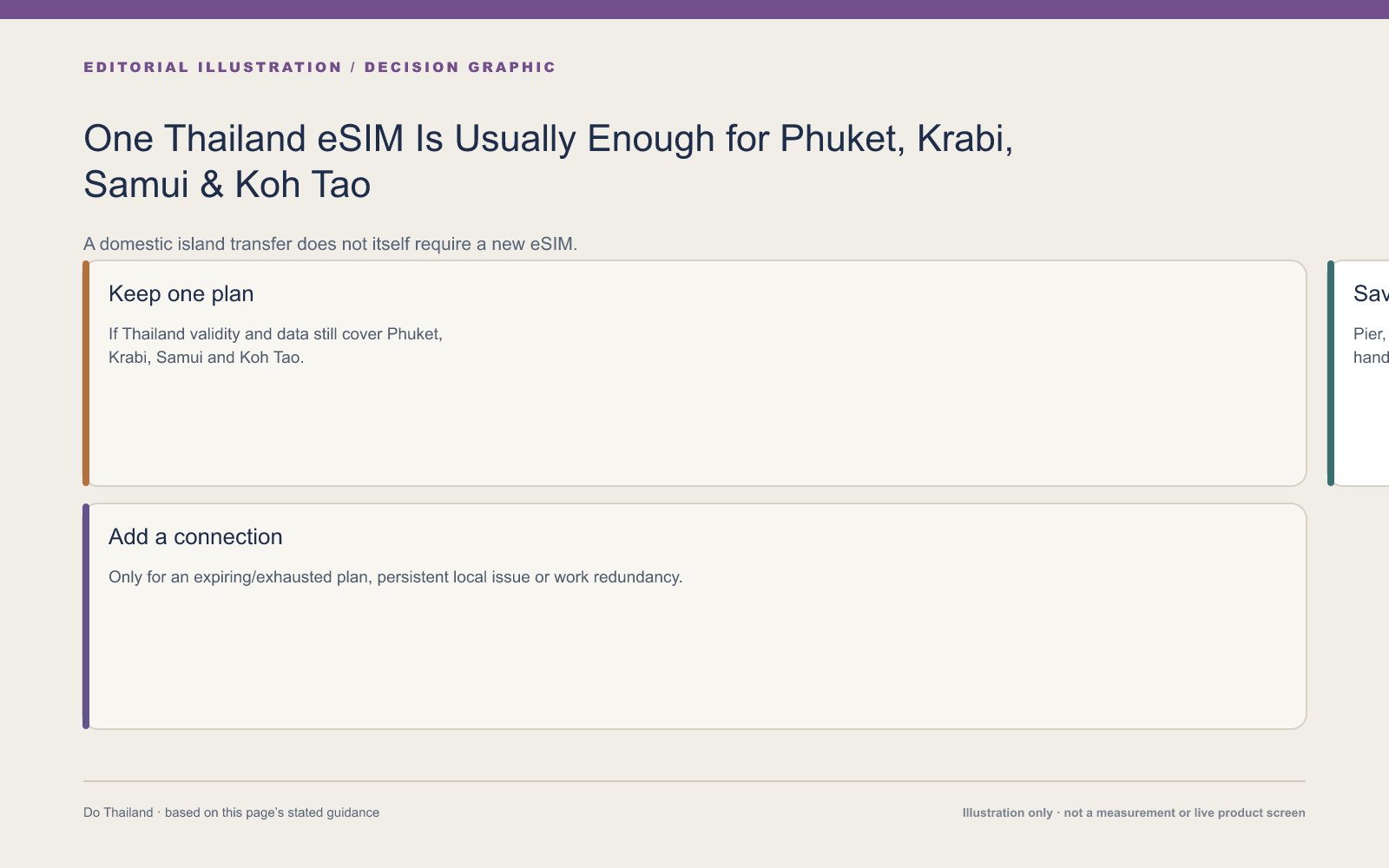
The decision in 30 seconds
Normal leisure trip: one Thailand eSIM, one profile, one data allowance. Re-test it after major transfers, but leave it alone while it works.
Longer trip: keep the same setup if the plan still has enough validity and data. A top-up can be cleaner than installing another profile when the provider supports it.
Work-critical trip: one eSIM can still be the primary line, but a second genuinely independent connection can be worth paying for if missing a video call or upload would be costly.
Ferry day: save the next pier, hotel and pickup instructions offline. A weak signal at sea is not, by itself, evidence that your eSIM has failed.
Do Thailand editorial explainer, checked 11 August 2026. This is not Airalo or Saily UI, a provider coverage map, or a promise that any specific beach, ferry or hotel room will have signal.
What changes when the island changes — and what does not
Phuket, Krabi, Koh Samui and Koh Tao feel like separate travel worlds because the transport changes: airport to road transfer, road to pier, pier to ferry, ferry to hotel pickup. Your mobile-data product does not automatically need to change with each handoff. They are all Thailand destinations, so a current Thailand country plan that remains valid does not become a different country product when you cross from the Andaman side to the Gulf.
That is different from a Thailand-to-Malaysia or Thailand-to-Singapore itinerary. If you are crossing an international border, use the Thailand-only vs Asia regional eSIM guide. For a domestic island loop, the cleaner question is whether the same current plan still has enough days, data and usable local-network access.
Current provider pages reinforce why you should think in terms of the exact product rather than the island name. Airalo's Thailand storefront currently lists a Thailand data-only family using True as the primary network with another supported network shown, while a separate dtac Thailand product includes calls/texts as well as data. The fixed-data Thailand product page also states that its package begins when it connects to a supported network. Saily's current Thailand page says its Thailand plans connect through local network providers, can activate automatically on arrival when the Saily eSIM and data roaming are enabled, and are designed for coverage across Thailand. These are provider/product rules, not separate Phuket or Samui rules.
If you still have not chosen a provider, compare the operating model in Airalo vs Saily for Thailand. If you already own a working plan, provider shopping should not become a hobby halfway through the holiday.
Use this route test at every major handoff
| Travel stage | Keep the current eSIM if… | What to save offline | When to investigate a second connection |
|---|---|---|---|
| Phuket arrival | Cellular data loads a fresh map and message after Wi-Fi is off. | Hotel entrance, pickup contact and the next transfer. | Only after the current line fails a real cellular test and basic settings/recovery checks. |
| Phuket → Krabi / Railay | The plan still has days/data and reconnects on land after the transfer. | Boat side, hotel side, booking reference and exact meeting point. | Investigate persistent service failure at the hotel or work location; a brief signal drop on the longtail crossing is expected. |
| Krabi → Koh Samui | The same Thailand plan reconnects after the road/ferry chain. | Samui pier or airport pickup, property pin and driver messages. | If a persistent destination-side problem remains after the phone has had time to re-register on a supported network. |
| Koh Samui → Koh Tao | The plan reconnects after docking and the profile is still valid. | Mae Haad arrival point, hotel/dive-resort pickup and booking thread. | If the destination-side line remains unusable after non-destructive troubleshooting, or you need a separate work backup. |
The destination handoff details matter more than installing extra profiles. Before Rassada, use the Phuket Airport to Rassada connectivity guide. Before a longtail transfer, use the Railay arrival connectivity guide. On Samui, save the exact resort or pier handoff with the Koh Samui pickup guide. Before the Koh Tao ferry docks, the Koh Tao Mae Haad pickup guide covers the last-mile problem.
Five bad reasons to install another eSIM
“I changed islands.” A domestic geography change is not itself a product problem.
“The ferry had no signal for a while.” Offshore coverage can be intermittent. Judge the connection after docking, not from the middle of the crossing.
“My phone showed fewer bars in one room.” Signal quality can change by building, terrain and exact location. First test whether real data tasks fail repeatedly.
“The phone did not reconnect instantly.” Give it a short re-registration window after landing, then use airplane mode or a restart before reaching for the delete button.
“I want a fresh profile because troubleshooting feels messy.” Deleting a paid eSIM can make recovery harder. Read the delete/reinstall caveats before removing anything.
Four reasons a second connection can be rational
Keep one plan
Use one plan when it still has enough validity, enough data and acceptable service at the places where you actually need it. Check your remaining allowance instead of predicting from the number of islands. Our Thailand data guide is the better sizing tool.
If the trip runs long, a supported top-up can be cleaner than another profile. The 30-day vs top-up guide explains that decision.
Add a second connection
Consider a second line when the first has genuinely expired or run out, when a key accommodation/work location has persistent unusable service, when the exact plan does not allow the hotspot workload you need, or when a work-critical trip justifies independent redundancy.
For laptop work, treat the problem separately with the Thailand remote-work hotspot guide.
“Unlimited” does not automatically solve any of those problems. It is a data-policy decision, not a coverage guarantee. If heavy use is the concern, compare the trade-off in unlimited vs fixed-data Thailand eSIMs instead of assuming a larger label improves island reception.
On ferry days, the offline packet is part of your mobile setup
Before boarding, save: the next pier name, hotel/property pin, Thai property name if supplied by the property, pickup instructions, driver or host contact, booking reference, and one screenshot of the route between arrival point and accommodation.
If the next leg is time-sensitive, also keep the actual ferry/transfer booking you hold. Do not rely on a generic timetable screenshot when operators can change schedules.
Preserve battery. Navigation, hotspot use, video and high screen brightness can turn a perfectly good eSIM into a useless arrival tool if the phone is dead.
The practical rule is simple: the ferry crossing is a planned low-connectivity zone; the pier-to-hotel handoff is where you need proof that mobile data is back. You do not need a new profile to make that distinction.
Separate a location problem from a plan problem
When data looks weak after a transfer, move through this order before buying anything:
- Turn Wi-Fi off and confirm the Thailand eSIM is still selected for mobile data.
- Confirm Data Roaming matches the exact provider instructions. If you use Dual SIM, review the Thailand data-roaming routing guide.
- Toggle airplane mode, wait briefly, then test a fresh webpage or map search.
- If the provider requires a specific APN, use only the value in that exact eSIM's instructions. Do not guess. See the APN decision guide.
- Try the same phone in a different open-air location before concluding the entire island is a coverage failure.
- If the line still fails, follow the broader Thailand eSIM troubleshooting order and contact the provider before deleting the profile.
Installation timing still matters. Some products begin validity on network connection; others have different triggers. Check the exact product before travel with the install vs activate guide. Do not assume that a rule from one Thailand product automatically applies to another product from the same brand.
For remote resorts, test the location — not the island name
A statement such as “works in Thailand” is not a room-level guarantee. Saily's current technical details say speed depends on local mobile network providers, and Airalo's current Thailand storefront exposes the network(s) attached to the selected product. For a remote resort, villa, dive stay or work retreat, the useful question is therefore: which local network does this exact plan use, and does that network perform acceptably at the exact place that matters?
If a property is mission-critical for work, ask the property what local mobile networks guests currently use successfully and keep hotel Wi-Fi as a separate variable. Do not write “Koh Tao has bad coverage” or “Phuket always has 5G” from one anecdote. Island-wide statements are too blunt for a location-level radio problem.
If your current Thailand eSIM works, buy nothing
Keep the working profile. Check remaining days and data. Save the next handoff offline. Re-test after the ferry. That is the lowest-friction setup for most island-hopping holidays.
If you still need to choose a provider before departure, use our Airalo vs Saily decision page. If you already have a working line, there is no editorial reason to replace it just because your hotel changed islands.
The rule I would use for a Phuket → Krabi → Samui → Koh Tao trip
Start with one Thailand eSIM whose validity and data fit the whole itinerary. Keep that profile through the domestic route. Treat ferries as moments to save information and preserve battery, not as automatic profile-switch points. After each major handoff, prove cellular data with a fresh map or message. Only add a second connection when you can identify a real coverage, expiry, allowance or redundancy problem.