
The border-count rule
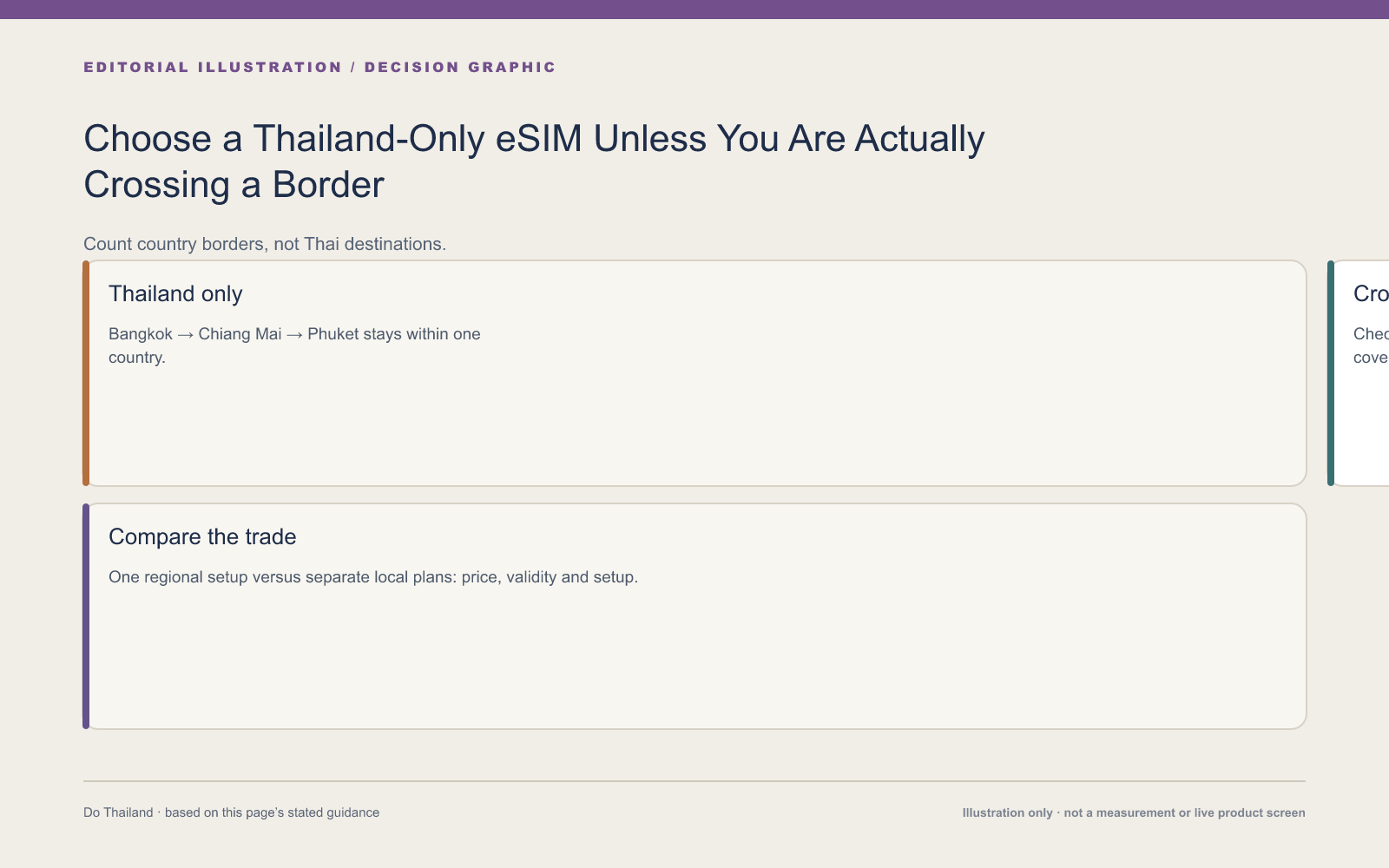
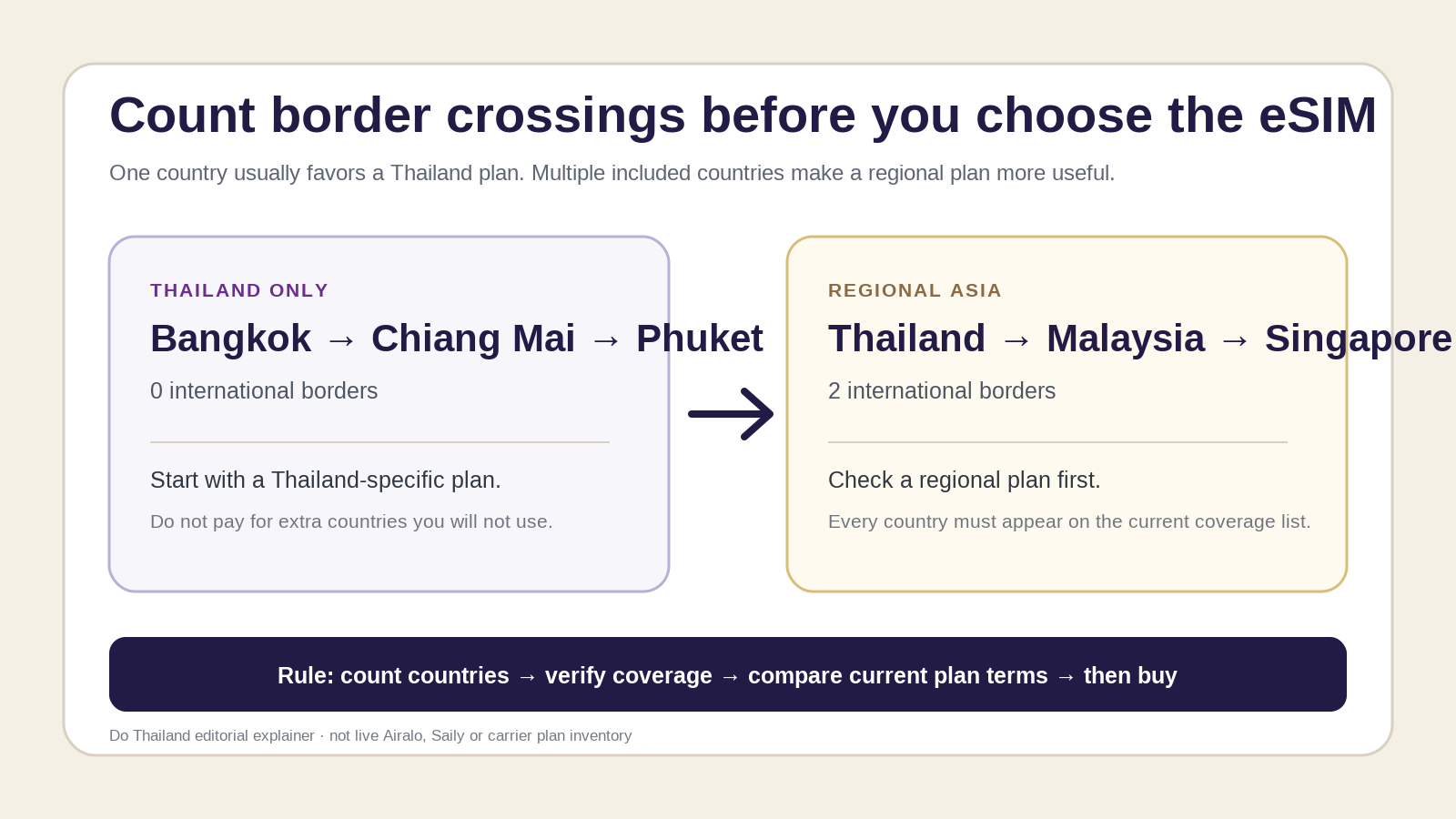
Zero international border crossings: buy for Thailand first. A Bangkok-to-Chiang-Mai-to-Phuket itinerary is still one-country use, even if it feels like three different trips.
One or more international border crossings: check a regional plan, but only after confirming every country on your itinerary appears in the current coverage list.
Do not solve the wrong problem. If your real uncertainty is data volume rather than geography, use our Thailand data-allowance guide. If the question is whether to buy before departure at all, start with Thailand eSIM vs airport SIM.
Count countries, not Thai destinations
Bangkok → Chiang Mai → Phuket
Stay Thailand-specific. All three stops are inside the same country, so regional coverage is extra geography rather than extra usefulness.
Bangkok → Penang
Regional becomes worth checking because the phone has a second country to cover. Compare one regional plan with the total cost and setup effort of separate Thailand and Malaysia plans.
Thailand → Singapore → Vietnam
A regional plan has a clearer job: keep one data setup across several included destinations, provided the data allowance and validity still cover the whole trip.
This distinction matters because domestic complexity can trick you into buying geographic coverage you do not need. A trip that includes a Phuket Airport to Rassada Pier handoff and then an island stay may be logistically complicated, but it is still Thailand. The same applies to a Samui Airport arrival: the transport may depend on maps and messaging, but there is no international roaming boundary to solve.
“Asia regional” does not mean “all of Asia”
Airalo's current Asia page lists coverage across 18 countries and networks. Saily's current Asia and Oceania page lists 22 countries. Those sets overlap heavily, but they are not identical and they are not universal.
Saily's Thailand page makes the practical distinction unusually clear: its Thailand-specific eSIM does not work in Malaysia; travelers who need both countries are directed toward a Malaysia plan or the Asia and Oceania regional option. Saily's help centre also warns that not every country belongs to every regional bundle.
Before buying, write your route as a country list and check it line by line. Do not infer coverage from the region name, the map graphic or the fact that two countries share a border.
A current price snapshot shows why Thailand-only often wins for a one-country trip
The regional premium is not theoretical. On the provider pages checked on August 10, 2026, same-provider examples showed a meaningful difference between Thailand-only and multi-country coverage.
| Provider example checked Aug 10, 2026 | Thailand-only | Regional Asia | What the difference buys |
|---|---|---|---|
| Airalo · 10 GB / 30 days | US$11 | US$25 for Asialink 10 GB / 30 days | Coverage across Airalo's current 18-country Asia bundle instead of Thailand only |
| Saily · 10 GB / 30 days | US$10.99 | US$35.99 for Asia & Oceania 10 GB / 30 days | Coverage across Saily's current 22-country regional bundle instead of Thailand only |
This is a dated product snapshot, not a price guarantee. Plans, currencies, promotions, coverage, allowances and validity can change. Recheck the exact package immediately before purchase.
For a Thailand-only holiday, paying more for unused countries is hard to justify unless the regional package happens to have a different allowance, validity or feature you specifically need. For a multi-country trip, compare border coverage and setup steps alongside map coverage.
One regional plan can remove setup friction, but separate local plans can still be rational
Two local plans can win on value
If Thailand is a long main stay and the second country is only a short stop, two country-specific plans may still cost less or give you more useful data. The trade-off is another purchase and another plan handoff.
This is especially reasonable if you are already comfortable installing eSIMs. Our installation and activation timing guide explains why purchase, profile installation and plan validity should be treated as separate clocks.
One regional plan can win on continuity
If you are moving Thailand → Malaysia → Singapore → Vietnam in a compact itinerary, one regional plan has a clear operational advantage: the product is designed to cover multiple included countries under one regional purchase.
That does not mean every border handoff will feel instant or every local network will behave identically. It means you have removed the need to shop for a fresh country plan at each stop.
Run this five-question test before paying the regional premium
- How many countries are actually on the itinerary? Domestic Thai flights and islands do not count as border crossings.
- Are all of them on the exact current coverage list? If one destination is missing, the regional label does not solve your whole trip.
- Does one allowance cover the full travel period? A 30-day regional plan is not useful if your trip is longer, and a tiny allowance may be false economy if you rely on maps, ride apps and uploads.
- Would two local plans cost materially less? Compare the same realistic data need, not the smallest local plan against a much larger regional plan.
- How much do you value not changing plans at the border? For a fast multi-country itinerary, fewer setup moments may be worth paying for. For a slow Thailand stay plus one weekend elsewhere, maybe not.
If two people are travelling together, geography is only half the decision. Our one-hotspot-vs-two-eSIMs guide explains why two independent phone data lines can matter more than concentrating all the data on one device. And if your home number needs to stay reachable for bank codes, keep the identity job separate from the travel-data job using the home SIM and OTP setup.
What happens on the actual border day?
The regional plan's advantage appears when transport gets messy. A flight lands, a bus crosses a border, or a train arrives and you want maps, a ride app, hotel chat or a booking confirmation before hunting for Wi-Fi. You are buying fewer connectivity handoffs.
But I would still save the provider's setup instructions offline before the trip. If the eSIM does not connect after entering a covered country, do not immediately buy a second plan. Work through the data-line, roaming, APN and supported-network checks in our Thailand eSIM troubleshooting guide. The same logic travels with you.
And remember that a transport-heavy day rarely needs huge data volume. Even in Pattaya, where you might be choosing between a route-based songthaew and an app ride in our baht bus vs Grab guide, the real value of mobile data is having the route, pickup point and messages available at the moment you need them.
Thailand eSIM vs Asia regional eSIM: my decision table
| Your itinerary | Thailand-only plan | Asia regional plan | My lean |
|---|---|---|---|
| Bangkok + Chiang Mai + Phuket | Direct fit | Extra countries unused | Thailand-only |
| Thailand + Malaysia | Needs a second country plan | Useful if both countries are currently covered | Compare both |
| Thailand + Singapore + Vietnam | Multiple separate purchases | One regional purchase can cover all three if the current list includes them | Regional usually stronger |
| Three weeks Thailand + two days Singapore | Can be excellent value for the long Thailand segment | Convenient, but the regional premium may be large | Price two local plans too |
| You are still changing the route | Best if Thailand is the only certain country | Can buy flexibility only within the listed countries | Wait until the route is real |
Compare the Airalo landing page that matches the itinerary you actually have
If Thailand is the whole trip, start on the Thailand page. If you are crossing into other countries, open the Asia page and verify every destination in the current coverage list before selecting a package.
My final rule
Buy geography you will actually cross. For a Thailand-only trip, a country-specific plan is usually the cleaner starting point because you are not paying for regional reach you will never use.
Move to a regional Asia plan when multiple countries are genuinely in the itinerary, every one is on the current coverage list, and the convenience of one multi-country setup is worth the premium. Do not let the word “Asia” make that decision for you.