
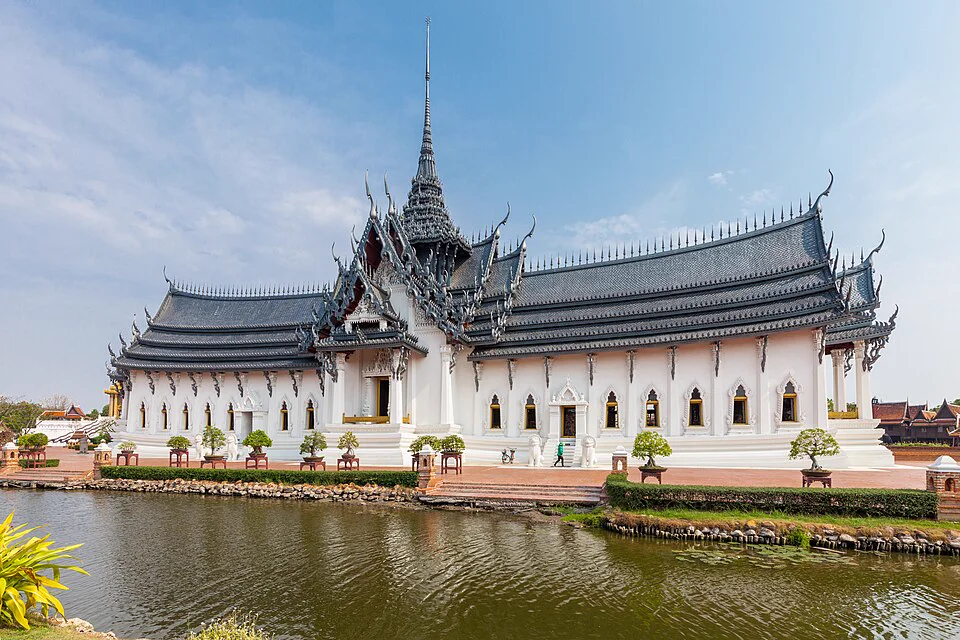
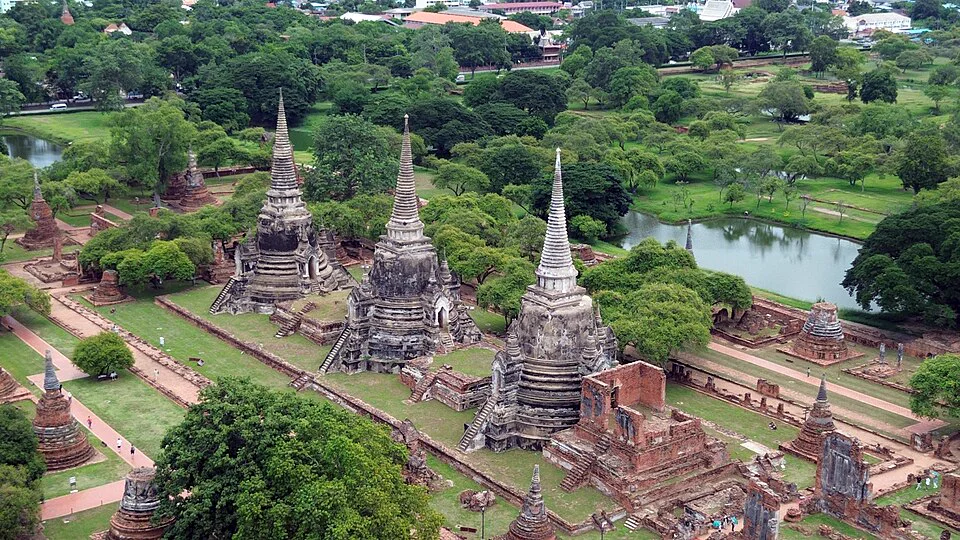
Sanphet Prasat Throne Hall makes this comparison concrete. At Ancient City in Samut Prakan, the reconstructed building has a roofline you can study as a complete architectural composition. In Ayutthaya, the surviving foundations and monuments belong to the place where the capital stood. Each answers a different question about the past, and that difference matters more than which destination produces the longest sightseeing list.
My starting point would be the building or historical setting you are most curious about. Someone interested in how Thai architecture changes across regions may get more from Ancient City's concentrated collection. Someone drawn to the former capital will probably prefer Ayutthaya, even if that means a longer excursion. Neither choice needs to be justified by a claim that it is the more serious way to spend a Bangkok day.
A complete-looking palace and a ruined capital tell different stories
Ancient City, also called Muang Boran, is an open-air museum rather than an excavated city. Its buildings bring together examples from different parts of Thailand, including researched reconstructions and works that interpret cultural beliefs. The Sanphet Prasat reconstruction is particularly relevant here because it offers a way to imagine an Ayutthaya-period palace whose original appearance survives only through limited evidence.
That is useful if you want to understand architectural form. An intact-looking roofline gives a different sense of scale from a footprint in the ground. I would treat the reconstruction as an interpretation to look at closely, with attention to what the exhibit explains about its sources. Ancient City's appeal is the ability to compare buildings without traveling to all the regions they represent.
Ayutthaya was founded around 1350 and became the second Siamese capital. Its destruction in 1767 left a very different setting for a visit. The ruins make absence part of the experience: you are looking at a city whose buildings no longer survive as complete spaces. The historical landscape is the reason to go, rather than a collection assembled to survey the country.
“Original ruins” also does not mean that everything is untouched. Monuments have been conserved, repaired, and sometimes reconstructed. The important distinction is the connection between the surviving fabric and its historical location. That is why Ancient City can help explain architecture without replacing an Ayutthaya visit for someone whose interest is the capital itself.
Ancient City needs a route through the grounds
The museum is in Samut Prakan, southeast of central Bangkok. It is a substantial outing even though its name often appears with “Bangkok” attached. A BTS journey toward Kheha followed by a local road connection is a possible approach; a car from the hotel removes that transfer. Which is easier depends on the hotel's location and the group's tolerance for getting in and out of vehicles.
The gate is only the beginning of the visit. The grounds are spread out, with exhibits arranged across regional zones, so walking without a plan can use up the time meant for looking at buildings. I would choose a few structures that explain the architectural differences I want to see, then connect them on the museum map. Reaching every corner is a different ambition from having a satisfying introduction.
Internal transport changes that calculation. The museum has advertised bicycle and golf-cart rentals, while tram arrangements need checking for the visit date and ticket. A cart may suit friends who want to move together and stop for photographs; a bicycle makes sense only if everyone is comfortable riding in the conditions. The admission ticket and the chosen transport should be priced together before deciding that this is the simpler outing.
A cart also brings practical questions: how many people fit, who is permitted to drive, and how rental time is charged. For a visitor who needs mobility support, transport between exhibits is only one part of access. Getting on and off the vehicle and entering individual buildings still matters. The group can build a shorter route around accessible stops rather than assuming one vehicle makes the whole museum equally easy.
For the Bangkok return
Find a Sukhumvit hotel base
A stay near the rail corridor can simplify a Samut Prakan outing while leaving dinner close to the room.
Search places to stayAyutthaya rewards a smaller, connected set of stops
Ayutthaya is a living city as well as an archaeological destination. Arriving there does not put every monument within one admission gate or along one convenient walking loop. A useful first route has a small group of sites you genuinely want to understand, with a realistic way to move between them. Adding an isolated temple late in the day can consume more time than its position on a sightseeing list suggests.
Wat Phra Si Sanphet is a strong starting point for someone interested in the royal precinct and the scale of the former capital. Wat Mahathat and Wat Ratchaburana offer other perspectives nearby in the historic island area. Choosing among them is more productive than assuming a first visit must include every famous temple. Time for a guide's explanation or for reading the site interpretation can make a short selection feel substantial.
A temple across the river, such as Wat Chaiwatthanaram, changes the transport plan. It can be the stop you most want, in which case the day should make room for it. But it is not a quick extra simply because the photographs look appealing. A local driver can help connect dispersed monuments; the arrangement needs to establish where you will be dropped off and whether the driver waits while you visit.
A guided outing can make sense when historical explanation is the priority and the group wants fewer coordination jobs. The tradeoff is someone else's site order and time at each stop. Independent travel is more attractive when you want a long pause at one monument or the freedom to finish early. Our Ayutthaya train-versus-guided-tour comparison deals with that transport choice after the destination is settled.
The midday break belongs in either itinerary
Both outings involve a lot of outdoor time. A longer visit does not automatically produce a better one if everyone is hot and rushing between photographs. The most ambitious stop belongs in the part of the day when the group has energy; lunch can then become a proper pause rather than something squeezed in while arranging the next ride.
At Ancient City, keeping the visit inside one managed site reduces the number of travel decisions, but the scale of the grounds remains. In Ayutthaya, a vehicle between monuments can provide a useful break without changing the exposed conditions at the ruins. The question is how much outdoor walking each person wants, not whether one destination deserves an “easy” label.
For friends with different interests, an agreed meeting time is often more helpful than insisting that everyone photograph the same building. A keen architecture traveler may want to linger; another friend may prefer a drink and a seat. That arrangement works best when the meeting place is specific and reachable. At Ayutthaya, splitting up also needs a shared plan for the onward ride.
Clothing that works for temple entry avoids having to alter the route for an active religious site. Secure footwear is useful on uneven surfaces, especially after rain. Water and sun protection are straightforward additions to either day. Where ruins or buildings have restricted access, the marked visitor path sets the limit; a desirable photograph is not a reason to climb onto historic masonry.
Compare admission with the day you actually plan
Ancient City's dedicated English ticket page currently lists foreign-national admission at 800 baht for adults and 400 baht for children ages 6–14. It lists daily opening from 9 a.m. to 7 p.m., with ticket sales ending at 6 p.m. Those hours leave room for different arrival times, but a late ticket does not create enough daylight to cover the grounds at the same pace as a morning start.
The useful cost comparison includes any internal rental and the journey from the Bangkok hotel. For four friends, a shared cart or car may change the per-person total, depending on capacity and terms. A discounted admission offer is less compelling if it excludes the transport the group needs. Checking what the exact ticket covers is more useful than comparing the lowest advertised number with a different product.
Ayutthaya has site-specific admission arrangements rather than one universal price for visiting the city. A tour quote needs to identify its paid sites and whether their admissions are included. An independent budget should follow the selected route. A package covering more monuments is only a saving when those are places you intend to visit; it should not become a reason to rush through extra stops.
Opening arrangements also belong to individual sites. A sunset photograph, an illuminated monument, and ordinary daytime admission are different plans. A special event or evening-opening notice needs to apply to the chosen date. I would not extend a Bangkok return on the strength of an older night-tour advertisement.
Give the return evening a job it can handle
An Ancient City outing can end when the group has seen enough, but the trip back from Samut Prakan still takes part of the evening. A neighborhood meal near the hotel is a comfortable match. Pairing the museum with another substantial attraction may work for a highly motivated group, yet it can turn a flexible visit into a day spent watching the clock.
For an Ayutthaya day trip, the return is part of the main commitment. A fixed dinner reservation in Bangkok can make the last site feel hurried, particularly when a road transfer is involved. A loose dinner plan gives the group room to stay at a monument that holds their attention. The hotel base matters here too: reaching Bangkok is not the same as reaching the room.
An overnight stay in Ayutthaya is a different proposition for travelers whose main interest is the city. It can separate an afternoon visit from the following morning instead of squeezing both into one Bangkok excursion. That is most useful when the extra packing and hotel change feel worthwhile. For a short Bangkok stay with several other priorities, keeping one base may be preferable.
If the ruins deserve more time
Compare an Ayutthaya overnight stay
Check the hotel's location against your chosen monuments and onward transport before adding a night.
Search places to stayMy choice for an architecture-focused Bangkok break would lean toward Ancient City, with a selective route through the grounds. For a traveler who wants the former capital, I would give Ayutthaya the day and simplify the monument list. On a brief stay, the four-day Bangkok itinerary comparison helps decide whether that away-day fits alongside the city's other plans.
Source evidence and practical limits · checked October 12, 2026
The museum's history page supports its researched reconstruction and interpretive collection, including Sanphet Prasat. Its dedicated ticket page lists 800/400 baht for foreign-national adult/child admission, child ages 6–14, 09:00–19:00 opening, and 18:00 ticket-sales closure. Its travel page confirms the Samut Prakan address and hours; it no longer displays the older price cited in this article's previous version.
The museum's access notice and amenities notice are dated August 20, 2022; their embedded graphics were inspected. They support Kheha with an onward road connection and the advertised rental types, not a guarantee of current rental prices or ticket inclusions. The Tourism Authority of Thailand's Muang Boran page asks visitors to confirm tram arrangements locally; its older 700/350 baht price was not used.
UNESCO's Historic City of Ayutthaya entry supports the capital's foundation, destruction in 1767, archaeological landscape, and conservation/reconstruction distinction. The Fine Arts Department park site and park contact page identify the managing authority. No uniform current Ayutthaya fee or opening schedule is asserted here. Site-specific admissions, evening events, vehicle availability, and step-free access need confirmation for the visit date.
Safety and site care: outdoor heat and wet or uneven surfaces affect route length. Temple dress requirements and marked access restrictions still apply; masonry and Buddha images are not climbing surfaces. Dates and image adaptations appear under each photograph. The Ayutthaya aerial photograph is archival location evidence, not evidence of current visitor access.