
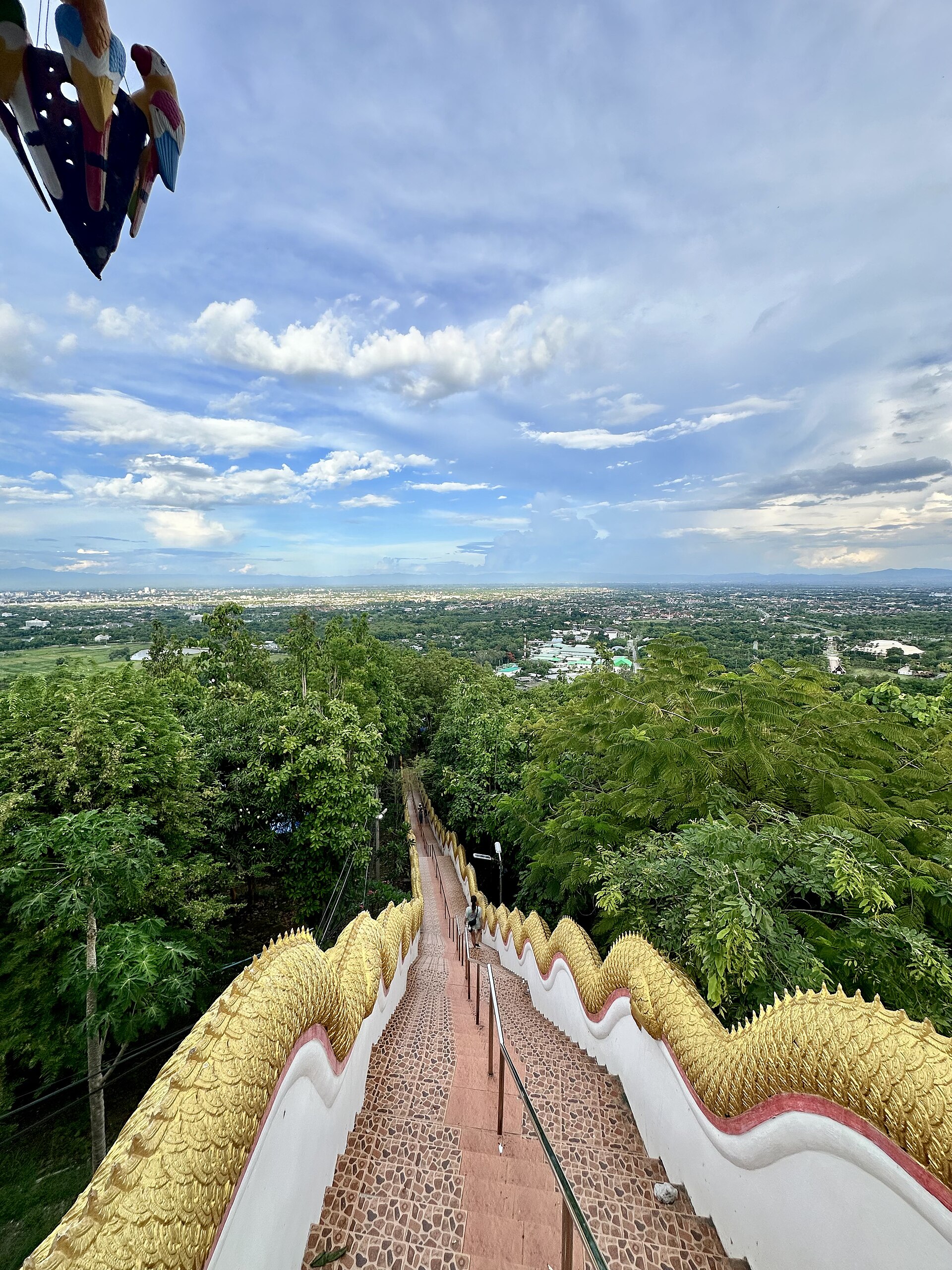
Doi Kham and Royal Park Rajapruek are geographically close enough that they often appear on the same map search. That makes them look interchangeable. They are not. One is an active Buddhist pilgrimage site on a hill. The other is a large curated garden attraction with formal landscapes, international gardens and Lanna-style architecture. The useful question is not “which is better?” but “what kind of half-day is missing from the rest of your Chiang Mai trip?”
Choose Doi Kham
You want a religious landmark, an older Lanna-area sacred site, Luang Pho Tan Jai, a hilltop setting and a visit that can remain relatively focused rather than filling an entire half-day.
Choose Royal Park Rajapruek
You want gardens to be the activity: Ho Kham Luang, formal plant displays, shaded and open-air zones, photography and enough space to slow the pace of the day.
The easiest first-trip rule: choose the experience, not the postcode
Chiang Mai public-relations material describes Wat Phra That Doi Kham as sitting on Doi Kham behind Royal Park Rajapruek, so combining the two is geographically logical. But proximity does not mean they solve the same travel need. Doi Kham is a sacred-site decision. Rajapruek is a garden-and-design decision.
If you already have several major temples planned, adding another temple simply because it is nearby may create repetition. In that case, Rajapruek gives you a different visual language and a slower day. If your itinerary already includes a serious garden or Mae Rim nature outing, the reverse can be true: Doi Kham may add a distinct religious layer without consuming another large green-attraction block.
Before you stack more mountain and nature time into the trip, use the Doi Suthep and Doi Inthanon decision guide. If Doi Suthep is already your headline temple, Doi Suthep morning vs late afternoon will help you decide whether another hilltop temple belongs anywhere near the same day.
Doi Kham works when religious context is the point
Tourism Authority of Thailand currently describes Wat Phra That Doi Kham as an ancient hilltop temple with a history of more than 1,300 years, a relic pagoda and the Luang Pho Tan Jai Buddha image. Chiang Mai Provincial PRD material also records the temple as an important local Buddhist site associated with the Hariphunchai-era founding tradition and an annual relic-bathing pilgrimage.
Doi Kham combines a hilltop viewpoint with an active temple. The visit suits travelers interested in Luang Pho Tan Jai, the relic chedi and local devotional practice; without that interest, the viewpoint alone may not warrant a detour on a short first trip.
The contrast is useful if you are already considering another quieter temple. Wat Suan Dok vs Wat Umong handles royal Lanna context versus forest-monastery atmosphere, while Wat Pha Lat vs Wat Umong is better if what you actually want is a green, contemplative temple experience rather than a pilgrimage-style hilltop stop.
Doi Kham is shorter on paper, but the hill changes the friction
TAT's current spiritual-travel article lists Doi Kham's visitor hours as 08:00–17:00. Treat that as check-before-you-go information rather than a permanent promise, especially around major religious dates. Provincial reporting also shows that the approach road can become busy during festival and holiday periods, with local shuttle arrangements used to reduce congestion.
For planning, the important point is simple: a focused temple visit can be shorter than Rajapruek, but the approach and return deserve a plan. Do not look at the map, see that the temple is near the park, and assume the hill behaves like a flat garden entrance.
Royal Park Rajapruek works when you want the garden to occupy the block
Royal Park Rajapruek's current official site says the park covers more than 500 rai and organizes its plant displays across Thai gardens, international gardens and other themed areas. Ho Kham Luang gives the visit a strong Lanna architectural anchor, so the Lanna pavilion gives the garden a strong architectural focal point.
The park currently lists daily visitor hours of 08:00–18:00. Its official FAQ also says the sightseeing tram is included, which matters for a site of this scale: you can reduce the walking load without turning the visit into a rushed drive-through. For foreign visitors, the current official admission page lists 200 baht for adults and 150 baht for children 100–140 cm tall; recheck before travel because admission details can change.
If you are deciding between two plant-focused outings, the separate Royal Park Rajapruek vs Queen Sirikit Botanic Garden guide is the correct comparison. Rajapruek is the more controllable city-side garden; Queen Sirikit Botanic Garden earns the longer Mae Rim detour when botany itself is one of your strongest interests.
Do both only when the pairing solves the itinerary
Because Doi Kham sits behind the Royal Park area, doing both on one road block can be sensible. But “they are close” is not enough reason. A first trip with three or four full days usually benefits more from contrast than from collecting neighbouring attractions.
Three sensible ways to use the south-west side
Temple-first day: make Doi Kham the purpose, then use the remaining time for a lighter creative or city stop rather than forcing a giant garden. Baan Kang Wat vs One Nimman can solve that second-half question.
Garden-first day: give Rajapruek the time it deserves, then keep the evening simple. If your trip already has enough greenery, Huay Tung Tao vs Ang Kaew Reservoir may be unnecessary on the same short itinerary.
Both in one block: reserve this for travellers who genuinely want both a Buddhist pilgrimage site and a major garden. Do not compress each place simply to say you saw two pins.
Which one fits a four-day Chiang Mai trip better?
For a mixed first trip, Royal Park Rajapruek is easier to justify when your temple quota is already high; Doi Kham is easier to justify when your green-attraction quota is already high. This is why a rigid “top ten Chiang Mai attractions” list is less useful than a role-based itinerary.
The Chiang Mai 4-day guide protects geography rather than forcing every landmark into the same day. If your cultural foundation is still weak, the City Arts & Cultural Centre vs Lanna Folklife Museum comparison may add more understanding than a second scenic stop. If your trip is already temple-heavy and you want a different kind of craft/culture day, Bo Sang vs Baan Kang Wat provides a stronger contrast.
Heat, rain and energy change which choice feels better
Rajapruek is large and includes exposed outdoor sections, so heat can turn an ambitious garden plan into an energy drain. The tram helps, but it does not make the park entirely climate-controlled. If the forecast is hot, reduce your walking ambitions rather than trying to “finish” the park.
Doi Kham is more compact, but temple clothing, the hill approach and exposed terrace time still matter. On rainy days, neither attraction should be treated as a guaranteed indoor backup. A temple can still involve slippery outdoor surfaces; a garden is still a garden.
If your real goal is simply a low-intensity green reset, compare the role of this half-day with Huay Tung Tao vs Ang Kaew before committing more road time.
Women travelling solo: the practical difference is the return plan
At Doi Kham, dress for an active Buddhist temple rather than for a viewpoint: cover shoulders and knees, carry a light layer if needed, and treat prayer areas and offerings as religious space. If you are not driving, decide how you are getting back down before you finish the visit instead of negotiating transport only when you are ready to leave.
At Rajapruek, the practical issue is more about scale. Wear shoes you can walk in, carry water and sun protection, and do not assume the last garden zone you reach will be close to the exit. For either stop, keep your phone charged and your hotel address saved in Thai. Thailand Tourist Police currently lists 1155 for traveller assistance.
The biggest mistake: using Doi Kham as a substitute for Doi Suthep
Both are hilltop Buddhist sites with views, but they do not play the same role in a first trip. Doi Suthep is the city's headline mountain temple and often deserves protected time on its own. Doi Kham is a different religious site with its own local devotion and south-west geography. If you are deciding whether Doi Suthep belongs in your schedule at all, solve that first rather than treating Doi Kham as a cheaper or easier “version” of it.
Once you know your mountain-temple commitment, the decision here becomes much cleaner: use Doi Kham for a distinct pilgrimage stop, or use Rajapruek to introduce a garden-and-Lanna-architecture layer that your itinerary may otherwise lack.
The final call
Pick Doi Kham if the temple is the reason for the trip south-west. Pick Royal Park Rajapruek if you want the half-day itself to unfold through gardens, architecture and slower walking. For most first-time visitors who already plan Doi Suthep and several Old City temples, Royal Park Rajapruek usually adds more contrast. For travellers who care about Luang Pho Tan Jai, Buddhist pilgrimage and the specific Doi Kham story, the temple is the stronger choice.
Continue with the Chiang Mai Experiences hub or return to the Chiang Mai destination guide to keep the rest of the itinerary balanced.