
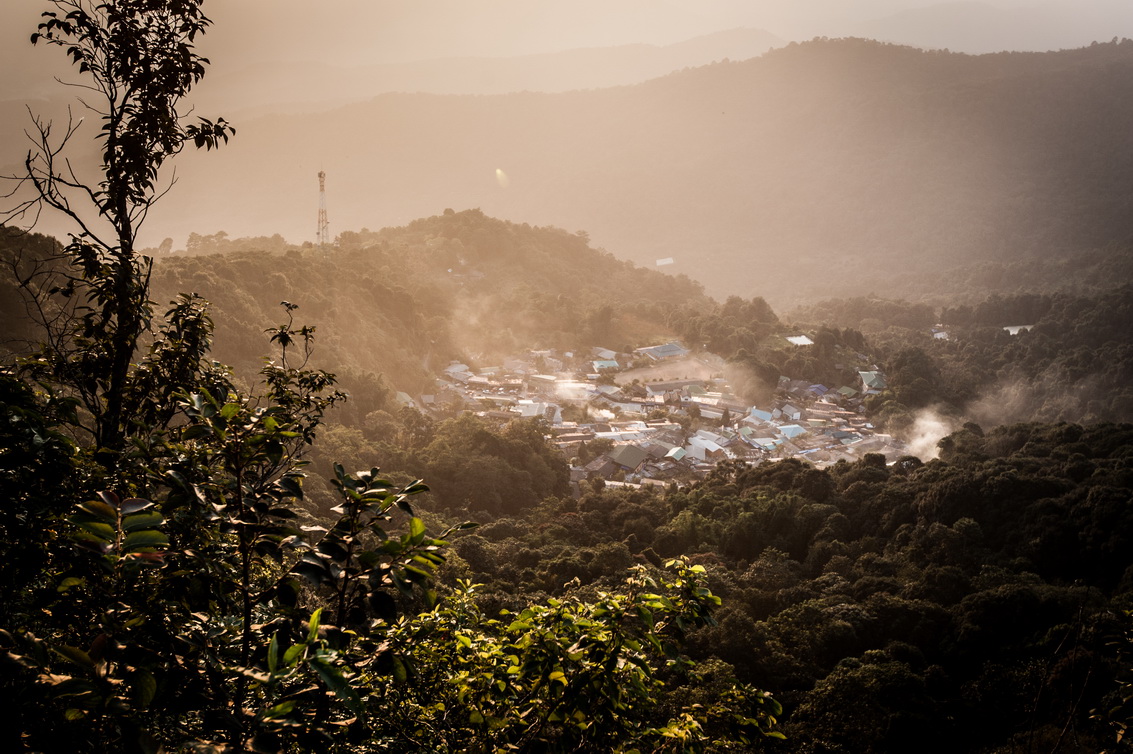
Tourism Authority of Thailand's current Chiang Mai destination guidance still names both experiences: Hmong villages in Doi Pui and ecotourism homestays in Mae Kampong. That is about where the similarity ends. They ask for very different amounts of time and create very different days.
A mountain-road extension
Doi Pui works best when your day already has a Doi Suthep-Pui spine. The value is efficiency: you can add a living Hmong community context to a mountain day without creating a completely separate excursion from Chiang Mai.
A destination day
Mae Kampong sits about 50 kilometres from Chiang Mai city in Mae On. Forest, village lanes, cafés, waterfall, food and homestay culture form the outing. If you go, the village itself should deserve the time.
Do not compare these as two versions of the same “hill-tribe village” trip
Doi Pui is part of the Doi Suthep-Pui mountain landscape immediately west of Chiang Mai. The Department of National Parks describes Doi Suthep-Pui as a large protected mountain system whose access starts only a few kilometres from the city, with attractions spread along the mountain road. TAT's current Chiang Mai page specifically includes visits to Hmong villages in Doi Pui among the province's mountain experiences.
Mae Kampong is a different proposition. TAT describes it as a small forested village in Mae On with restaurants, cafés, guesthouses and homestays, and places it around 50 kilometres from Chiang Mai city. The older TAT mountain guide also connects the village with miang — fermented tea leaves — and the rural livelihood around the mountain environment.
That is why the first planning question is not “which village is more authentic?” It is how much of your trip are you willing to give the village? “Authentic” is too vague to be useful and too easy to turn living communities into scenery. Route commitment is a much better decision tool.
Doi Pui wins when Doi Suthep is already fixed
If Wat Phra That Doi Suthep is already on the itinerary, Doi Pui has a strong practical advantage: it belongs to the same mountain system. Start with the Doi Suthep morning vs late-afternoon guide to decide when the mountain block should happen. Then use the songthaew vs private-car guide before assuming your transport arrangement can simply continue farther uphill.
The editorial case for Doi Pui is strongest when it is an extension, not when you invent a second mountain day purely to collect another place name. You are adding a Hmong-community layer to an already coherent Doi Suthep day. That can be much more efficient than opening an entirely separate east-of-city excursion.
Doi Pui also suits a traveller who wants the village visit to stay compact. You may browse community shops, walk the village lanes and observe the mountain setting, then return to Chiang Mai without restructuring your evening. If you still want more forest rather than more village time, Wat Pha Lat vs Wat Umong helps you compare two lower-commitment quiet stops on another part of the trip.
Mae Kampong wins when you want to stop treating the countryside as an add-on
Mae Kampong becomes the better choice when the trip needs one substantial village-and-forest day. TAT's current material describes a forested community with cafés, restaurants, guesthouses and homestays, and its green-season coverage adds the stream, waterfall and cool mountain setting. The point is not one single attraction; it is the slower combination.
If that sounds like what you actually want, protect enough time for it. Do not leave Chiang Mai late, rush lunch, photograph the main street and immediately turn around. You would be paying the road-time cost without receiving the village-time benefit.
If Mae Kampong wins, your next decision is already covered in Mae Kampong: day trip or overnight?. Most first trips should keep it as a day trip; an overnight only becomes persuasive when the evening, morning and homestay rhythm are part of the reason for going.
Also check the whole itinerary before committing. The Chiang Mai 4-day guide helps stop a common first-trip mistake: turning every usable day into an out-of-centre excursion. And if you already have major mountains scheduled, the Doi Suthep and Doi Inthanon guide helps test whether the trip needs yet another highland commitment.
The friction budget is more important than the Instagram photos
The main risk is overloading a Doi Suthep day. Keep the mountain route coherent, confirm the return plan before you continue farther up, and do not assume the same transport arrangement automatically covers every additional stop.
The main cost is distance and commitment. TAT places the village around 50 km from Chiang Mai city. That makes it a proper out-of-centre day, not a casual coffee stop after lunch in Nimman.
Choose by missing layer, not by “most cultural”
If your Chiang Mai trip already has Old City temples, museums and markets, ask what is still missing. A compact Doi Pui extension can add Hmong mountain-community context without consuming another full day. Mae Kampong can add a different rural rhythm: forest, food, village lanes and homestay culture farther east.
If your real gap is hill scenery rather than village life, Mon Cham vs Queen Sirikit Botanic Garden is the more precise comparison. If the trip instead needs a low-commitment green reset, Huay Tung Tao vs Ang Kaew solves that problem with much less road time.
And if craft is the missing cultural layer, Bo Sang vs Baan Kang Wat gives you a traditional-handicraft versus contemporary-maker decision without another mountain day.
Visit both as living communities, not costume sets
Do not use “authenticity” as a scorecard. Ask before taking close photographs of residents, especially children. Do not block residential lanes for portraits. If you buy textiles, food or crafts, buy because you value the work rather than treating the purchase as a performance fee.
At Doi Pui, remember that Hmong identity is not a tourism prop. At Mae Kampong, homestays and cafés sit inside a real community, not an open-air theme park. The better visit is the one where your behaviour leaves more space for ordinary life.
For women travelling solo: solve the return before you chase the village atmosphere
The practical question is how you leave
Doi Pui: if you extend a Doi Suthep trip farther uphill, confirm the return arrangement before you separate from the transport that brought you up. Mountain roads, weather and availability can make an improvised return less comfortable than the outbound trip.
Mae Kampong: because the village is around 50 km from Chiang Mai city, treat the return as part of the booking decision. Save your accommodation address in Thai and English, keep your phone charged, and know whether the vehicle is waiting, returning later or leaving you to find another ride.
Neither place needs a gendered fear narrative. The useful safety rule is simpler: do not let a beautiful mountain stop erase the logistics of getting back before you are tired, low on battery or unsure where the pickup point is.
Weather can change the mood without changing the decision
Doi Suthep-Pui National Park's official profile shows a high-elevation mountain environment with distinct rainy and cool seasons. Conditions can vary sharply with altitude. Doi Pui can therefore feel very different from Chiang Mai city on the same day.
Mae Kampong's appeal is also weather-sensitive, because rain changes the forest paths and running water as well as visibility. TAT's green-season material specifically highlights forest, running water and misty mornings. Rain can make the setting atmospheric, but it can also make roads and walking less pleasant. The decision should not depend on a promise of mist, cool air or perfect light.
If weather or fatigue makes a mountain day less attractive, move to a lower-commitment city block instead of forcing it. Mae Kha Canal vs Ping River is useful for a gentle evening, while City Arts & Cultural Centre vs Lanna Folklife Museum gives you a structured indoor history choice.
My final pick by trip type
Three usable Chiang Mai days: Doi Pui only if it attaches cleanly to Doi Suthep. Otherwise skip both and protect the city.
Four usable days: Doi Pui is the efficiency choice; Mae Kampong wins if one full rural day is a genuine top-three priority.
Five or more usable days: Mae Kampong becomes easier to justify because it no longer competes so brutally with Old City, Nimman and another mountain day.
Already doing Doi Suthep: Doi Pui has the strongest route logic.
Already doing Doi Inthanon or Mon Cham: ask whether another mountain destination is adding a new layer. Mae Kampong can still win if community and village pace are the missing experience, but it should not be added automatically.
Bottom line
Doi Pui is the better add-on. Mae Kampong is the better destination day. Pick Doi Pui when Doi Suthep is already fixed and you want a compact Hmong-community context without opening a second excursion. Pick Mae Kampong when you are willing to spend most of a day on a forested village experience and the road time is part of a deliberate choice rather than an inconvenience you forgot to count.
For the rest of the trip, compare more live options in the Chiang Mai Experiences hub, choose your base with Old City vs Nimman, or return to the Chiang Mai destination hub.