
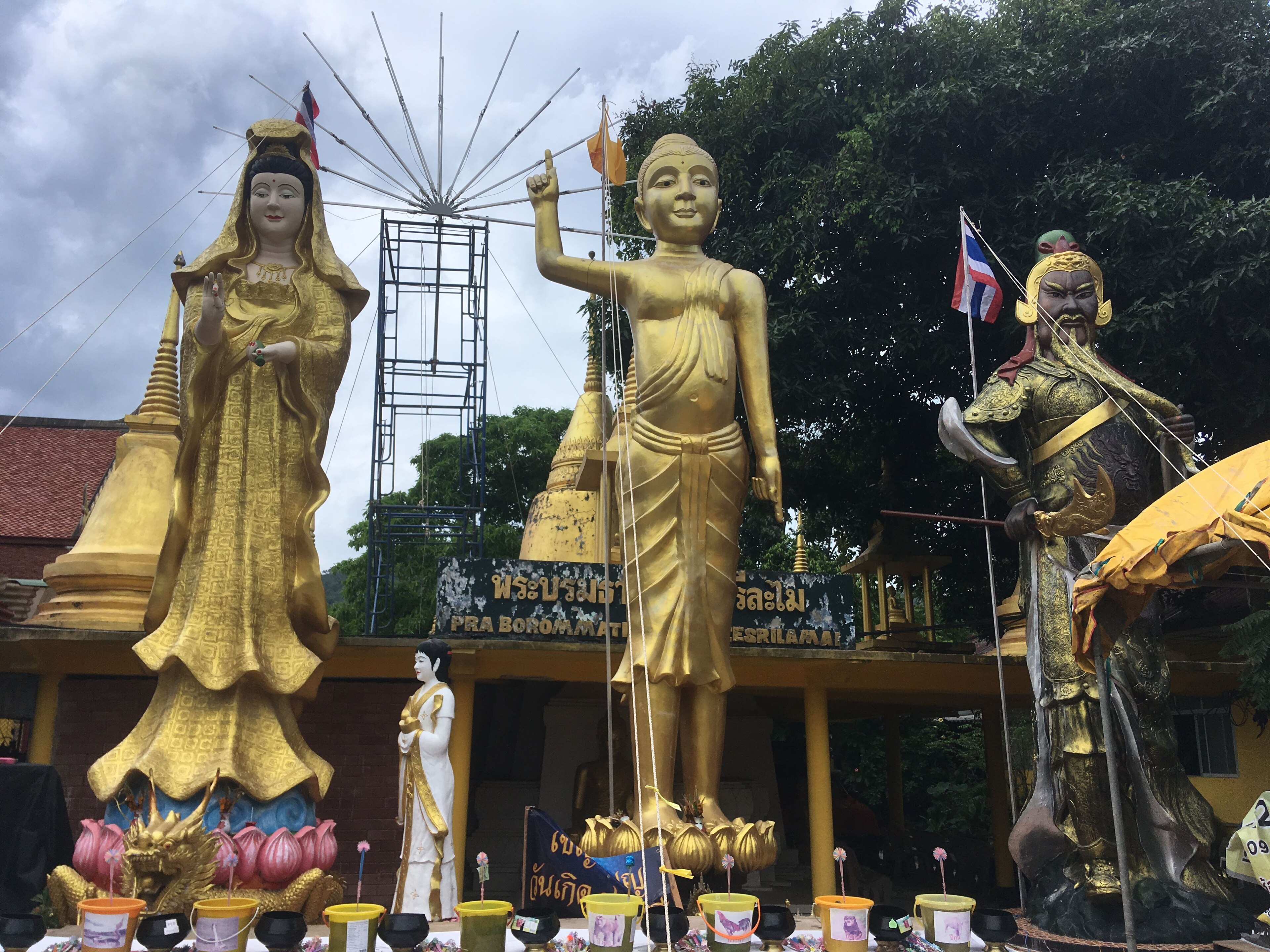

Choose Dusit Dhewa if visual culture is the point
You want to spend your time looking closely at architecture, carved forms, statues, ornamental details and the way several Southeast Asian visual traditions have been combined in one landscaped setting. This is the stronger choice when the centre itself — not “learning some Samui history” in a generic sense — is what interests you.
Choose Wat Lamai if you want Samui to make more sense
You want to understand ordinary island life through objects: household equipment, ceramics, lamps, woven items, tools and the material culture of coconut-growing communities. The museum is less about spectacle and more about giving texture to the island beyond beaches and resorts.
The easiest mistake is to call both places “cultural attractions” and assume they are interchangeable. They are not. Dusit Dhewa is a visual arts and architectural environment in Lipa Noi. Wat Lamai Folklore Museum is a small local-history collection inside Wat Lamai. If your itinerary already contains famous temples, viewpoints and beach scenery, the question is not which place looks more impressive. It is which missing layer of the island you actually want to add.
Dusit Dhewa vs Wat Lamai: the real difference is regional art versus island life
Bangkok Airways' May 2026 Samui itinerary describes Dusit Dhewa as a Lipa Noi cultural centre where Balinese, Khmer, Burmese, Thai and Lao design and sculpture are brought together in a shaded garden setting. Museum Thailand's indexed listing similarly describes an eight-rai cultural-art centre built around Southeast Asian architectural forms, deities, stone carving and decorative traditions.
That makes Dusit Dhewa useful when you enjoy reading buildings and objects visually. You are not going there for one canonical “Samui artefact”. You are going because the centre deliberately places different Southeast Asian aesthetics beside one another and turns the grounds into the exhibition.
Wat Lamai does almost the reverse. Its collection includes traditional lamps, ceramics, woven items, bird cages, household tools and equipment connected with coconut gardens. That is a much more specific story about how people on the island lived and worked.
If you have already read our Wat Lamai Folklore Museum vs Wat Khunaram guide, the distinction is important: that comparison asks whether you want everyday island history or a Buddhist religious stop centred on Luang Pho Daeng. This guide asks something else — whether your one culture stop should be a visual Southeast Asian arts environment or a local Samui memory collection.
Wat Lamai is the better first-trip default because the story is more specifically Samui
Most travellers do not need another broad category called “culture”. They need one place that tells them something they would otherwise miss. Wat Lamai does that well because its objects are ordinary enough to be revealing. Coconut-garden tools, kitchenware, lamps and woven equipment shift the island away from the resort version of itself and back toward work, households and local material life.
That is especially useful if Lamai is already part of your route. The museum can sit beside lunch, a beach stop or another south-east-coast decision without becoming a separate cross-island project. If you are already deciding how much cultural content to add around Lamai, compare Red Temple vs Wat Khunaram rather than stacking every nearby temple and museum into one day.
It also gives you a cultural stop without requiring the preserved-body context at Wat Khunaram. If that display is not something you want to see, you do not lose anything by choosing the museum instead. A first trip becomes better when every stop has a reason, not when it has the maximum number of pins.
Dusit Dhewa wins when architecture and sculpture are the experience, not the backdrop
Choose Dusit Dhewa when you would still want to visit even if it were not a Samui attraction. That is the strongest test. If the idea of comparing Balinese, Khmer, Burmese, Thai and Lao motifs in one garden environment sounds genuinely interesting, the west-coast detour has a purpose.
The location can also make sense when you are already building a west-side day. If Nathon is in your plan, the Nathon vs Fisherman's Village guide helps decide whether a working west-coast town belongs in your trip. If sunset is the reason you are on this side of the island, use Nathon vs Lipa Noi for sunset before inventing a second west-coast transfer.
Accommodation geography matters too. A traveller based around Lipa Noi or Taling Ngam has a very different friction profile from somebody staying in Choeng Mon or Chaweng. If you are choosing a west-coast base rather than just one cultural outing, Taling Ngam vs Lipa Noi answers the accommodation question separately.
Do not leave for Dusit Dhewa without checking access first
This is the most important 2026 planning point in the whole comparison. Bangkok Airways included Dusit Dhewa in a current May 2026 Samui itinerary, which is a useful recent signal that the centre remains part of contemporary visitor planning. But the indexed Museum Thailand listing says access is for visitors who contact the centre, and lists advance reservation as available. Other current listings do not present one clean, consistent operating schedule.
Treat Dusit Dhewa as verify-before-you-go, not walk-in-assumed. Confirm that the centre is receiving visitors on your date before paying for a cross-island ride. Do not choose it because one aggregator shows a convenient opening time and assume that time is definitive.
That access uncertainty is one reason Wat Lamai wins the general first-trip recommendation. The subject is more specifically local, and the route can be easier if Lamai is already in your day. But opening details for small local museums can also change, so verify access before relying on it to fill a narrow gap before a transfer or dinner reservation.
Use your hotel geography as a filter, not as an excuse to over-plan
Staying west
Lipa Noi, Nathon or Taling Ngam makes Dusit Dhewa much easier to justify. Add it only if you have confirmed access and the visual-culture brief still excites you.
Staying east or south-east
Lamai makes Wat Lamai Museum the more efficient cultural layer. You can keep the day compact and still have time for a meal, beach or another nearby stop.
Staying north-east
Neither is automatically worth a special cross-island journey. First ask whether your existing north-east cultural stops already cover what you want. Big Buddha vs Wat Plai Laem solves that more local decision.
If a culture day starts turning into a chain of point-to-point rides, compare a private driver vs individual taxis. Hire a private driver when you plan enough dispersed stops to justify one continuous route.
For women travelling solo: make the return leg boring
The practical difference is transport predictability, not a made-up safety ranking between the two cultural sites. Dusit Dhewa sits in the Lipa Noi orbit, so if you are going specifically for the centre, confirm access and your return ride before you arrive. Wat Lamai is easier to fold into a more populated Lamai day, but it is still inside a temple/community setting rather than a purpose-built tourist mall.
At Wat Lamai, dress conservatively enough for temple grounds, follow shoe rules where posted and avoid photographing worshippers or local people at close range without permission. At either place, keep your phone charged and know your next pickup point before late afternoon. Thailand Tourist Police currently lists 1155 as the traveller-assistance hotline.
What not to combine just because it is nearby on a map
Do not turn a culture stop into a collection exercise. If you choose Wat Lamai Museum, you do not automatically need Wat Khunaram, Red Temple and every Lamai-area landmark on the same afternoon. If you choose Dusit Dhewa, you do not automatically need Nathon, Lipa Noi sunset and every west-coast shrine in one sweep.
The same principle is behind our Nathon Hainan Shrine worth-it guide: a small cultural stop earns its place when it deepens a route you already value, not when it creates an hour of transport for five minutes of context. And if your trip is already overloaded, use the one resort vs split stay logic as a reminder that reducing transitions is often more valuable than adding one more attraction.
The simplest decision test
Choose Dusit Dhewa if you can answer “yes” to all three: I have confirmed access; I am genuinely interested in Southeast Asian architecture and sculpture; and Lipa Noi fits my route without forcing a major detour.
Choose Wat Lamai Folklore Museum if you want a quieter, more specifically Samui story about household life and coconut-era material culture, especially when Lamai is already in your day.
Choose neither if you are only trying to fill a blank space. Samui already has enough culture, beaches and viewpoints that you do not need to manufacture an obligation. The Tourism Authority of Thailand itself notes that the island has more activities than one trip can realistically cover.
Final call: local memory beats visual spectacle for most first trips
Wat Lamai Folklore Museum is the better default for a first visit because it explains Samui through the ordinary objects of island life. Dusit Dhewa is the more distinctive choice for travellers who specifically want a garden-scale survey of Southeast Asian architecture and sculpture — but its access needs to be confirmed before you commit to Lipa Noi.
Keep the rest of the trip coherent through the Koh Samui Experiences hub or return to the Koh Samui destination guide before adding another cross-island stop.