
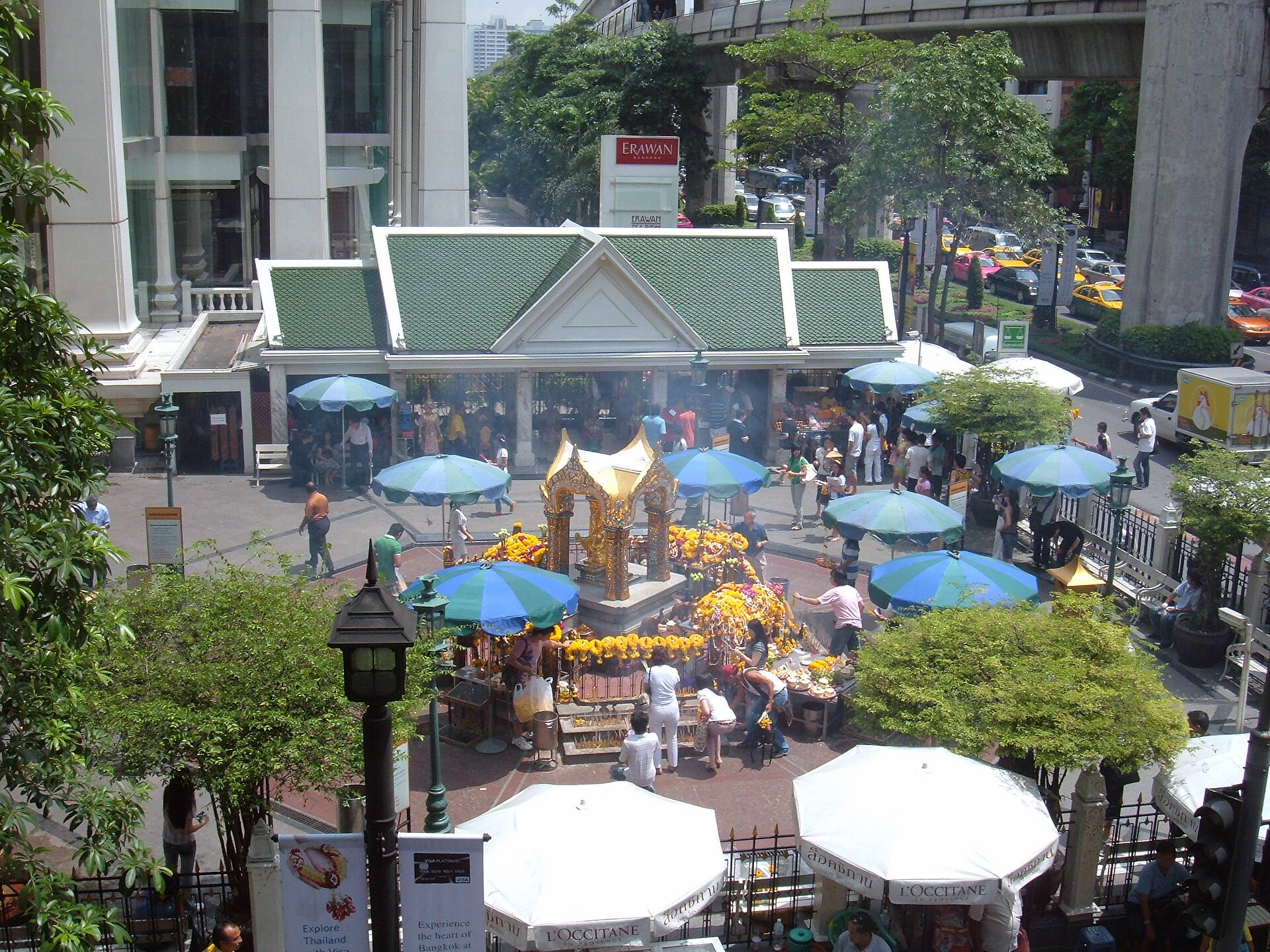

Erawan Shrine gives you a famous four-faced Brahma shrine, active worship and a very visible contrast between devotion and modern Ratchaprasong. Trimurti works better when the meaning of the shrine itself — rather than simply “seeing a Bangkok shrine” — is what draws you there.
The two shrines sit in the same broad central-Bangkok orbit, which makes them easy to lump together as interchangeable “lucky shrines.” They are not. They represent different deities, attract different devotional habits and create different kinds of travel moments. The useful decision is not which one is more powerful. It is which religious and cultural context you actually want to understand.
This is also why I would not build a first trip around shrine-counting. If your hotel decision is still open, solve the geography first. Our Siam vs Chit Lom guide explains why Chit Lom is the cleaner base for Ratchaprasong, while Ratchadamri vs Chit Lom is the better comparison when you want central luxury convenience without treating every shopping district as the same place.
Erawan Shrine
Choose it for a more established Bangkok landmark, a compact devotional stop with visible ritual activity, and a stronger “this is Ratchaprasong” sense of place.
Trimurti Shrine
Choose it when the shrine's contemporary prayer culture, love-related reputation or CentralWorld setting is specifically what you want to experience.
First: Erawan Shrine is a Brahma shrine, not a “four-faced Buddha”
This is one of the most common shorthand mistakes in travel content. Tourism Authority of Thailand identifies the Erawan Shrine as the Thao Maha Phrom shrine, a four-faced image of Brahma. TAT's current spiritual-places guide describes worship moving around the four faces clockwise, with different faces associated in popular devotion with different areas of life.
You do not need to copy a ritual you do not understand. It is perfectly appropriate to visit quietly, watch how local worshippers move through the shrine and avoid blocking people who are praying. The traditional dancers you may see are part of the shrine's living devotional culture, not a scheduled tourist show that every visitor is guaranteed to catch.
TAT currently lists Erawan Shrine as open daily from 06:00 to 22:30. Treat that as current published information rather than a permanent promise; major events, maintenance or security arrangements can change access. If the shrine is one small piece of a central day, pair the timing with your wider plan rather than making the whole itinerary bend around an arbitrary “best hour.”
Why Erawan wins for most first trips
Erawan works even if you are not arriving with a specific prayer request. Its value is the combination of belief, incense, offerings, dancers, traffic, malls and office towers compressed into one small Ratchaprasong corner. That contrast tells you something about contemporary Bangkok that a checklist of monuments does not.
Trimurti Shrine is more specific — and that is its advantage
TAT describes Phra Trimurti at CentralWorld as a combined divine form associated with Brahma, Shiva and Vishnu. In contemporary Bangkok popular devotion, the shrine is especially famous for wishes around love, although TAT's own guide frames requests more broadly around success, prosperity, career, finance, health, luck and relationships.
That distinction matters. If you are going because you saw a social-media post calling it “Bangkok's love shrine,” do not reduce the stop to a novelty photo or treat belief as an Instagram prop. The more respectful version is simple: understand what people are praying for, give worshippers space and decide whether you actually want to participate.
TAT's current guide lists the Trimurti shrine as accessible 24 hours and notes that Thursday at 09:30 and 21:30 are commonly chosen prayer times. That describes current devotional practice; each visitor assigns personal meaning to it. If you are not going specifically to join that atmosphere, there is no editorial reason to force your Bangkok day around 21:30.
CentralWorld itself remains a major Ratchaprasong anchor, so Trimurti is especially easy to justify when shopping, dinner or a central evening is already on the plan. If your base decision sits farther east, Chit Lom vs Phrom Phong shows why “both are central” is not the same as having the same evening geography.
Three Bangkok day shapes make the choice easier
You are already doing Siam and Ratchaprasong
Erawan Shrine first. It is the stronger standalone cultural stop. If you still have energy and Trimurti genuinely interests you, add it without pretending the two visits are duplicates.
Your evening is built around CentralWorld
Trimurti becomes much more logical. The shrine fits the route without creating a separate attraction block, particularly if the devotional culture is part of why you chose the area.
You have only three full Bangkok days
Do not overbuild this. Protect your bigger city layers first. Our Bangkok first-full-day guide is a more important decision than squeezing two nearby shrines into a tight schedule.
If you are not religious, should you visit either shrine?
Yes, if your interest is cultural rather than performative. Ratchaprasong's shrines are a clear example of how Hindu deities, Thai ritual practice, shopping districts and everyday urban life overlap in modern Bangkok. TAT has previously promoted a Ratchaprasong shrine-and-culture walk that included both Erawan and Trimurti among a wider group of Hindu shrines in the district.
But “cultural interest” is not a licence to treat active worship as theatre. Do not stand directly in front of someone praying for a photo, move offerings, interrupt dancers or imitate rituals simply because a short-form video told you what to do. If you want a deeper indoor culture block instead, BACC vs Jim Thompson House or Bangkok National Museum vs Museum Siam may add more to your trip than another symbolic stop.
A better way to think about “wish-making”
Visit because the practice interests you. Religious belief is not a conversion funnel. If you choose to make an offering, follow the shrine's current on-site guidance and observe what worshippers are doing rather than improvising a ritual from outdated online instructions.
Erawan is usually the better route fit before dinner; Trimurti is easier to fold into shopping
Both shrines sit inside one of Bangkok's busiest central shopping and hotel districts. BTS's current route planner remains the right source for live network planning, and Chit Lom is the practical rail anchor most visitors will use for Ratchaprasong. I would not publish a fixed “walk exactly X minutes” claim here because crossings, skywalk choices, construction and mall entrances change how the route feels.
If your evening priority is food rather than devotion, let that decision lead instead. Banthat Thong vs Yaowarat compares two very different food-night formats. If you need a green reset before a central evening, Benjakitti vs Lumphini is a cleaner use of spare daylight than accumulating another shrine simply because it is nearby.
Thursday night at Trimurti: worth planning around?
Only if that atmosphere is specifically part of the experience you want. TAT currently notes Thursday 21:30 as a popular prayer time. That can mean a more concentrated devotional atmosphere, but it also means you are deliberately using a later evening window for one shrine.
If you are travelling solo, already tired or carrying shopping, there is nothing inferior about visiting earlier. Bangkok rewards coherent evenings more than symbolic “perfect times.” The same logic applies to Pak Khlong Talat at night vs before dawn: the most intense local window is not automatically the best window for every first-time visitor.
For women travelling alone: keep the spiritual stop easy to exit
Both shrines are in busy central Bangkok rather than isolated temple grounds, but late-evening plans still deserve a simple exit strategy. Keep your bag closed in crowds, do not leave a phone or wallet loose while handling flowers or incense, and if you visit Trimurti late, know how you are getting back before you settle into a long prayer or shopping block.
If anything feels wrong, Thailand Tourist Police currently lists 1155 as its traveller-assistance hotline. If you want a central hotel base that reduces late-evening friction, compare Siam vs Chit Lom before optimising individual attractions.
Should you simply visit both?
You can. They are part of the same broader Ratchaprasong shrine landscape, and TAT has historically presented the district as a shrine-and-culture walk. The question is whether doing both adds understanding or just ticks two nearby pins.
If you are interested in Bangkok's living religious geography, visiting both can be useful precisely because they feel different. If you are shrine-neutral and your schedule is dense, Erawan alone is enough to understand the central idea. Save the remaining time for a neighbourhood, museum or food experience that changes the texture of the day.
Is Erawan Shrine a Buddhist temple?
No. TAT identifies it as a shrine to Thao Maha Phrom, the four-faced Brahma. It exists within Bangkok's wider religious culture, but it is not a Buddhist temple in the same sense as Wat Pho or Wat Suthat.
Is Trimurti Shrine only for love prayers?
No. TAT notes its strong popular association with love, but its current guide also describes prayers connected with success, prosperity, career, finance, health and luck.
Do I need to buy an offering?
No. A respectful visit does not require a purchase. If you want to participate, use current on-site guidance rather than relying on a ritual list copied from an old blog.
Which shrine is better at night?
Trimurti has a well-known late-evening prayer culture, especially on Thursdays, while Erawan remains active into the evening. Choose by the atmosphere and route you actually want rather than assuming night automatically makes either shrine better.
My pick for a first Bangkok trip
Erawan Shrine. It is the more complete single stop: famous without needing hype, culturally legible even if you are only observing, and easy to fold into a Chit Lom/Ratchaprasong day. Choose Trimurti instead when you are interested in its devotional culture.
Then move on. Bangkok has much more to offer than central-shrine collecting. Browse the Bangkok Experiences hub or return to the Bangkok destination guide for the next decision.
Sources checked
Tourism Authority of Thailand, “Spiritual places to visit for blessing in 2025” — current Erawan and Trimurti deity descriptions, worship context, published hours and Thursday Trimurti prayer-time note.
Tourism Authority of Thailand, Erawan Shrine official attraction listing and Bangkok destination pages — current attraction status and Bangkok visitor context.
TAT Newsroom, Ratchaprasong Shrine and Culture Walk — district-level shrine context and the modern Ratchaprasong shrine network.
BTS Skytrain official Routes and Fares — current rail-planning source for the central Bangkok approach.
Thailand Tourist Police — current 1155 traveller-assistance hotline.