
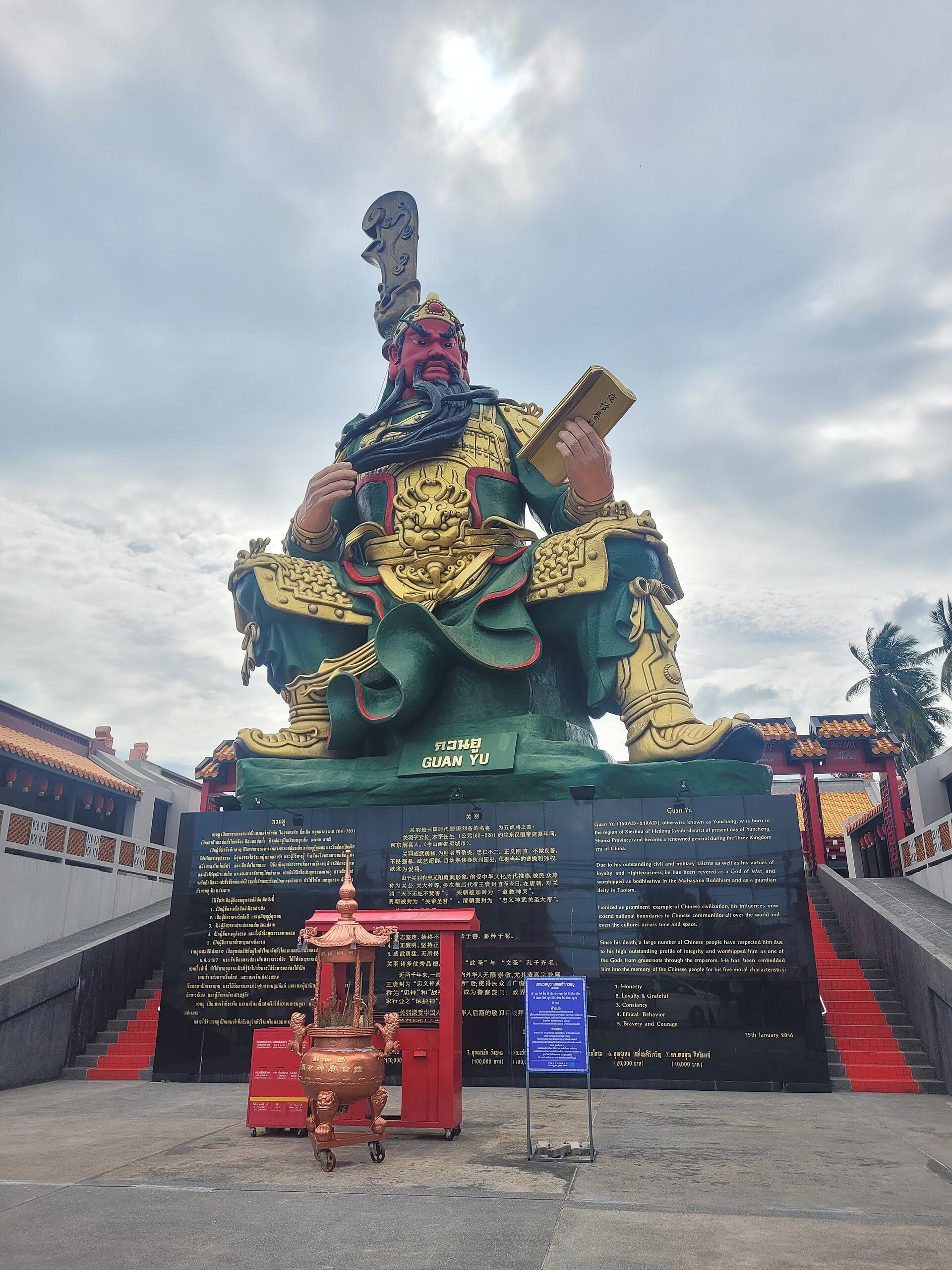

Guan Yu: witness a community landmark
The 16-metre Guan Yu figure makes the stop instantly legible, but the more useful reason to visit is the Hainanese-Chinese story behind it. Tourism Authority of Thailand material links the shrine to Hainanese Chinese migration, while Koh Samui Municipality treats it as a long-standing community landmark in the Na Khai–Hua Thanon area.
Fish Market: witness a working system
The Tourism Association of Koh Samui describes Hua Thanon Fish Market as part of a traditional Muslim fishing village. Koh Samui Municipality adds the missing supply-chain detail: local fishing boats return in the early morning and seafood is sent to the Hua Thanon fresh market.
If your real cultural choice is between Buddhist architecture and Chinese-Hainanese community history, use Red Temple vs Guan Yu Shrine. If the market is already your preferred format and you are deciding between a working daytime market and an evening food market, use Hua Thanon Fish Market vs Nathon Night Market. This page assumes you have only one short Hua Thanon stop and asks what deserves those minutes.
Run the 25-minute test
The market has a stronger clock than the shrine
Koh Samui Municipality says Hua Thanon fishers traditionally head out around 22:00 and return roughly 04:00–08:00, with seafood then sent to the fresh market. Visit Samui likewise highlights the fresh catch of the day. That is a strong clue about when the market has the most meaning: earlier in the day is usually a better fit than treating it like an all-day tourist attraction.
I would not build the decision around one immutable market opening time. Current directories publish broad daytime hours, but a working market's stock and energy can change well before a listed closing time. If you can only arrive late afternoon, Guan Yu is usually the safer use of a short stop.
These two places belong to different local stories
Hua Thanon is not culturally singular. The wider area includes both a long-established Muslim fishing community and the Hainanese-Chinese history represented by Guan Yu Shrine. That is exactly why this comparison works: you are not choosing “local” versus “touristy.” You are choosing two different local institutions with different jobs.
If your itinerary is already temple-heavy, Guan Yu can still add useful contrast because it is not another Buddhist temple. That logic is explored more directly in Laem Sor Pagoda vs Guan Yu Shrine. For the larger one-day balance between religious landmarks and the south coast, use temples vs south-island nature.
The exact places look different for a reason
Do not turn either place into an “authenticity” performance
At Guan Yu Shrine: it is a place of worship and community significance. Dress and behave respectfully, keep voices low around worshippers and follow any on-site instructions for incense, shoes or restricted areas rather than inventing rules from a different religious site.
At the fish market: it is a workplace. Stay out of the way of vendors carrying crates or handling seafood, ask before taking close portraits, and do not block a transaction to get a photograph. You do not have to buy raw fish to prove that the visit was worthwhile.
The fish market is not a food tour and not a dinner market
This is the easiest expectation mistake. Hua Thanon Fish Market is strongest as an ingredient-and-community stop. If what you actually want is to eat multiple prepared dishes with context, a guided food tour or Nathon Night Market is a cleaner decision. If you are comparing an organised sightseeing loop with a food-first experience, use market tour vs food tour.
Do not downgrade the market because it does not entertain you like a night market. Its job is different. Equally, do not upgrade it just because “working market” sounds more authentic. A place only has value when you are genuinely interested in what it does.
Choose the stop that fits the route you already have
Lamai + Red Temple day
Guan Yu usually adds the sharper next chapter. You can compare Buddhist terracotta architecture with Hainanese-Chinese community history without pretending they are the same kind of sacred site.
Use Red Temple vs Laem Sor if your route is stretching farther south.
Food + south-coast day
The fish market can make more sense. It gives ingredient context before a cooking, coconut or market-focused day, especially if you are there while the working market is active.
One short stop from Chaweng/Bophut
Choose only if the stop has a job. Do not cross the island merely to collect a pin. A private driver or taxi plan should follow the route, not create it.
For solo women, the friction is ordinary but different
Guan Yu Shrine
Keep shoulders and clothing comfortably respectful without assuming Buddhist-temple rules automatically apply to a Chinese shrine. Keep valuables on you rather than setting a bag down for photographs. The larger practical issue is transport: if this is one isolated south-side stop, pin the pickup point before you finish.
Hua Thanon Fish Market
Wear footwear with grip, keep long hems away from wet floors, use a small hands-free bag and expect seafood smells. If close photography feels intrusive, skip it. The visit still works as observation. Earlier daylight also makes the stop easier to fold into a south-island route.
If this is your first few hours on Samui and you are tired from airport or ferry travel, do not force either stop simply because it is nearby on a map. The arrival-day activity vs flexible-plan decision is more important.
Who should choose which?
The shortest answer
Choose Guan Yu Shrine when you want one clear cultural story you can understand in a short stop. Choose Hua Thanon Fish Market when you specifically want to watch a working local food system. The shrine is the better default; the market is the better specialist choice.
Current source checks
Independent visiting is the better fit.
TAT · Guan Yu Shrine contextKoh Samui Municipality · Guan YuVisit Samui · Hua Thanon Fish MarketKoh Samui Municipality · Hua Thanon villageFor more local-decision guides, browse the Experiences hub or return to the Koh Samui destination hub.
Sources checked
Sources checked 15 August 2026: Tourism Authority of Thailand current Koh Samui highlights material for Guan Yu Shrine's Hainanese-Chinese context and 16-metre statue; Koh Samui Municipality exact Guan Yu Shrine and Hua Thanon Fishing Village pages for local community context, fishing rhythms and exact-location media; Tourism Association of Koh Samui / Visit Samui current Explore Samui page for Hua Thanon Fish Market identity, Muslim fishing-village context and exact official market media; current Trip.com Guan Yu attraction listings only for the opening-hours discrepancy audit.