
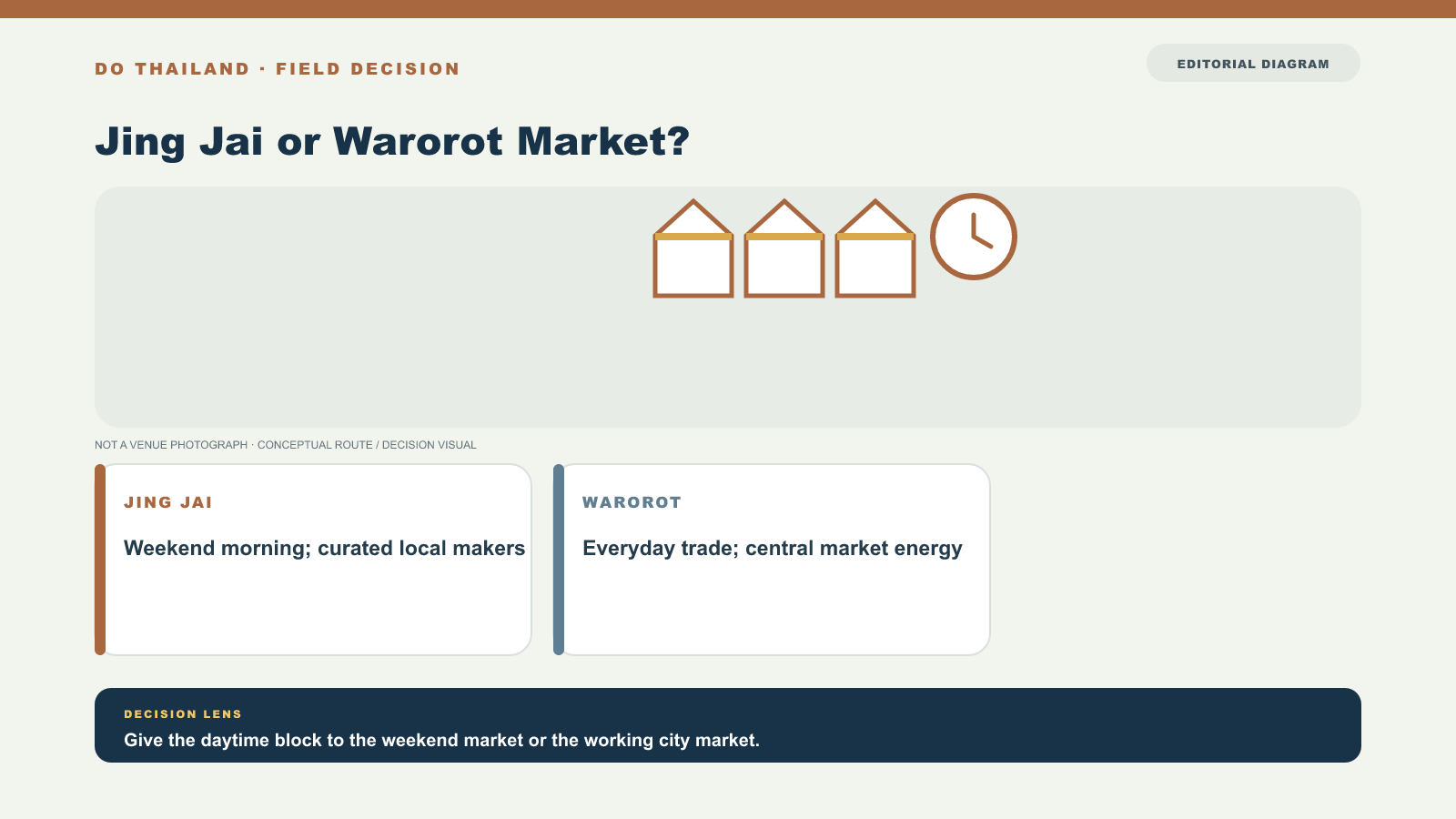
This is a daytime-market decision, not another night-market ranking. If your one market slot is after sunset, compare Sunday Walking Street vs Night Bazaar. If you are choosing between the two weekend walking streets, use Saturday Wua Lai vs Sunday Walking Street. Jing Jai and Warorot solve a different question: what kind of Chiang Mai do you want to see before the evening begins?
Start with the calendar, because Jing Jai changes character by day
Jing Jai Central itself operates beyond the weekend, but its official current market page lists the signature Jing Jai Farmers Market and handmade-craft zone on Saturday and Sunday from 06:30 to 15:00. That is the version most travelers mean when they talk about a Jing Jai market morning.
The same official site now also advertises a Wednesday morning market from 06:30 to 12:00, introduced in June 2026. Treat that as a current extra option, not proof that every weekday reproduces the full weekend farmers-and-craft mix.
If your only free market block is a normal weekday, Warorot becomes the easier default. Tourism Authority of Thailand's current Warorot listing publishes weekday-specific opening times rather than one universal daily schedule, so verify your exact day before leaving instead of copying an old “open until” time from a blog.
Pick Jing Jai for makers, produce and a softer morning
The official Jing Jai operator divides the market concept around food, art and design, and craft. Its weekend Farmers Market sells organic and safe produce from local farmers, prepared food and homemade bakery, while the handmade zone focuses on work sold by local makers and designers.
Pick Warorot for density and local-market texture
TAT describes Warorot, or Kad Luang, as a historic market central to Chiang Mai daily life. Its multi-level building mixes fresh food, clothing, traditional crafts, northern specialties and souvenir shopping across roughly 500 shops.
Decide by what you actually want to take home
Why Jing Jai wins when the weekend morning itself is the experience
Jing Jai works best when you want a morning that can expand naturally. Tourism Authority of Thailand describes Jing Jai Central as three connected zones—Village, Market and Gallery—with eateries, cafés, local ingredients, craft activity and art around the market. The operator's current page adds that the signature Saturday–Sunday market runs until 15:00, so you do not need to arrive at dawn to make the visit worthwhile.
That makes it a useful choice when a first Chiang Mai trip already has plenty of dense temple streets and evening markets. If you booked room-only because you want the city to own your mornings, Jing Jai can be one of the reasons that decision pays off. It also gives the weekend a different job from your evening plans instead of repeating another road-closure market at night.
The trade-off is that the experience is deliberately curated. If your idea of a “local market” is crates, dry goods, clothing, household shopping, strong food smells and people buying things for ordinary life, Jing Jai may feel too composed for the question you are trying to answer. That is where Warorot has the stronger case.
Why Warorot wins when you want a market that is part of the city
TAT's current official listing traces Warorot to the reign of King Rama V and notes its local name, Kad Luang. More useful for a traveler, it describes the market as an essential part of Chiang Mai residents' daily life, with fresh food, clothing, traditional crafts and northern products in a large multi-level building.
Warorot therefore rewards curiosity more than a shopping list. You can look at dried goods, compare northern snacks, notice what locals are buying, then continue through the Chang Moi and Ping River side of the city. If that east-of-the-moat geography is becoming a recurring part of your trip, compare Chang Moi vs Night Bazaar or Wat Ket vs Old City before turning one market visit into an accommodation decision.
The best market is often the one that finishes your route instead of starting a new one
Old City / Tha Phae morning: Warorot is the cleaner continuation if you want to move east toward Chang Moi and the river. If your base is still undecided, the separate Chiang Mai Gate vs Tha Phae Gate guide handles repeated location friction.
Nimman or a deliberately slow weekend morning: Jing Jai makes more sense as a destination in its own right. Do not choose it only because you saw a pretty market photo; choose it because farmers, food, crafts and design are what you want the morning to be about.
Already doing an Old City heritage morning: avoid adding a market just to fill another hour. The Old City temple timing guide explains why a focused morning works better than turning the day into an endless checklist.
Do not choose by which one looks more “authentic” online
That label creates a false contest. Jing Jai's current weekend market genuinely supports local farmers, makers and designers. Warorot genuinely functions as a historic local market with everyday commerce. They are both real parts of contemporary Chiang Mai; they simply reveal different parts of it.
Use a more useful test: if you bought nothing, which two hours would still be interesting? At Jing Jai, the answer should involve food, design, people-watching and a relaxed creative-district morning. At Warorot, it should involve market density, northern ingredients, everyday commerce and the surrounding east-side streets.
How much time should you give each?
Plan roughly 2.5–4 hours if you want breakfast, produce, crafts and a café or gallery stop. If you only want a quick look, you are probably choosing the market for the wrong reason.
Plan roughly 1.5–3 hours for the market and surrounding streets. A longer visit suits a deeper browse or a Chang Moi and riverside walk.
Only do both if the contrast genuinely interests you. A weekend Jing Jai morning and a separate Warorot/Chang Moi block can work. Two markets back-to-back simply because both are “famous” is weak itinerary design.
Where this fits in a first Chiang Mai itinerary
On a four-day trip, markets should not consume every flexible block. The four-day Chiang Mai structure works best when Old City heritage, contemporary Chiang Mai, one mountain commitment and food/market time have different jobs. If you are staying inside the moat, inside Old City vs outside the moat is a more important repeated-friction decision than saving ten minutes on one market ride.
If your afternoon later moves west, the Old City vs Nimman guide explains the bigger neighbourhood trade-off. If the day already started on Doi Suthep, use After Doi Suthep: Nimman or Old City? rather than trying to force a market into the return just because there is empty space on a map.
For women travelling solo: make the market easy to use, not dramatic
Carry a small crossbody or zipped tote you can keep in front of you in tight aisles. This is ordinary city-market planning, not a claim that one market is unsafe.
Bring small cash as a backup, but do not assume every stall uses the same payment method. Buy food only when storage and the rest of your day make sense; a bag of fresh produce is less charming after three hours in the heat.
Save your pickup point before you get tired. Warorot can spill your attention into surrounding streets; Jing Jai can turn into lunch or coffee. Know what “going back” means before another stop quietly extends the morning.
If you already have Sunday Walking Street, do you still need Jing Jai or Warorot?
Maybe—but only if the daytime market solves a different job. Sunday Walking Street is an evening pedestrian event. Jing Jai can add a farmers-and-makers morning; Warorot can add a working market and east-side city block. If all three are on your list because “Chiang Mai has markets,” cut one.
If your hotel choice is already being pulled east by markets and dinners, compare Old City vs Night Bazaar before treating one market outing as proof you should sleep there every night.
The final rule
Choose Jing Jai when your free slot is a weekend morning and food, makers, design and a curated community atmosphere are the point. Choose Warorot when you want a historic working market that exposes more of Chiang Mai's everyday commercial life.
If neither description excites you, skip the market block. Return to the Chiang Mai decision hub or browse other experience guides and give those hours a different job.