
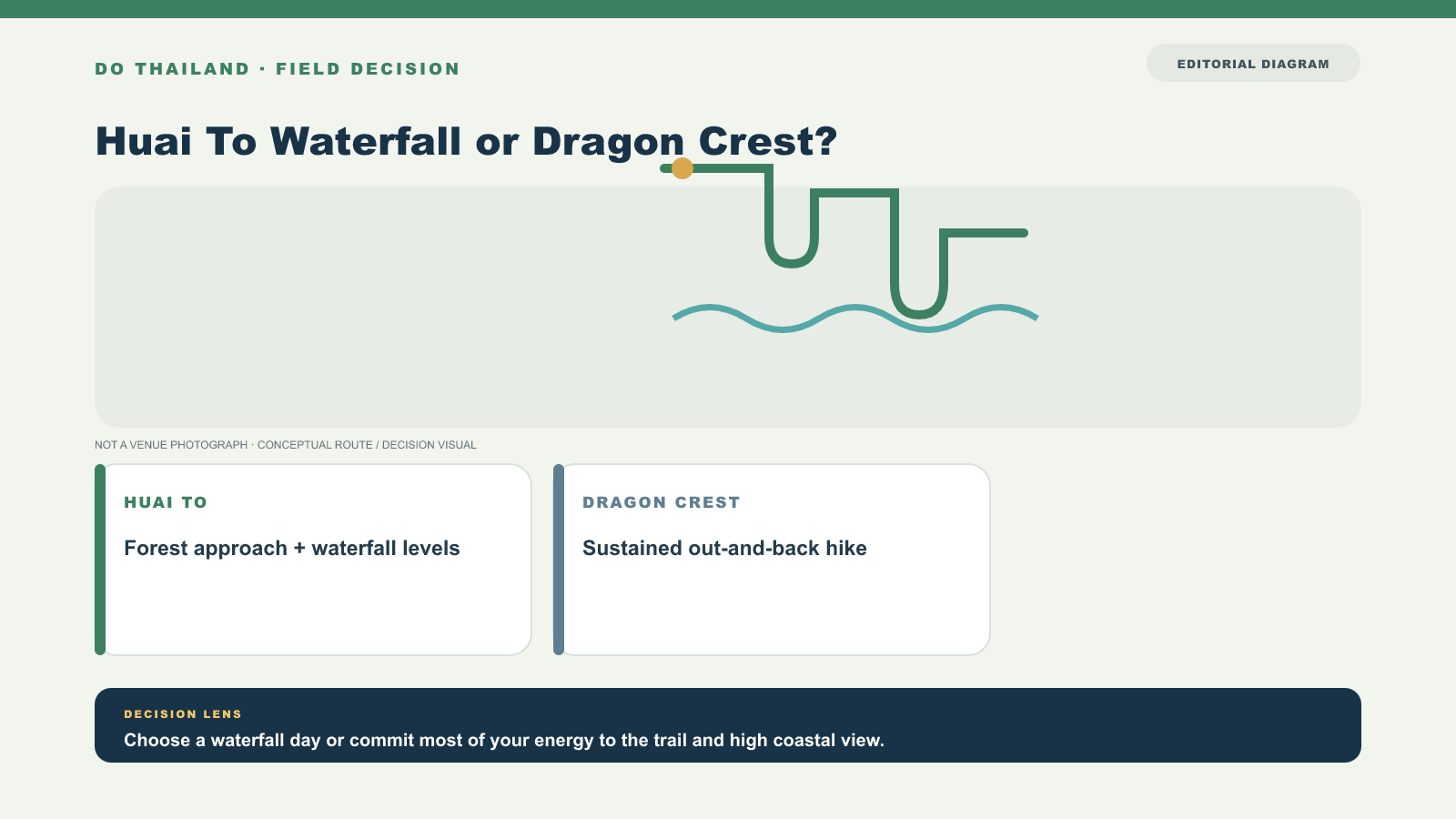
These two places are often filed under the same vague label—“Krabi nature day”—but they spend your energy in completely different ways. Huai To gives you a forest approach and a multi-level waterfall environment. Dragon Crest asks you to commit to a proper out-and-back hike before the viewpoint reward arrives.
If your real alternative is a freshwater swim rather than a summit trail, use Khao Phanom Bencha vs Emerald Pool. If the question is whether you prefer waterfall forest or a temple staircase, the separate Khao Phanom Bencha vs Tiger Cave guide solves that decision more cleanly.
You want nature without turning the day into a summit mission
The current Tourism Authority of Thailand page describes about a 15-minute forest walk before the waterfall area. The reward starts relatively early: forest, moving water and several cascade levels rather than one distant finish line.
You would enjoy the hike even before the viewpoint appears
TAT currently describes the Khao Ngon Nak nature trail as 3.7 km one way and roughly two hours one way. The hike itself is the main commitment: 3.7 km and roughly two hours each way.
The real question is how much of the day you want nature to own
Huai To is easier to justify when you want a substantial inland nature stop but still care about what happens before or after it. Dragon Crest works better when you are happy for road transfer, hiking, pauses, the viewpoint and the descent to consume the core of the day.
That distinction matters on a four- or five-day Krabi trip. A “free morning” on paper can disappear quickly once a long trail is involved. If you are still deciding how many land days deserve space beside island trips, start with the broader Krabi islands-versus-inland itinerary decision before squeezing either attraction into leftover time.
Huai To is the forest-and-waterfall choice, not the easy choice
Tourism Authority of Thailand currently lists Huai To Waterfall inside Khao Phanom Bencha National Park, with a roughly 15-minute forest approach before the cascades. Its current planning information lists visitor hours of 08:30–16:30, an entrance reference of 100 baht for adults and 50 baht for children, and about 1.5–2 hours by car from Ao Nang.
The short approach can make Huai To sound casual. That is misleading if you translate “shorter trail” into “zero friction”. Waterfall environments can mean wet rock, mud, uneven ground and clothing that stays damp on the ride back. Rain also changes the value of the day in two directions at once: stronger water can make a waterfall more dramatic, while slippery footing and park management can make access less comfortable or less sensible.
Huai To is therefore the stronger answer for travellers who want to feel surrounded by forest rather than prove they can reach a summit. It also creates a different memory from a beach day without demanding the same sustained leg load as Dragon Crest.
If your body is asking for an even lighter nature stop, compare Tha Pom vs Khao Phanom Bencha. That page separates boardwalk-style ecology from a fuller waterfall outing instead of pretending every inland attraction is equally physical.
Dragon Crest is a hike first and a viewpoint second
TAT's current Khao Ngon Nak page describes a 3.7 km nature trail to the viewpoint area, roughly two hours one way, with current published visitor hours of 08:30–17:00. It also specifically recommends proper trekking shoes or sneakers and carrying your own snacks and drinks.
Those details are the important ones. A 3.7 km one-way route means the descent is another serious part of the day. Heat, humidity and rain are not background conditions; they affect pace, footing, water needs and the margin you want before the published closing time. If you only want “one high Krabi view”, Dragon Crest may be a poor fit because the trail is too large a share of the experience to treat as transport to a photo.
It becomes a much better choice when you like the rhythm of a forest hike: the gradual climb, stops, changes in vegetation and the satisfaction of a longer ascent. If you are comparing it with another iconic hard climb rather than a waterfall day, use Dragon Crest vs Tiger Cave Temple.
August 2026: do not confuse the Khao Phanom Bencha summit closure with Huai To
Thailand's current national-park status information lists Khao Phanom Bencha National Park as open, while Kho Nang Non and Yot Khao Phanom Bencha are seasonally closed from 16 May through 30 September. The seasonal closure applies to the named trails; confirm separately whether Huai To’s visitor area is open.
Dragon Crest is a separate trail decision. The current TAT Khao Ngon Nak page publishes visitor hours, but on a rainy-season day you should still confirm the actual trail gate and conditions before committing to the drive. Thailand's 2026 national-park guidance explicitly notes that access can change with weather and park conditions.
This is also why “the boat was cancelled, so we'll hike instead” is not automatically a sound rainy-day rescue plan. Use the rainy-day island-versus-inland guide to decide whether conditions support an inland nature day at all.
Your hotel base changes which drive feels sensible
Dragon Crest is the more natural geographic pairing because Khao Ngon Nak sits on the Nong Thale side of Krabi. If you are already deciding whether that quieter coast deserves hotel nights, compare Railay vs Tubkaek rather than treating the hike as an isolated pin on the map.
Huai To fits more naturally into a road-based inland plan. If several inland days are already winning the itinerary, Klong Muang vs Krabi Town for inland days helps decide whether beach recovery or road-day positioning matters more.
Both need deliberate road planning, but a long Dragon Crest hike makes the return pickup more important. In unstable weather, the broader Ao Nang vs Krabi Town rainy-season base guide is useful before building the day around a trail.
For women travelling independently, solve the return before you start walking
Neither day is improved by finishing tired and then discovering that your return transport was only an assumption. For Dragon Crest, a late start can push the descent toward the end of the published visitor window; for Huai To, wet clothes and slippery shoes can make a long road return less pleasant than the outward journey suggested.
If you are travelling solo, prearrange or at least confirm the pickup plan and meeting point before you leave your base. Do not rely on the idea that an app car will definitely appear at an isolated trailhead when you finish. Carry enough water for Dragon Crest, keep one dry layer or small bag for waterfall gear at Huai To, and choose a turnaround time that leaves daylight and park-closing margin rather than treating the summit as mandatory.
If weather resilience is one of the reasons you chose a particular coast, the separate Ao Nang vs Klong Muang rainy-season guide shows how hotel-base flexibility changes when outdoor plans fail.
Do not combine both simply because they are both inland
A map can tempt you into treating Huai To plus Dragon Crest as one efficient “nature day”. The problem is that the two attractions spend energy differently: Huai To asks for road time, forest footing and waterfall time, while Dragon Crest asks for a long return hike. Combining them can turn two distinct experiences into a rushed endurance exercise.
If you only have one inland day, pick the one memory you want more. If you have two inland days, separate them with a lower-effort evening or a recovery day rather than treating land days as automatically easier than island days.
Three trip shapes that make the answer obvious
Active couple staying in Tubkaek for three nights: Dragon Crest is the cleaner fit if both travellers genuinely like hiking and the weather window is good. The trail can become the purpose of a quiet-coast morning rather than a transfer-heavy excursion.
Solo traveller based in Krabi Town with one inland nature day: Huai To is usually easier to justify if the objective is forest and water rather than a long ridge challenge. It leaves more physical margin for the rest of the trip.
Boat-heavy Ao Nang trip with sore legs: neither attraction needs to be forced. Huai To is the less sustained hiking commitment, but if rain is heavy or footing is poor, a road/town day may be smarter than converting marine disappointment into another outdoor risk.
FAQ
Is Dragon Crest harder than Huai To Waterfall?
For most travellers, yes in sustained hiking commitment. TAT currently describes Dragon Crest as a 3.7 km one-way trail taking roughly two hours one way, while Huai To's published forest approach is roughly 15 minutes. Huai To can still involve wet, uneven terrain and should not be treated as obstacle-free.
Can I do Dragon Crest and Huai To Waterfall in one day?
It may be physically possible with private transport and an early start, but it is usually a poor decision for a leisure trip. Dragon Crest already deserves a large hiking block, and Huai To is more enjoyable when you are not watching the clock.
Which is better in rainy season?
Neither is automatically the rainy-season winner. Waterfall flow can be attractive, but wet ground can become slippery; a long ridge trail also carries more exposure and return-time risk. Check current park/trail conditions on the day rather than using “inland” as a synonym for weather-proof.
Which one is better if I am staying in Klong Muang or Tubkaek?
Dragon Crest is geographically the more natural pairing with the Nong Thale/Tubkaek side of Krabi. That does not override fitness or weather: choose it only if the hike itself is wanted.
Which one gives the stronger first-time Krabi memory?
There is no universal winner. Dragon Crest gives the more committed high-viewpoint hike; Huai To gives a forest-and-waterfall environment that contrasts cleanly with Krabi's coast. The better first-time memory is the one whose effort pattern matches your trip.
Check the official attraction information before leaving
Published hours and park conditions can change, particularly during rainy months.
Check Huai To official information Check Dragon Crest official informationThe dividing line
Pick Huai To when you want forest and moving water without making a long summit hike the day's central contract. Pick Dragon Crest when a sustained hike is exactly what you want and the viewpoint is the reward, not the only reason you tolerated the trail.