
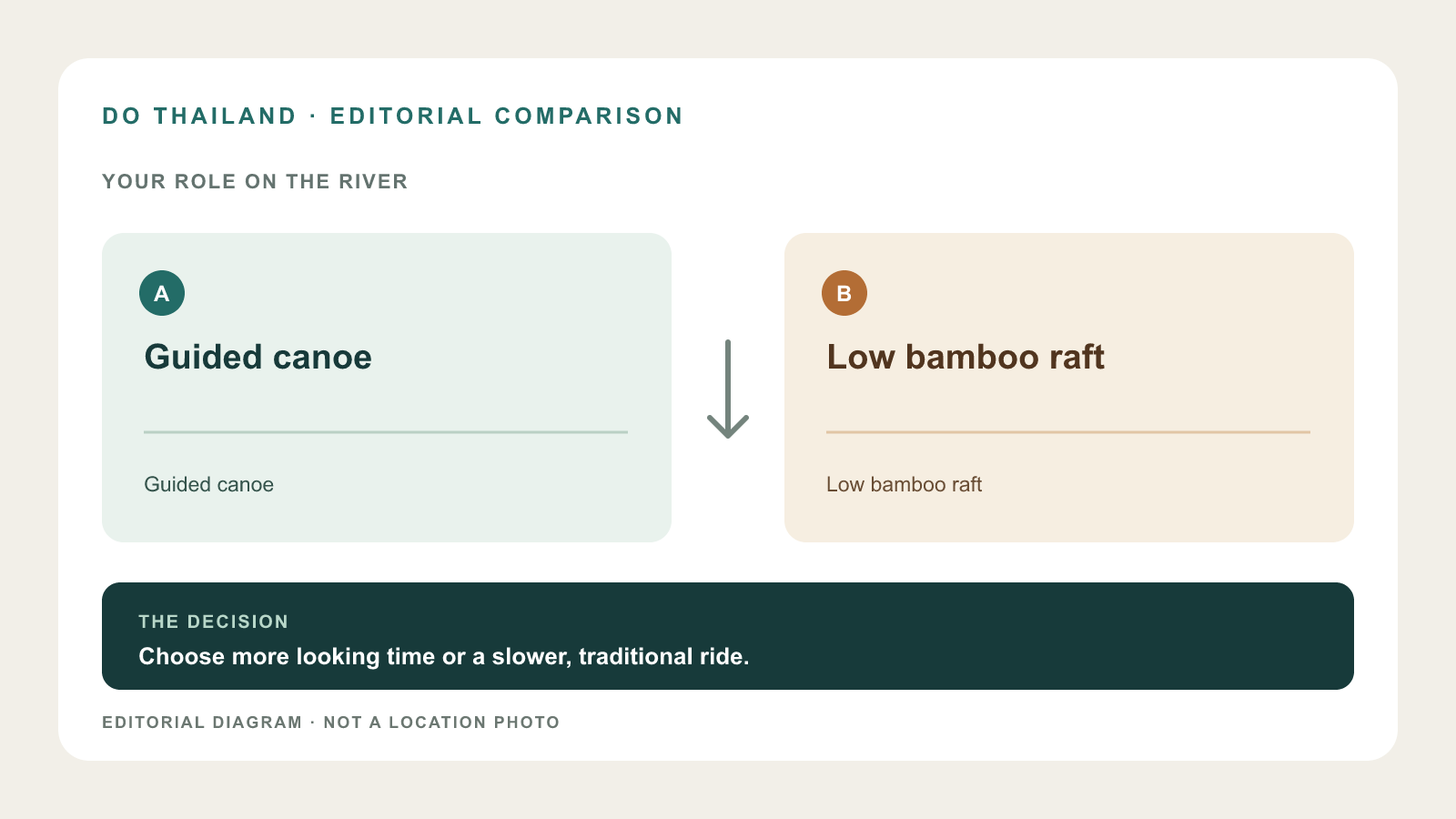
Both are guided river experiences on Khlong Sok. The canoe removes more work from you. Bamboo rafting makes the craft, the low-to-water movement and the local ritual a larger part of the experience. If you are choosing by Instagram aesthetics alone, you are solving the wrong problem.
Canoe
Better when you want to look rather than manage the boat, when a compact river block must fit around transfers, or when wet footwear and balance are annoyances rather than part of the fun.
Bamboo raft
Better when the hand-built raft, local captain, low river perspective and a slower traditional rhythm are specifically what you want to remember.
What are you actually paying the river experience to do?
Khlong Sok is one of the rare places where the same rainforest-and-limestone corridor is sold through several movement formats. Tourism Authority of Thailand currently lists bamboo rafting, tubing and canoeing in Khlong Sok, with multiple private operators serving visitors. That means the scenery is not the differentiator by itself. The useful decision is which format makes the river easiest — or most interesting — for your body and your itinerary.
Canoe buys you less work — and more looking time
One current Khao Sok operator example, Our Jungle Camp, describes its river canoe experience as a guided trip where the guide paddles while guests watch the riverbank and surrounding forest. Its current package material puts a canoe block at about two hours. Treat that as an operator example, not a universal timetable: Tourism Authority of Thailand notes that multiple private operators work this river, so pickup, duration, stops and inclusions can differ.
That is why canoeing is the cleaner default for a first visit. If you arrived from Khao Lak, Phuket or Krabi and still have a bag, transfer clock or dinner plan in your head, removing the boat-handling task has value. You can watch the banks, take in the cliffs and let the guide manage the line.
For two friends, canoeing also reduces the “one person wanted adventure, one person did not” problem. You still get a river experience without requiring both travelers to be equally excited about balance, technique or wet-foot logistics.
Bamboo rafting is worth it when the raft is the memory
Bamboo rafting is not simply the canoe with a more photogenic floor. Tourism Authority of Thailand currently describes a Khlong Sok bamboo-raft route of roughly three kilometres, commonly carrying two guests plus a local guide, with actual duration changing with stops. A current Our Jungle Camp product describes a slow-paced raft, a local captain, a cave stop with coffee prepared in bamboo cups, and sometimes the chance to try punting the raft near the end.
with bamboo rafting, the transportation method itself contributes more of the experience. If the hand-built raft, low river position and local ritual sound like the reason you want to go, the raft earns its place. If those details sound like extra friction between you and the scenery, choose the canoe.
Bring the right expectations. A current operator tells guests to bring swimwear, a camera and water shoes. That does not mean every operator follows the same route or stop pattern, but it is a useful reminder that this is a river activity, not a dry sightseeing vehicle.
Three moments change the answer more than the brochure
1. You have an arrival or transfer day
Choose the format that leaves the least uncertainty. A guide-paddled canoe usually makes the cleaner compact block. If your day already contains a van from Surat Thani, a move from the Andaman coast or a next-day Cheow Lan handoff, you do not need to turn the river into another logistical project.
This is where your accommodation plan matters. If Khlong Sok is only a staging night, start with one night or two in Khao Sok Village. If you are still deciding whether the land-side base or the reservoir should own more of the trip, use Khao Sok Village vs Cheow Lan Lake first.
2. You care about footwear, balance or keeping gear simple
Canoe is the practical winner. A phone, small camera, sunscreen and a wet bag are already enough things to think about in tropical humidity. Bamboo rafting makes sense when stepping onto a low raft and being closer to the water feels like part of the experience rather than a nuisance.
3. The river or weather changes the operating plan
River current, recent rain and local conditions can change timing, route and whether a product runs as planned. Do not convert one operator’s current duration or stop list into a guarantee for every date. Ask what is actually operating on your day.
Do not let a lake day choose your river activity for you
Cheow Lan Lake is a different product. The lake is about longtail-boat movement, limestone views and — depending on your plan — floating accommodation, cave or trail stops. Khlong Sok river time is land-side and much smaller in scale. If you are deciding whether the lake should be a day trip or an overnight, solve that separately in Cheow Lan Lake day trip vs overnight.
A useful Khao Sok sequence is: decide where the trip is based, decide how many Khlong Sok nights you actually need, then choose the river format that fits the remaining land-side block. If your accommodation itself is part of the rainforest experience, the Our Jungle House decision guide is a separate hotel question, not evidence that you should buy one of its activities.
For a solo traveler, minimum numbers matter more than the format
At least one current Khao Sok operator publishes a minimum of two people for its bamboo-rafting product, and package conditions can differ across operators. If you are traveling solo, ask whether you can join another booking, pay a private minimum, or choose a scheduled departure. Do that before falling in love with the format.
For two friends, ask one practical question: does either person actively dislike the more hands-on river setup? If yes, canoe. The trip is too short to spend it negotiating with the person sitting next to you.
Ask these eight questions before paying
- Is the product definitely canoeing or bamboo rafting? Do not book from a generic “river adventure” label.
- Who controls the craft? Confirm whether the guide paddles or steers throughout, and whether guest participation is optional.
- What is the actual duration on your date? Separate river time from hotel pickup and transfer time.
- What is the minimum group size? This is especially important for solo travelers.
- How wet should you expect to get? Ask about footwear, swimming stops and dry-bag availability.
- What stops are actually included? Cave, coffee, swim or wildlife-scanning descriptions should match the exact operator product you are buying.
- What happens after heavy rain or unsafe river conditions? Check rescheduling and cancellation terms.
- Which fees are separate? Confirm park fees, transfers and any activity-specific extras instead of assuming the headline price includes everything.
The final rule
Choose canoe when you want the river to disappear beneath the scenery. Choose bamboo rafting when you want the way you move down the river to be part of the story.
Neither is universally “more authentic,” and neither guarantees more wildlife. The better purchase is the one that removes the inconvenience you do not want while preserving the part of Khlong Sok you actually came to experience.
Keep the Khao Sok decision chain moving
Khao Sok Experience Decisions → Khao Sok Stay Decisions → Khao Sok destination hub.
Then close the remaining logistics with Thailand transport guides and, if you need connectivity for pickups and driver messages, Thailand eSIM vs airport SIM.