
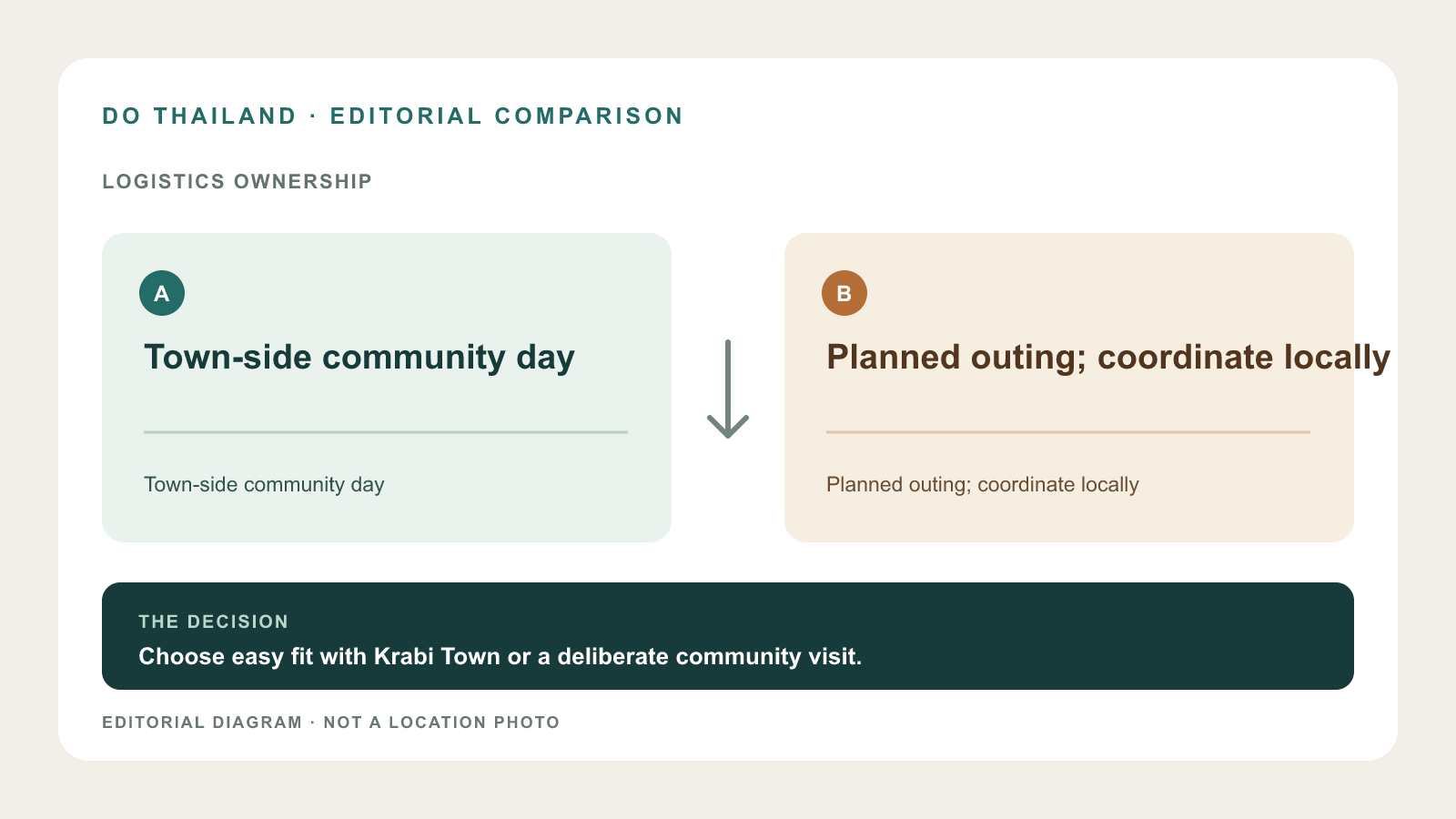
This is not “which village has more things to do?” Both are genuine community-tourism destinations. The useful decision is how much logistical attention you want the community day to own. Ko Klang fits naturally into Krabi Town geography. Laem Sak is better treated as a deliberate community outing whose activities can depend on local coordination and tide conditions.
Start with the day around the community, not the attraction list
If you are already staying in or deliberately visiting Krabi Town, Ko Klang has unusually clean geography. Tourism Authority of Thailand currently places Ko Klang in the same one-day town-side route as Khao Khanap Nam and Krabi Walking Street, and its 2025 Ko Klang feature describes access by long-tail boat from the Krabi Town side. That does not mean you should rush through all three stops. It does mean Ko Klang can sit inside a coherent day without creating a second transport story.
That matters on a short trip. If you have not yet decided whether the town side deserves any time at all, use our Krabi Town half-day from Ao Nang guide first. If you already know the answer is yes, Krabi Town morning vs evening helps place the urban part around the community visit.
Laem Sak asks a different question: are you willing to make the community itself the purpose of the outing? TAT's community material describes Hua Thong boat cruising, fishing-related activities, sea-grape cultivation, ancient cave paintings, local orchids, batik and Baba-Yaya cultural elements. That is a richer menu than you should try to compress into a spare two-hour gap. The value comes from choosing the parts you care about and giving the local programme room to work.
Ko Klang day shape
Krabi Town → river crossing → community activities / lunch → return to town → optional market or riverside evening
Best when you want local culture to deepen a Krabi Town day rather than replace the rest of it. The handoffs are comparatively intuitive, and you can decide how deep to go once you understand whether you prefer crafts, food, farming or a slower island stay.
Laem Sak day shape
Dedicated road transfer → community meeting point → selected cultural / coastal activities → tide-aware boat or kayaking element if arranged → planned return
Best when “three cultures by the sea” is the headline experience. Do not arrive expecting every listed activity to operate as a walk-up attraction. Community-based activities are strongest when you treat them as coordinated experiences rather than an amusement-park menu.
Choose Ko Klang when you want community life without sacrificing trip flexibility
Ko Klang is not a museum island. TAT's current material describes a Muslim community surrounded by mangroves where local activities include Sangyod rice cultivation, model long-tail-boat making, batik and natural-dye work, plus moving around the island on foot, bicycle or local transport. The appeal is cumulative: one craft demonstration is interesting, but the stronger memory is how the farming, boats, food, river and households fit together.
For a first trip, that cumulative quality is useful because you can scale the day. If you want only a substantial daytime visit, keep it as a day trip. If the quieter community rhythm is the part of Krabi you most want to understand, read Ko Klang day trip vs overnight before automatically returning to Ao Nang.
Ko Klang also works when your itinerary is already beach-heavy. Our Ko Klang vs Emerald Pool non-boat-day guide handles the bigger question: do you need human and cultural contrast, or another nature-and-water day? If two island tours and Railay are already protected, community texture often adds more variety than a third scenery-led day.
Choose Laem Sak when the three-culture story is worth a dedicated outing
Laem Sak's strongest case is specificity. TAT describes the community as a blend of Thai-Buddhist, Thai-Muslim and Thai-Chinese cultures—its “sea on three sides and three cultures” identity is expressed through everyday community life. The official community programme connects that cultural mix with food, dress, craft, fishing and the coastal landscape.
The marine setting is also part of the experience rather than merely the backdrop. TAT lists Hua Thong boat cruising, coastal-fishing activities and sea-grape cultivation, while the surrounding landscape includes unusual limestone formations and ancient cave-painting context. In other words, Laem Sak works best for a traveller who wants culture and coastal ecology in the same story.
That is why I would not choose Laem Sak simply because you saw a longer activity list online. The current 7greens guidance says kayaking timing can depend on the tide, and it frames roughly 9 a.m. to 4 p.m. as the strongest visiting window. Treat that as a cue to coordinate the day rather than as a promise that every activity is available continuously.
Let local customs guide how you visit Ko Klang
TAT explicitly notes that Ko Klang residents are Muslim and asks visitors not to bring pigs or dogs onto the island. More broadly, dress and photograph people with the same judgment you would use in a lived religious community: modest clothing is the easier default, ask before photographing individuals, and do not treat homes or workspaces as sets.
Laem Sak's tri-cultural identity means the same afternoon can move between Buddhist, Muslim and Chinese cultural contexts. Let each site set the etiquette. Shoes, clothing and photography rules can change when you move from a public waterfront or workshop into a temple, shrine, mosque or private community space.
Do not turn “local” into a race to collect demonstrations
Community tourism goes flat when every interaction becomes a five-minute checkbox. If you choose Ko Klang because you are interested in Sangyod rice, spend enough time to understand why it matters rather than photographing the field and moving on. If boat-model making or batik is the stronger interest, let that be the anchor instead.
The same rule matters even more at Laem Sak. A boat cruise, fishing demonstration, rock-art context, sea-grape cultivation and craft workshop can sound like one efficient package on paper. In reality, weather, tide, local schedules and human pace decide what makes sense. Pick the two or three layers that actually explain why you came.
If your preference is active nature rather than community interaction, do not force either option. Ao Thalane vs Tha Pom is the cleaner mangrove-and-ecology decision, while the Krabi rainy-day marine vs inland guide is more useful when weather has changed the whole day.
For a 3–4 day Krabi trip, protect contrast rather than completeness
Short Krabi trips are easy to overfill because islands, Railay, waterfalls, temples and communities all look individually reasonable. The problem appears when every “half-day” produces another transfer, wet change of clothes or late return. Our Krabi 4-day islands vs inland guide is the better place to decide how many non-marine blocks you can afford before choosing the exact community.
Once that budget is fixed, Ko Klang is the stronger default because it can share geography with town-side experiences. For example, TAT itself pairs Ko Klang with Khao Khanap Nam; our Khao Khanap Nam vs Ko Klang guide helps if you need to decide whether the river cave or the community deserves more of the day.
If your visit falls on a Friday, Saturday or Sunday, returning to Krabi Town can also lead naturally into an evening market. The separate Krabi Walking Street vs Ao Nang Night Market guide explains whether keeping dinner on the town side is actually useful for your trip.
Pick Ko Klang if...
- You want a community day that integrates naturally with Krabi Town.
- Your trip is already full of coast and islands, and you want crafts, food and daily-life context.
- You prefer a plan that can stay substantial without requiring every activity to run on a fixed schedule.
- You may want to extend the experience into an overnight stay instead of adding a separate remote day.
Pick Laem Sak if...
- The Thai-Buddhist, Thai-Muslim and Thai-Chinese cultural mix is a specific reason you are travelling there.
- You want the community, coastal livelihoods and limestone seascape to form one deliberate day.
- You are comfortable coordinating tide-sensitive or locally arranged activities rather than relying on a walk-up checklist.
- You would rather give one community day more depth than combine it with several unrelated Krabi stops.
For women travelling solo: decide the return before the day becomes quiet
I would not label one community “safer” than the other from a travel article. The more useful distinction is transport certainty. Ko Klang's connection to Krabi Town gives the day a clearer urban handoff, but you should still confirm which pier you are using in each direction and how you plan to move around the island.
For Laem Sak, settle the return plan before the activities begin—especially if a community programme, boat segment or changing tide can move your finish time. A pre-arranged driver or clearly confirmed local transport is more valuable than trying to improvise after the main activity window. Keep a charged phone, share your plan when travelling alone, and use Thailand Tourist Police 1155 if you need tourist assistance.
Your hotel base should not decide this by itself
If you are still choosing where to sleep, solve that separately. Krabi Town vs Ao Nang is about repeated daily geography, not one community outing. Do not move hotels solely to make a single Ko Klang visit easier, and do not choose Laem Sak simply because your map makes it look like a possible road detour.
For the wider destination picture, use the Krabi destination guide. If you are still browsing activity decisions rather than accommodation, the Experiences hub keeps the next step in the same editorial layer.
The final rule
Ko Klang is the first-trip default because it gives you real community depth with cleaner Krabi Town integration. Laem Sak is the better choice when you are not looking for an efficient cultural add-on at all—you want the three-culture community, coastal livelihoods and locally coordinated activities to be the reason for the day.
If you are still undecided, ask one question: if every boat or activity ran a little differently than expected, which community would I still be glad I travelled to just to understand the place? Pick that one.