
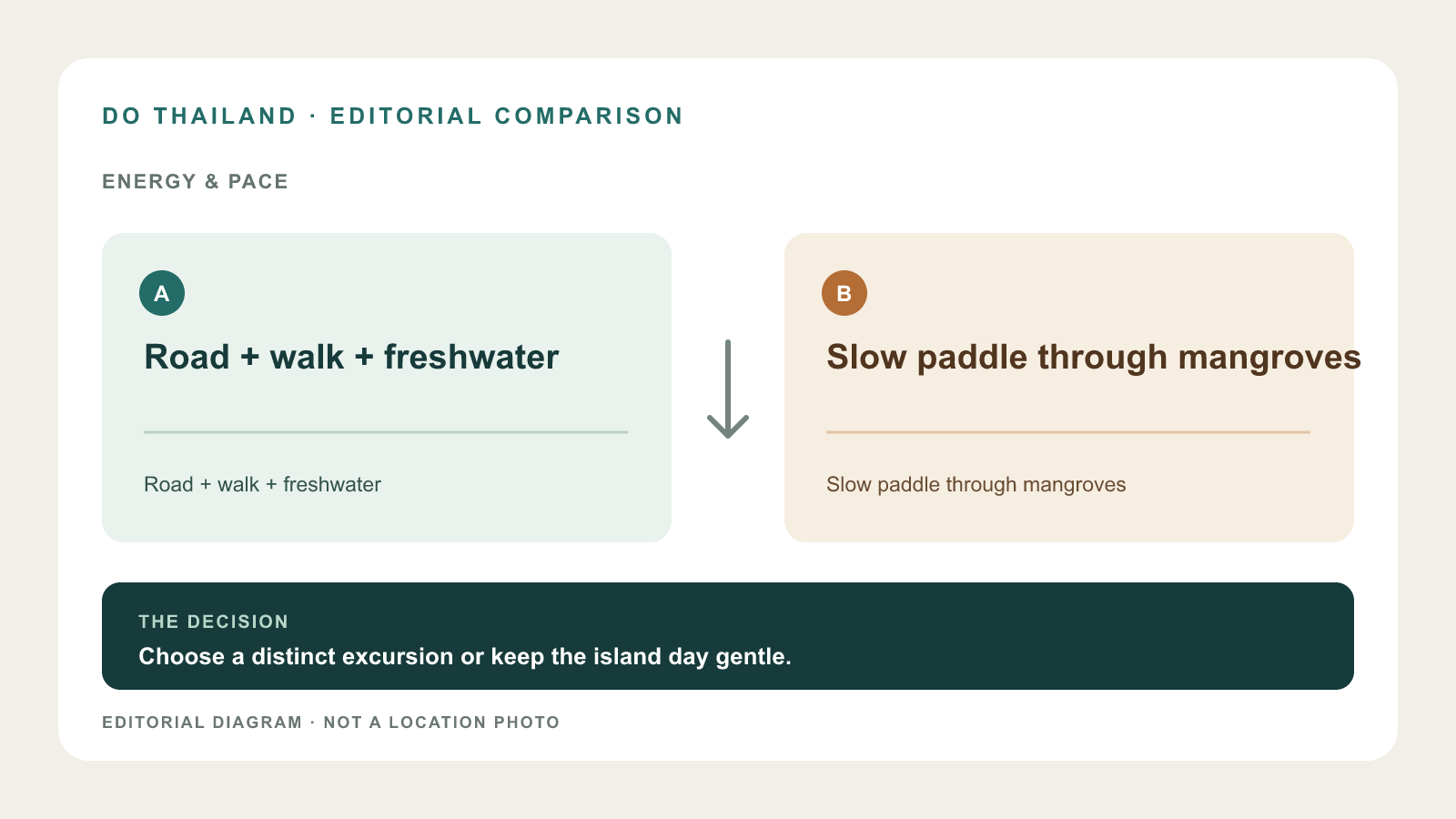
Koh Kood is quiet enough that a small activity decision can change the shape of half a day. Tourism Authority of Thailand currently highlights both Khlong Chao Waterfall and kayaking along the Khlong Chao waterway and mangrove forest. They sound like two boxes on the same sightseeing list, but they solve different holiday needs.
Pick the waterfall for a bigger outing
You are happy to arrange the road approach, walk in, get hot, get wet and make the freshwater pool the point of the excursion. It works best when you want a distinct “we went somewhere” block rather than another gentle hour near the hotel.
Pick kayaking for a softer day
You want to control the pace, stay on the water and make the mangrove channel itself the experience. It is especially attractive when you are already based around Klong Chao and do not want another island-crossing plan.
The real decision is energy versus movement
TAT describes Koh Kood as an island with limited conventional public transport. Travellers use motorcycles, bicycles or chartered songthaews, and the road network is hilly. That means an activity with a modest duration can still carry a meaningful transport cost before and after it.
The waterfall tends to concentrate effort: you move inland, walk, swim if conditions are suitable, then reverse the trip. Kayaking spreads the effort differently: less road movement can be exchanged for sustained paddling, sun exposure and a wet-clothes transition. Neither is automatically easier. The question is which type of effort you would rather own.
The waterfall usually asks more of your island transport plan. The kayak answer depends on the launch point you actually use.
The waterfall adds walking and a swim decision. Kayaking trades that for repeated upper-body work and sitting close to the water.
Both can end wet. Plan for the activity, shower, clothes change and next meal.
Khlong Chao Waterfall is better when the payoff justifies a real excursion
TAT continues to list Klong Chao Waterfall among Koh Kood's headline natural attractions and describes it as flowing year-round. That does not mean water conditions are identical every day, or that swimming is always appropriate. It means the waterfall is a genuine destination rather than a seasonal decorative stop.
Choose it when the forest-and-freshwater contrast is something you actually want after several beach hours. It gives the day a change of texture: road, shade, walk, waterfall, pool, then back to the coast. That is more satisfying than kayaking for a traveller who already has plenty of sea time and wants one clear inland memory.
The trade-off is that the outing is less forgiving if you dislike arranging transport, if your shoes are wrong for a wet path, or if the group has very different walking tolerance. For two friends, decide before leaving whether both of you want the walk and swim. One reluctant person can turn a simple excursion into a negotiation about when to leave.
Mangrove kayaking is better when you want the island to stay slow
TAT specifically describes kayaking along the Khlong Chao waterway, where the route passes mangrove forest and marine life. That makes kayaking more than a generic beach-rental activity: the waterway itself is the reason to paddle.
The strongest case is not “kayaking is adventurous.” It is that paddling can occupy a meaningful block without forcing the whole day to reorganise around another road transfer. If you are staying around Klong Chao, this can be exactly the kind of activity that earns the area's optionality: do something real, return to the room, change, and still have the late afternoon intact.
For a solo traveller, the useful question is whether the launch and return arrangement is clear enough that you do not need to improvise transport after getting wet. For two friends, kayaking can work particularly well when one wants activity but neither wants a full excursion. Ask about life jackets, current water conditions and the actual route before you get in—not after the kayak is already on the water.
The 2 p.m. weather switch
Koh Kood's rainy season is generally June to October, and TAT recommends checking weather conditions even though the island can be visited year-round. Do not turn that into a crude “rain means waterfall” rule. Heavy rain can make paths, water conditions and road travel less predictable; wind or thunderstorms can make paddling a poor choice.
If the weather is unstable, choose the activity whose current conditions you can verify most clearly—or skip both. A flexible afternoon at the hotel is better than forcing a nature activity because it appeared in the plan yesterday.
Your hotel base changes the answer more than most people expect
If you chose Klong Chao over Bang Bao because you wanted more island life outside the resort, this is where that premium should start paying you back. The waterfall and waterway give Klong Chao two different activity jobs without requiring a new accommodation base.
If you chose Bang Bao because the exact resort and bay are meant to carry the trip, do not undo that decision by filling every day with rides back toward Klong Chao. One waterfall outing can still make sense. Repeatedly commuting north for “optional” activities usually means the original hotel-area decision and the actual itinerary are fighting each other.
Use the Koh Kood Stay hub if you have not yet locked the base, and the Koh Kood destination hub to keep the activity decision connected to the rest of the island plan.
Do one of the two well. Waterfall if you want an inland contrast; kayak if you want a softer activity that leaves more day around it.
Choose whichever has the cleaner hotel handoff. If both require awkward transfers, neither needs to win.
Re-check conditions on the day. Do not preserve the itinerary at the expense of the conditions.
Do not let one activity buy an unnecessary hotel location
A waterfall visit is one block. A kayak paddle is one block. Your hotel area is every morning, every return, every shower, every dinner and both ferry-day handoffs. That is why this experience guide feeds the accommodation graph rather than replacing it.
If the activity decision makes Klong Chao more attractive, verify the exact hotel pin and ordinary evening route in the Klong Chao vs Bang Bao guide. If you are comparing eastern Gulf islands instead, the Koh Chang hub and Koh Samet hub use different transport and stay logic, so do not transfer this decision model blindly.
Seven checks before you commit the afternoon
- Check current weather, thunderstorm and wind conditions; a monthly forecast is not detailed enough.
- Current waterfall path and water conditions if Khlong Chao Waterfall is the plan.
- The exact kayak launch point, route and return point.
- Life-jacket availability and the operator or rental provider's current safety instructions.
- How you will reach and leave the activity without relying on an unverified island-wide taxi assumption.
- A dry-clothes and phone plan after swimming or paddling.
- The next fixed commitment: dinner, ferry, transfer or another booked activity.
Why there is no booking button here
This comparison is between two destination-level activity formats, not two verified bookable products. TAT confirms both activities, but the exact kayak provider, rental point, route and waterfall transfer can vary. A generic tour link would pretend those products are interchangeable when they are not.
Finish the decision first. When you have a verified operator or exact product, compare that product's route, pickup, cancellation terms and weather policy. Until then, use the Koh Kood Experience hub and Thailand Transport guides rather than forcing a purchase step too early.
The rule I would use
Choose the waterfall when you want the activity to feel like a destination. Choose kayaking when you want the activity to fit inside the day. If neither description sounds appealing in the actual weather, keep the afternoon unbooked. Koh Kood does not need every quiet hour converted into a product.
Keep the rest of the trip connected
For accommodation, continue with Klong Chao vs Bang Bao and the Koh Kood Stay hub. For ferry and road handoffs, use Thailand Transport. For connectivity during pier, hotel and ride messages, compare Thailand eSIM vs airport SIM. If you are still browsing activities nationally, return to Thailand Experience Guides or All Guides.