
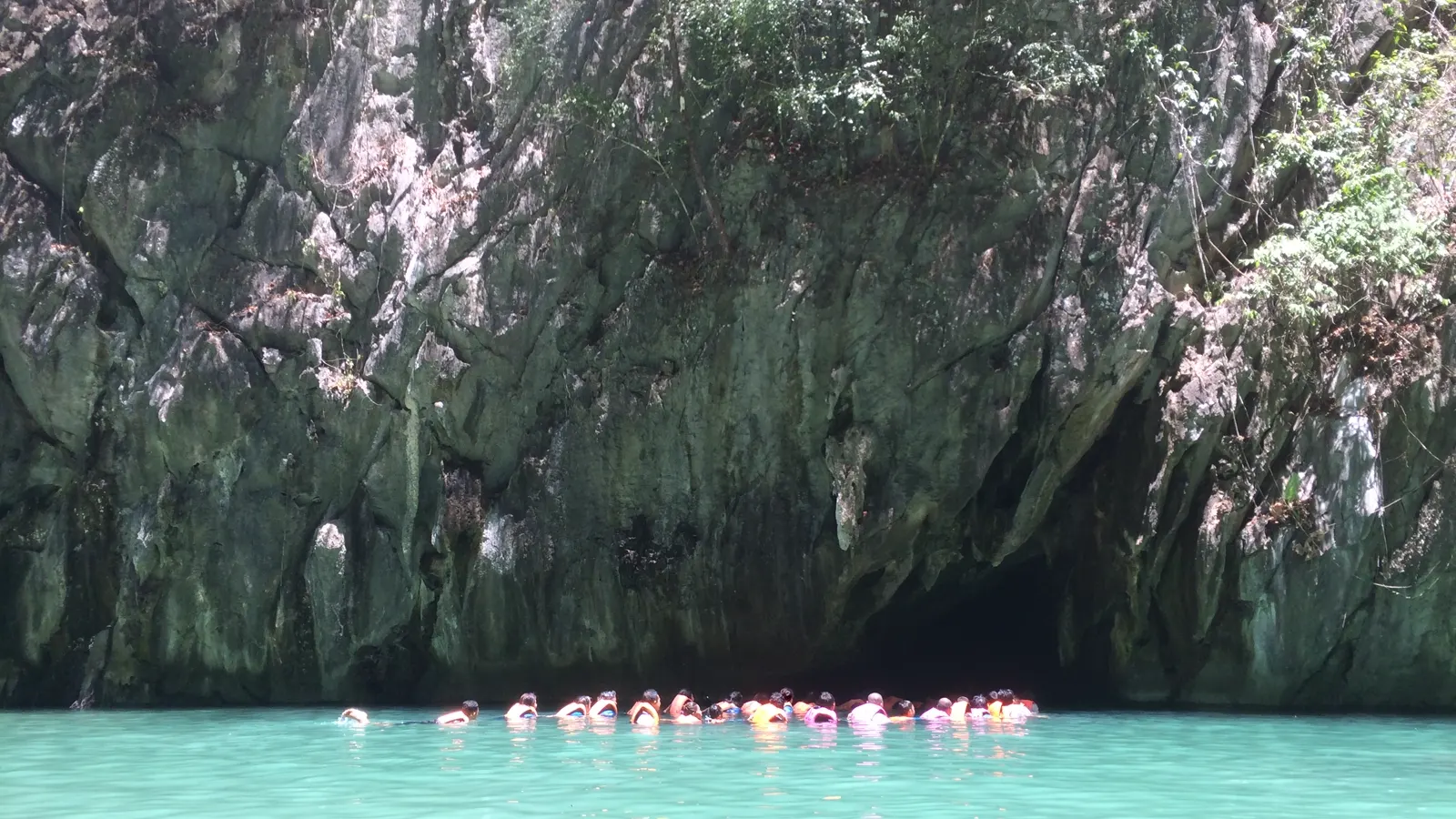
Tham Morakot—usually called the Emerald Cave—is on the west side of Koh Mook in Trang. Its draw is the transition: from the sea, the entrance is a low opening in the limestone; inside, the light falls away; beyond the passage is a small sandy cove ringed by steep cliffs and open to the sky. Thailand’s tourism authority describes the channel as about 80 meters long and under 10 meters wide. That scale matters more to your decision than a photograph of the lagoon. You are agreeing to the way in as well as the destination.
For some visitors, the darkness makes the emergence feel unusually dramatic. For others, being close to other swimmers in a space where the exit is behind them is the part they cannot enjoy. Neither reaction needs correcting. Decide based on the experience you want in the water, not on the idea that every visitor to Trang has to collect the same landmark.
Know what the swim actually involves
Expect a boat to bring your group to the cave entrance, where the crew or guide organizes entry. Visitors commonly wear life jackets and move through the dark passage in a line. Depending on the water level and conditions, you may float or actively swim; you should ask the operator which applies to the planned visit. A life jacket supports you, but it does not make the passage dry, remove the need to be comfortable in water, or guarantee that you can stop wherever you like.
The cave is dark enough that you may not be able to orient yourself by looking ahead. People often hold onto the person or flotation aid in front of them, following the guide. That can be reassuring if you like a clear group structure. It can feel restrictive if you need personal space, want to set your own speed, or dislike contact with strangers. Ask whether the group enters together, how the guide keeps it moving, and whether there is a practical option to remain at the boat or return before entering.
Once through, visitors reach the enclosed beach. Time inside the cove may be limited by the boat schedule, other groups, and the conditions at the entrance. Do not plan on a long private beach stop unless the operator confirms it. The visit is best understood as a brief guided passage and a look around the lagoon, not as an isolated beach day.
Tide and sea conditions set the real schedule
The cave entrance sits close to the water. Access depends on a suitable water level, and the timing changes with the tide. The tide chart alone is not a promise that a boat can safely enter: swell, wind, visibility, and the judgement of the local crew matter too. Do not copy a tide time from another date or assume that a tour advertised for a particular hour will enter regardless of conditions.
Before paying, ask the operator which tide window they are using for your date and what happens if the cave cannot be entered. Is the trip rescheduled, redirected to another snorkeling stop, or partly refunded? How much notice do they expect to give? A clear answer helps you compare an all-in island-hopping trip with a local boat arranged on Koh Mook. The cheapest departure is not automatically the best value if the cave is the main reason you are going and the fallback is vague.
Use official information as a starting point, then confirm the operational detail close to travel. The Tourism Authority of Thailand lists the cave among Trang’s key attractions and advises visitors to consider the province’s seasonal travel pattern. Park access and closures can change by year and by local conditions. Check the current notice from Hat Chao Mai National Park and ask your accommodation or boat operator to confirm that Koh Mook and the cave are open on your dates. Older brochures may show a recurring closure window; do not treat that as the current year’s final schedule.
Choose a boat plan that fits your day
If you are staying on Koh Mook, ask your accommodation about a local boat trip and whether the departure is shared or private. A local arrangement can make the cave the main outing, with the option to add nearby snorkeling or a beach stop if time and sea conditions allow. Confirm the meeting point, duration, what is included, life jackets, and whether the boat returns to the same beach or pier. Those details shape the day more than the phrase “Emerald Cave tour.”
From the mainland, tourism information describes trips and charters from the Pak Meng area, and the Tourism Authority of Thailand’s Japanese-language office also notes hotel-arranged trips and longtail charters from Pak Meng. This is a longer water day than starting from the island. Confirm the pier, road transfer, boat time, and return connection as one chain; a nominally convenient excursion can become a long day if the mainland pickup and pier transfer are separate bookings.
Group size is worth asking about. A small group may make it easier to hear instructions and stay together, while a larger outing may combine the cave with several snorkeling stops. Neither format is inherently better: decide whether you want the cave as a focused visit or a component of a full-day circuit. Request the approximate time at the cave, not just the number of destinations on the itinerary.
- What is the planned cave-entry window on my date, and who makes the go/no-go call?
- Do all guests need to swim, or can a non-swimmer stay on the boat?
- How is the group guided through the dark section, and can someone turn back?
- What is the plan if swell, tide, or visibility prevents entry?
- Which pier or beach is the meeting point, and are transfers included?
Koh Mook · sleep on the island
Search Koh Mook stays for a local boat departure
Staying on the island gives you more room to fit the cave around the local tide window and leaves the rest of the day for Koh Mook.
Be honest about swimming comfort and claustrophobia
You do not need to be a strong lap swimmer to enjoy every guided sea outing, but you should not infer that a life jacket makes this cave suitable for anyone who is uneasy in water. Ask the actual operator to explain the entry and exit, the flotation equipment, and their requirements for guests. If you cannot swim, have a medical concern, are pregnant, or are unsure about your mobility, get advice from the operator before booking and follow any restrictions they give. A generic “easy” label cannot account for your own comfort.
Think about the confined space separately from swimming ability. People who swim confidently in open water may still dislike a narrow, dark passage with a group moving close together. If darkness or enclosed spaces can trigger panic, choose a beach or snorkeling trip that does not depend on entering the cave. You can ask to wait on the boat while other travelers go in, but confirm that the tour allows this and that the boat will remain available. Do not assume you can simply peel away once the group is inside.
Children need the same honest assessment. Ask about minimum ages, adult-to-child supervision, flotation sizes, and the operator’s policy for a child who changes their mind at the entrance. A child who is happy in a pool may react differently when the light disappears and other swimmers are close. If the operator cannot explain the arrangement plainly, select a trip where the child can enjoy the water without entering the cave.
What to bring—and what to leave behind
Wear swimwear under light clothing and bring a towel and a dry change for after the boat ride. A waterproof pouch can protect a phone, but keep it secured: a dropped device is difficult to retrieve in the water or inside the passage. Ask the crew what they expect guests to carry through. Large bags and loose valuables have no place on a cave swim, and a floating case is not a substitute for keeping belongings attached.
Follow the guide’s instructions about footwear and equipment. The approach may involve stepping between a boat and the water, and the beach is natural rather than a paved attraction. Bring sun protection for the exposed boat ride, drinking water, and any medication you normally need. If you use a prescription inhaler or have a condition that could affect exertion or anxiety, make your own medical decision with a qualified clinician and tell the operator relevant safety information before departure.
Inside a protected natural site, keep the visit low-impact. Do not touch or mark the cave, disturb wildlife, or leave litter. The lagoon is the endpoint of a narrow natural channel; the crew’s instructions and any park rules take priority over getting a particular photo.
When the cave is a good fit
Go when you are curious about the transition from open sea to enclosed darkness, comfortable being in the water with a group, and flexible about the exact timing. It makes particular sense if you are already sleeping on Koh Mook and can let the boat outing fit around the local tide window. The island stay gives you a chance to enjoy the rest of the day even if the cave visit is short or conditions shift.
A day trip from the mainland can work if you have confirmed the whole transfer chain and are happy with a boat-led schedule. It is less appealing when you have a tight onward bus, train, or flight the same day. Weather and tide can alter the sequence, and the return journey includes more than the boat. Keep a generous buffer or add a night on the mainland before a critical departure.
If you are still deciding whether Koh Mook or Koh Kradan better suits your trip, start with the site’s Koh Mook versus Koh Kradan comparison. It frames the difference between a lived-in island with village services and an accommodation-led beach stay. For a closer look at where to sleep on Koh Mook, see the Koh Mook Sivalai Beach Resort guide. If you are building a longer island sequence, the Trang Islands guide links the main base decisions.
Trang mainland · overnight connection buffer
Search stays near Pak Meng Pier
If your cave outing starts from the mainland, an overnight near the pier can reduce pressure on the road-to-boat connection. Confirm the operator’s actual departure pier before choosing a location.
When to skip the swim
Skip the cave if entering the dark passage sounds like an ordeal, if you cannot get a clear answer about the group’s safety procedure, or if the operator is dismissive about conditions. Also skip it when the park or boat crew says the cave is closed or unsafe. A dramatic landmark is not a reason to override a local go/no-go decision.
You can still have a satisfying day on Koh Mook without entering. Pick a beach, arrange a boat trip that stays outside the passage, or spend time around the island’s east-side community and food stops. TAT identifies Koh Mook’s beaches and Morakot Cave as distinct attractions; the cave is not the island’s only reason to go. If your group is split, one person’s choice to sit out should be agreed before boarding, with a clear return arrangement.
The right question is not whether the cave is “worth it” for everyone. It is whether the combination of darkness, water, group movement, tide timing, and a short lagoon visit matches your own appetite for adventure. Ask the operator about the parts you cannot infer from a photo, check the current park notice, and choose the day plan that still works if the cave entrance is unavailable.
Sources checked
Primary sources reviewed 12 October 2026:
- Tourism Authority of Thailand, Trang province guide — Koh Mook and Morakot Cave as Trang attractions, Hat Yao Pier, seasonal travel notes, and visitor guidance.
- Tourism Authority of Thailand, Ko Muk and Tham Morakot attraction listing — English listing cross-referenced from the official Trang page.
- Tourism Authority of Thailand Japan Office, Morakot Cave (Tham Morakot) — approximately 80-meter passage, guided life-jacket entry, cave beach, and Pak Meng boat options.
- Thailand Government Public Relations Department, Trang highlights across its Andaman coast and islands — government context for Morakot Cave and Trang’s natural attractions.
Boat schedules, tide windows, park access, closure dates, inclusions, and safety rules vary and can change. Confirm with Hat Chao Mai National Park and the specific operator for your travel date.