
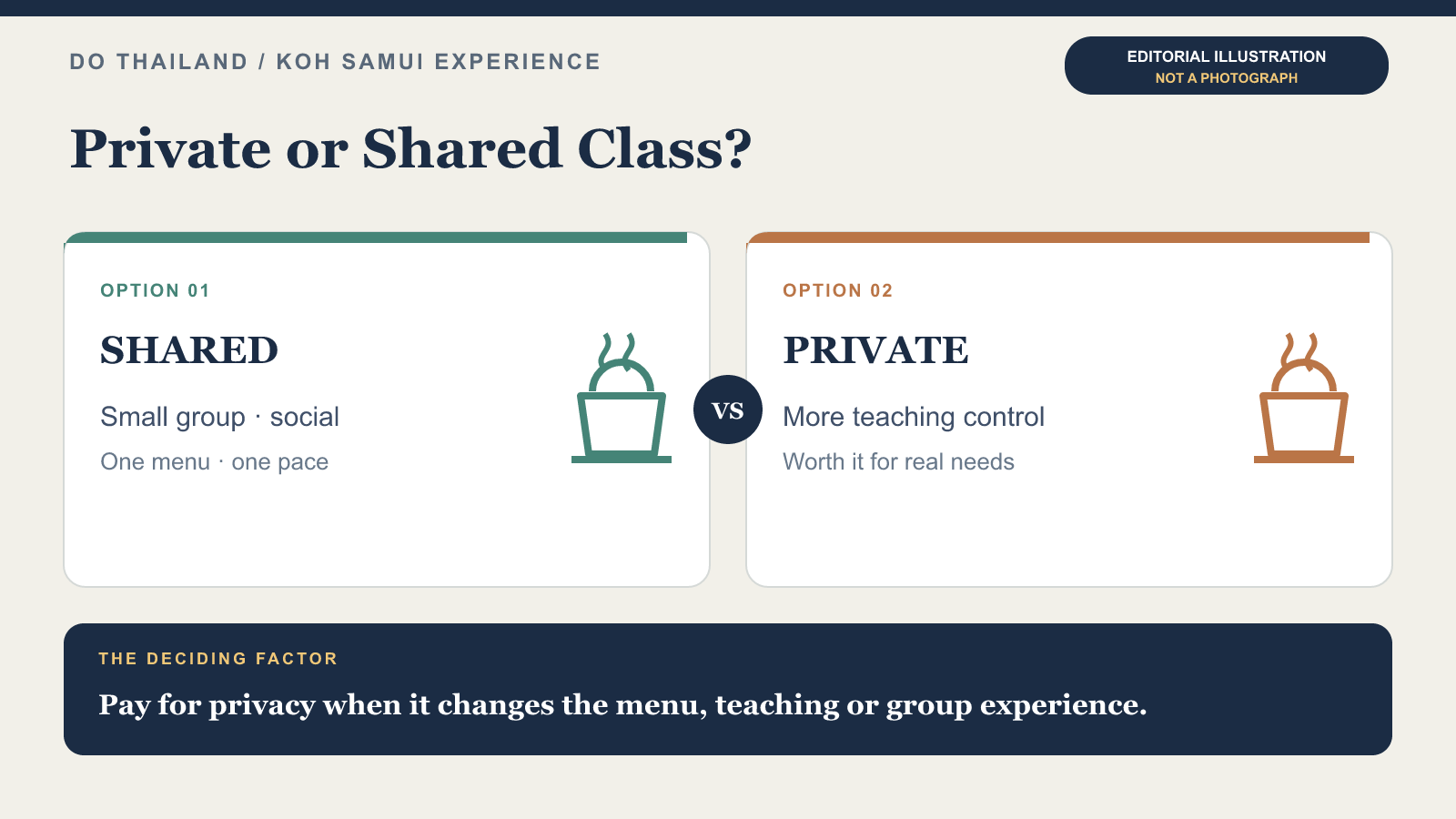
Four friends already arrive with their own social atmosphere. That changes the value equation. A shared class can still feel personal if the total class is small, while a private class can feel oddly expensive if all four of you are happy cooking the same dishes at the same pace. The decision is less about luxury and more about how much control you actually need over teaching, menu and transport.
Start with three filters: attention, menu and transport
Teaching attention
If two of you are confident home cooks and two are complete beginners, private instruction can stop the lesson drifting toward the middle. If everyone mainly wants a fun introduction, a small shared group is usually enough.
Menu control
Private formats are most valuable when your four-person group wants specific dishes or needs meaningful adaptations. If everyone is happy choosing from a standard Thai menu, exclusivity may change less than you expect.
Transport control
On Samui, pickup details can matter as much as class size. A private booking is not useful if your hillside villa is outside the vehicle-access policy or if four people still need a separate meeting point.
If transport is already becoming the annoying part of the holiday, read the Koh Samui hotel-location-for-pickup guide and the private driver vs taxis guide before choosing a class purely from its photos.
Current Koh Samui class formats show why “private vs shared” is not one standard product
Current first-party operator information checked on 11 August 2026 shows very different group models. Smiley Cook currently caps its small classes at eight people and says the group chooses four dishes together. Samui Good Herb currently lists a four-seat default class and says it can support five to seven when the guests are one group. Jungle Kitchen currently advertises a private evening class for up to twelve guests with a high degree of menu customisation. InFusion, by contrast, currently limits its private classes to one or two participants.
That variation matters for four friends. You cannot assume that “private class” means a four-person private booking is available, and you cannot assume that “shared class” means a large anonymous workshop. The first booking question should therefore be what is the exact maximum group size and will all four of us cook at our own stations?
This is also why the existing market-tour vs sea-view cooking-class guide is useful. Format can change the experience more than the private/shared label.
The teaching-attention test: will one friend quietly fall behind?
Think about your slowest cook, not your fastest one. In a shared class, an instructor has to keep the whole room moving. That is usually fine for chopping, curry paste, stir-frying and following a set sequence. It becomes less comfortable when one person wants to understand every ingredient while another wants to move quickly and eat.
| Your four-person dynamic | Better fit | Why |
|---|---|---|
| Everyone is a beginner and mainly wants fun | Shared | The group energy is part of the experience and you are unlikely to need four separate teaching tracks. |
| Two serious cooks, two casual cooks | Private | A flexible instructor can answer deeper technique questions without making the casual pair wait through a mini masterclass. |
| One friend is anxious about cooking or knives | Private, if the operator can accommodate the group | More direct attention can reduce the feeling of being hurried or watched by strangers. |
| Everyone wants to meet other travellers | Shared | You already have your friendship group, but the class becomes one of the easier social settings on the island. |
| You want the instructor to adapt to your existing skill level | Private | Personalisation is worth paying for only if you will actually use it. |
Menu freedom matters more than a private room
If you care more about the market visit than menu control, compare this with the food tour vs Nathon night market guide. A cooking class teaches a narrow set of dishes in depth; a food tour or market evening gives you more tasting breadth with less work.
For four friends, the private-class premium should buy one of four things
You can ask basic or advanced questions without worrying about the pace of strangers.
Your group can shape the dishes around what you genuinely want to learn, subject to the operator’s current preparation and dietary rules.
Private is valuable if it fits your beach, spa or travel day noticeably better than fixed shared sessions.
If the class is a birthday, reunion or deliberately social centrepiece, having the room to yourselves can be part of the memory rather than a technical upgrade.
If you cannot point to at least one of those benefits, the private label is probably doing more work than the experience itself.
Do not underestimate how much food four people will make
Cooking classes can occupy the nutritional centre of a day. A four-person group may each prepare multiple dishes, then sit down to eat what they made. Planning a large restaurant lunch immediately before the class or a tasting-heavy night market immediately after it can turn a good food day into an endurance event.
That is one reason I would not stack a cooking class with the same evening plan from the Fisherman’s Village vs Chaweng Night Market guide unless your class finishes early and the market visit is mostly for atmosphere rather than another full meal.
The morning vs afternoon cooking-class guide goes deeper on this. For four friends, the timing decision often matters more than whether strangers are at the next station.
The four-friends transport problem is different from the couple problem
One couple can squeeze transport decisions around a class fairly easily. Four friends create more luggage, more pickup coordination and more chance that someone wants to leave early or continue somewhere else.
Current operator policies illustrate the issue. Smiley Cook currently includes transfers in selected areas and asks guests outside the pickup area to meet at the class. InFusion’s current private-class information says standard-car access is required and steep-hill accommodation may need a nearby main-road meeting point. Those are operator-specific rules, not island-wide promises, but they show what you need to verify.
The red flag: “hotel pickup included” with no exact hotel check.
If your group is staying in a villa, especially on a steep road, send the exact property pin before relying on pickup. Four women standing on an unfamiliar roadside after an afternoon class is not the moment to discover that the original return arrangement only covered a main-road meeting point. Confirm the return drop as well as the outbound pickup.
If you are still deciding where four friends should stay, the villa vs resort for four friends guide is the direct bridge: a villa gives you shared space, while a resort usually makes transport handoffs easier to explain and verify.
Shared can actually be more social without becoming “tour-group energy”
Four friends are already self-contained. In a small shared class, meeting another couple or a few solo travellers can improve the atmosphere because the conversation has a natural subject: food. You do not have to manufacture small talk around a bar table.
That makes shared classes particularly good when the group has spent several days moving as a unit. A little outside social contact can feel refreshing without splitting up. If your wider Samui plan is already very group-heavy, you may also want to compare a food class with a more open evening in Bophut using the Bophut vs Choeng Mon stay guide.
Private wins when the class is part of the trip’s identity
There is a difference between “we should do a Thai cooking class” and “this is the food experience we have been looking forward to.” The first usually needs a competent, small, well-run shared class. The second can justify private instruction if you have a specific learning goal.
Jungle Kitchen’s current private evening format, for example, explicitly positions menu customisation as part of the product. That is the kind of private benefit that changes the experience. By contrast, if you simply want Pad Thai, a curry and a cheerful afternoon, exclusivity may not add enough.
If rain is the reason the class suddenly entered your itinerary, do not confuse urgency with value. Read the rainy-day cooking class vs spa guide first. A private booking that consumes the rest of the day can be worse than a shorter shared class if the weather clears.
A simple booking rule for four friends
Book shared when all four can agree on the menu, the class is genuinely small, everyone is comfortable at roughly the same pace, and the transfer works from your exact accommodation.
Book private when you need control, not status: real menu personalisation, dietary coordination, flexible timing, slower or deeper instruction, or a private atmosphere that is central to the occasion.
Then ask four questions before paying:
- Will all four people be cooking, and how many total participants will be in the room?
- Who chooses the dishes, and when is the menu locked?
- Can the class handle every dietary restriction in the group without reducing one person to a token substitute?
- Does pickup and return cover our exact hotel or villa entrance, including steep-road access?
If any of those answers is vague, the right comparison is not private versus shared yet. It is this exact class versus another class with clearer logistics.
Where this decision fits into a Koh Samui trip
A cooking class works best as one deliberate half-day, not filler squeezed between two bigger commitments. If four friends are changing hotels, compare that friction with the one resort vs split-stay guide. If food is the trip priority, use the Koh Samui experience guides to connect the class with markets, tastings and evening decisions rather than booking overlapping food experiences.
For the wider island picture, the Koh Samui destination guide links the accommodation, transport and experience decisions together.
The shortest answer
Four friends do not need a private cooking class just because there are four of you. Choose a small shared class for a first, social, low-friction introduction. Choose private only when the extra control changes what you will learn, eat or remember.