
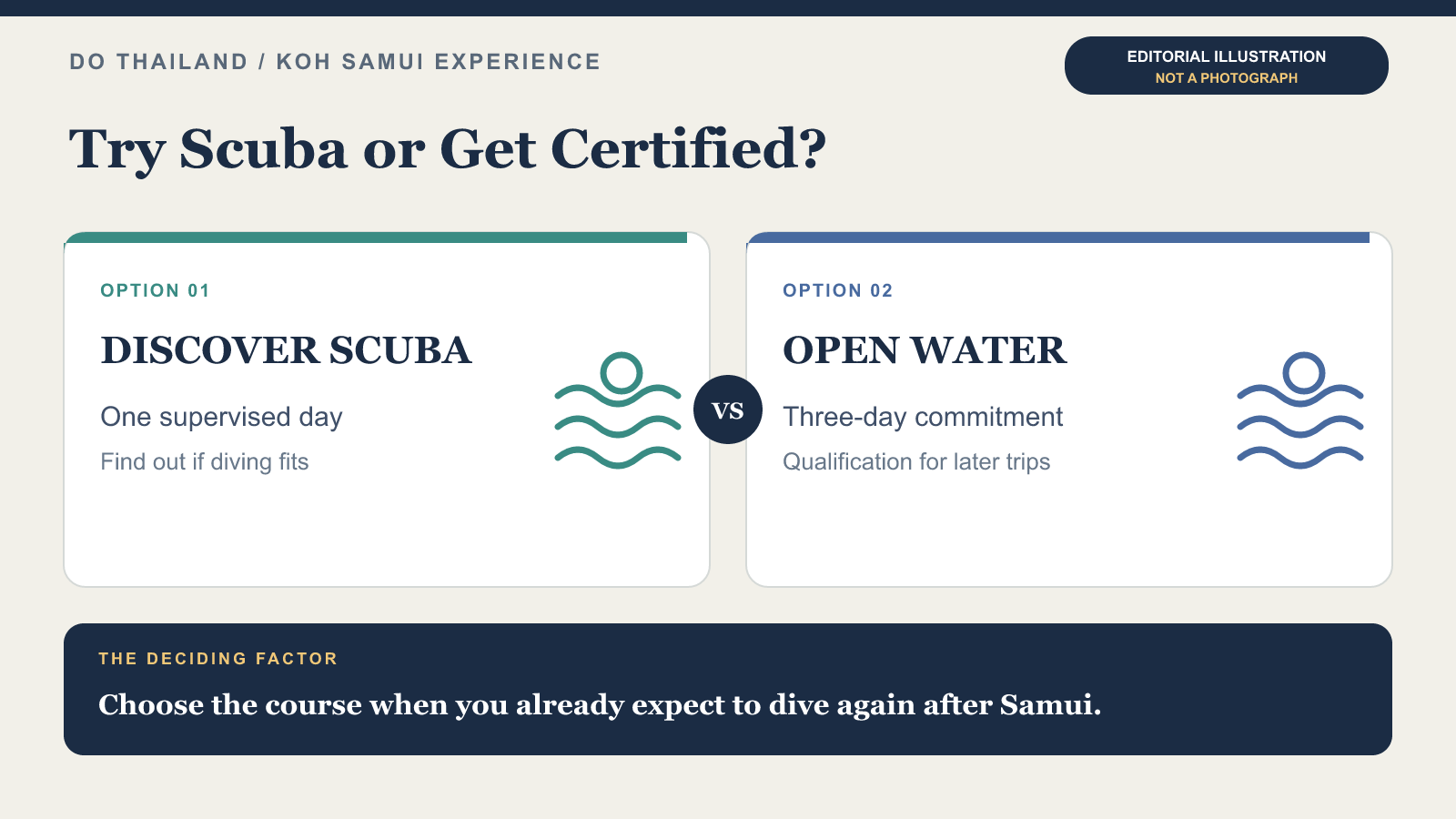
A first breath underwater can feel magical, surprisingly ordinary, or deeply uncomfortable. Discover Scuba buys you the answer with far less holiday commitment. But if you already know you want to dive again after Thailand, repeating try-dives is usually the less useful path: a proper Open Water course builds the skills and certification that future dive centers will actually ask for.
Choose by the dive experience and what you can do with certification after Koh Samui
Discover Scuba
You finish knowing much more about your comfort with a regulator, mask, equalising and open water. You do not finish as a certified diver. PADI describes Discover Scuba as an introductory experience under direct professional supervision, not a certification.
Open Water course
You complete knowledge development, confined-water skills and four open-water training dives. On successful completion, PADI Open Water is the beginner certification that lets you book future recreational dives with another certified diver within your training limits.
This is why the existing Koh Samui scuba vs snorkeling guide is an earlier decision. That page asks whether you want scuba at all. This one starts after the answer is already yes and asks how much commitment makes sense.
The cleanest test is your next twelve months
Imagine you are home six months from now and friends suggest a dive day on another trip. Which outcome would annoy you more?
The current exact GetYourGuide products checked make the difference clear. The Dive Academy's Discovery Dive is a one-day beginner experience with two dives, a 12-metre maximum and no certification. Its current three-day Open Water listing uses eLearning, pool training and four ocean dives, with certification dependent on successfully completing the required skills.
Three days does not mean three identical boat days
A certification course consumes the trip differently from a single excursion. PADI's Open Water pathway combines theory, confined-water practice and four open-water dives. The exact current Samui course checked uses eLearning before arrival, then pool work and ocean training. That makes the calendar more structured than a normal tour even when some theory is finished before you land.
Learn before the sea
Complete the required theory and arrive ready to ask questions rather than trying to squeeze all study into your beach time.
Make mistakes in controlled water
Mask clearing, regulator recovery, buoyancy and other core skills are practiced where the instructor can slow the process down.
Prove the skills in open water
Four open-water dives turn the course from “I tried scuba” into an assessed beginner qualification.
If your Samui trip is only four or five nights, that distinction matters. A three-day course can become the spine of the holiday. If you also want an island day, markets, a proper resort afternoon and a slow beach morning, put those blocks on the calendar before paying. For a destination-first comparison, Koh Tao vs Ang Thong helps decide whether another offshore day deserves space at all.
What the real activities look like
The images below come from the exact current Discovery Divers program pages for its one-day Discover Scuba and Open Water course. They are not generic underwater stock and are not being used to imply a different operator ran the session.
A course is not simply the same fun dive four times
Certification training includes performance requirements. PADI says Open Water students must demonstrate basic water skills, including a continuous 200-metre swim (or 300 metres with mask, fins and snorkel) and a 10-minute float or tread. The course also asks you to repeat and demonstrate skills rather than simply follow an instructor around a reef.
That changes the emotional texture. A Discover Dive can be a confidence test: breathe, equalise, follow the instructor, notice how your body responds. Open Water asks you to keep working when a skill feels fiddly. If clearing a flooded mask frustrates you, the useful question is whether you want to spend holiday time practicing until the skill becomes reliable.
Medical fitness and water confidence can override the comparison
Do not use a travel article to self-clear a medical condition. PADI requires student divers to complete a medical questionnaire and may require physician clearance depending on the answers. The Dive Academy's current terms likewise require a medical questionnaire for courses.
There is also a live-source mismatch worth taking seriously: The Dive Academy's own Discover Scuba page says no swimming skills are required, while its current GetYourGuide Discovery Dive listing marks non-swimmers as not suitable. If you are a weak or non-swimmer, treat that disagreement as a reason to contact the operator before paying—not as permission to choose the more convenient wording.
The flight home can make the decision for you
Both options involve real open-water diving, so build the no-fly interval into the itinerary before booking. Divers Alert Network recommends at least 12 hours before flying after a single no-decompression dive, and at least 18 hours after multiple dives in a day or multiple days of diving; longer intervals reduce risk further.
The current Discovery Dive example includes two dives, and the Open Water course includes multiple dives over multiple days. For a conservative holiday plan, do not put either immediately before an early flight. If the only open day is your last full day, moving scuba earlier—or choosing a non-diving activity—can be the better answer.
If you are connecting by sea rather than flying, the Samui Airport to Koh Tao ferry guide is a separate logistics problem. Boat schedules do not remove diving physiology; they simply change the transport calculation.
Where you stay matters more for a three-day course than for a one-day try dive
The Dive Academy's current course pages list transfer coverage around Maenam, Bophut, Choeng Mon and Lamai, with other areas requiring an enquiry; its GetYourGuide Open Water listing describes the included transfer zone as Maenam to Lamai. That is manageable for one day. Repeating an awkward pickup for three days is a different kind of friction.
If you are still choosing a base, Chaweng vs Bophut, Bophut vs Maenam and Maenam vs Lamai are more useful than chasing a hotel solely because it is near a dive shop. Pick a base you still like at dinner time, then confirm the transfer arrangement before checkout.
For solo women, the annoying details are mostly before and after the dive
On the water, instructor supervision is the key safety structure. Around it, small practical choices make the day less tiring: carry a compact dry bag for your phone and room key, bring a loose layer that is easy to pull over wet swimwear, and do not assume a dive boat has a comfortable private changing space. If you wear contact lenses, ask the operator about mask handling before the first skill session rather than improvising once you are wet.
A three-day course multiplies those details. You may have early pickups, wet hair at breakfast, repeated boat time and less appetite for a dressed-up evening after the final dive. If you already have several active water days planned, compare that cumulative fatigue with something shorter such as kitesurfing vs e-foil or parasailing vs jet ski safari.
Use these five lines instead of overthinking it
One useful middle option exists—but do not let it muddy this decision
PADI also offers a Scuba Diver certification as a shorter subset of Open Water, and The Dive Academy currently sells a two-day version. It is a legitimate route for people who want a credential but expect to dive under professional supervision. It is not the same end point as Open Water, so this article does not use it as a third winner. If three days is impossible but one-day Discover Scuba feels too temporary, ask the dive center whether that intermediate course fits your future diving plans.
Re-check the exact beginner formats on GetYourGuide
Editorially, choose the commitment level first. Then re-check the live product page for your date, pickup zone, medical or suitability wording, dive-site plan and cancellation terms. These are exact current GetYourGuide products from The Dive Academy; no price or availability claim is being made here.
The shortest recommendation
Discover Scuba is the better first purchase when scuba itself is still an unanswered question. It lets you test the sensation, the equipment, your ears, the boat day and your own nerves without surrendering three days of Koh Samui.
Open Water is better when the question has already changed from “Will I like it?” to “How do I become a diver?” In that case, the course is not three days lost to training. It is three days used to make future dive trips possible.
If neither sounds right after reading this, go back one decision to scuba vs snorkeling rather than forcing a certification-shaped answer onto a reef-day question.