
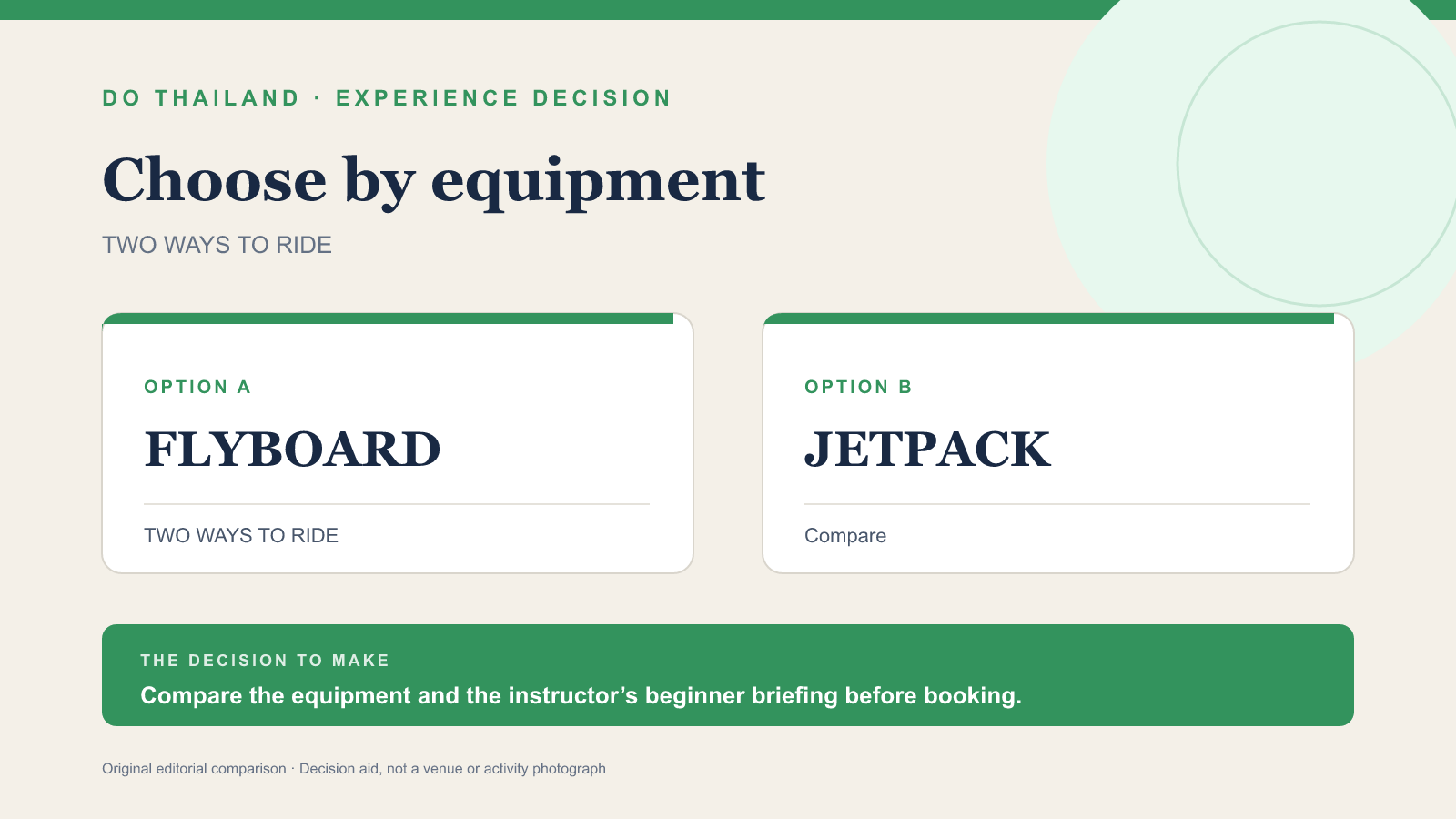
Start with Flyboard if...
You want the water-jet novelty but prefer a format the operator explicitly markets to beginners. The board is strapped to your feet, so the mental picture is closer to learning a new balance stance than wearing a flight rig around your body.
Pick Jetpack if...
The body-worn apparatus is central to the attraction; check the operator's safety and handling requirements. The operator calls Jetpack an extreme sport and says controlling and navigating it is physically demanding, so treat that description as part of the purchase rather than marketing fine print.
This is deliberately a narrower decision than our Flyboard vs Wakeboard guide. That page asks whether you want vertical-flight novelty or a tow-board learning loop. Here, both choices are water-jet flight formats from the same operator, at the same current headline durations and prices. The decision is about the interface: feet-mounted Flyboard versus body-worn Jetpack.
First, ignore the price board: it is currently a tie
On James Jetstar’s live Family & Extreme Watersports menu checked on 15 August 2026, both Flyboard and Jetpack are listed at THB 1,500 for 10 minutes and THB 2,500 for 20 minutes. Transfers are currently listed at THB 500 each way. That makes price a poor tie-breaker.
If the same money buys the same clock time, choose the movement problem you want to learn. Flyboard puts the device at your feet. Jetpack puts the apparatus on your body. That changes where your attention goes, even before you know whether you will rise high enough for the photograph in your head.
If you have already chosen Flyboard and are only deciding how long to buy, use the separate 10 vs 20 minutes Flyboard guide. If you would rather learn a tow sport, compare Wakeboard vs Water Skiing instead.
Why Flyboard is my default first-timer recommendation
The reason is not that I can prove Flyboard is safer or universally easier. I cannot, and the operator does not make that comparative claim. The useful evidence is narrower: its current Flyboard page explicitly says beginners are welcome and describes step-by-step instruction. Its live menu also carries a child-and-crew Flyboard option, which reinforces that the operator positions Flyboard more broadly than Jetpack.
For an adult first-timer, that makes Flyboard the cleaner first bet when you simply want to try water-jet flight. You are still buying a balance problem. You may spend much of the session making small corrections rather than hovering calmly. But if your internal question is “which of these two should I try first?”, the operator’s own framing gives Flyboard a clearer beginner signal.
That does not make Jetpack a bad choice. It makes Jetpack a more intentional choice. If wearing the apparatus is the part you have been imagining, choosing Flyboard because it sounds more approachable may leave you wondering why you avoided the format you actually wanted.
Jetpack only wins when the apparatus is the point
The Jetpack page is unusually useful because it is explicit about physical demand. The operator says participants need to be physically fit because controlling and navigating the Jetpack is demanding. That is a meaningful filter. Do not translate it into an invented medical threshold or a generic “athletic people only” rule; instead, take it as a prompt to ask the crew whether the format suits your current fitness, injuries and comfort with a body-worn rig.
Jetpack also has a different psychological feel. Some travelers like the idea that the equipment is around the torso rather than under the feet. Others find that more intimidating. Neither reaction is silly. If the equipment itself makes you tense before the lesson starts, the more photogenic option is not automatically the better holiday experience.
If your real goal is powered board flight rather than either of these jet systems, compare 30 minutes vs one hour of e-foil or the broader Kitesurfing vs E-foil decision. For a simpler board introduction, Wingfoil vs SUP lesson and SUP lesson vs rental sit lower on the spectacle scale.
Exact current operator media: compare the equipment, not the fantasy
Those images should help with one useful test: would you still choose the activity if nobody photographed you? If yes, you are probably choosing the experience rather than the image. If no, consider whether a shorter, calmer watersport would make you happier. The same logic applies to Jet Ski lesson vs safari: the activity format matters more than the social-media silhouette.
There is a current location conflict worth resolving before you travel
The operator’s Jetpack article and footer still refer to Lamai or Lipa Noi. But the current Contact & Find Us page labels Lamai Beach as “All sports” while the Lipa Noi line says “JETSKI only”, alongside some inconsistent OPEN/CLOSED wording on the same page.
Do not choose a taxi destination from an old screenshot or a blog paragraph. Ask the operator to confirm the exact operating beach for your date and activity in the booking message. This matters more than it sounds: a wrong-side transfer can turn a ten-minute activity into a disproportionately annoying afternoon.
If you are staying far from Lamai and do not want a scooter, compare the cost and friction with our private driver vs taxis guide. For a travel day, I would be especially conservative: both activities are a poor fit for an arrival-day plan when flight, baggage or transfer delays could eat into a fixed beach appointment.
Safety: treat both as real extreme watersports
James Jetstar’s current safety page says all watersports are undertaken at the customer’s own risk, says participants should have appropriate travel insurance, requires a declaration, and requires lifejackets. The dedicated Flyboard and Jetpack pages say helmets and lifejackets are provided. The Jetpack page additionally says the operator’s included insurance does not cover medical expenses or personal belongings.
Editorially, the practical conclusion is simple: do not assume “insurance included” means your medical costs or phone are covered. Check your own policy for the exact activity you plan to do, and leave valuables you do not need at the hotel.
Weather also overrides this comparison. I would not invent a claim that one format is reliably better in wind or chop. If the crew says conditions are unsuitable, a safer holiday decision is to move the activity rather than defend the slot because you planned around it. Keep a genuinely different fallback such as a cooking class or spa rather than trying to force an extreme watersport into marginal conditions.
Women’s practicalities: the ten-minute activity has a longer shadow
Choose a secure suit you would trust during repeated water entry rather than one designed mainly for lying on a lounger. An extra rash layer can also make harness/equipment contact feel less fussy.
Tie long hair securely and remove loose earrings, necklaces and anything you will think about while the instructor is talking. This is an attention-management choice as much as a loss-prevention choice.
Bring only what the session needs. The operator’s own terms limit responsibility for belongings, so a beach bag full of valuables creates stress without improving the experience.
A ten- or twenty-minute booking can still leave you wet for the ride back. Pack one easy dry layer instead of building an elaborate beach wardrobe around a very short activity.
Six traveler profiles: which one sounds like you?
“I want to try flying above water once.”
Flyboard. The operator’s beginner-friendly framing makes it the clearer first experiment.
“The Jetpack rig is the thing I came for.”
Jetpack. Do not downgrade your actual interest just to choose the more familiar product name.
“I am reasonably fit but nervous about extreme sports.”
Flyboard first. You can still decide the whole category is not for you after a short session.
“I enjoy physically demanding novelty.”
Jetpack. The operator explicitly describes the control task as physically demanding, which may be a positive rather than a warning for you.
“I mostly want the airborne photo.”
Neither by default. Expect the first session to focus on balance and control. Choose only if the learning attempts themselves sound worthwhile.
“I want to learn something I can repeat longer.”
Consider Wakeboard instead of either jet-flight format. A board skill may fit your motivation better than a short spectacle-led session.
The shortest answer
Choose Flyboard if you want a feet-mounted balance challenge with the clearest beginner-facing operator language. Choose Jetpack if the body-worn apparatus is specifically the experience you want and you are comfortable with its stated physical demands. Because the current durations and prices match, do not let the price board decide for you.
Re-check the live operator details before you go
Re-check the live price, exact operating beach, weather status and safety terms before paying or travelling to the beach.
Check current Flyboard & Jetpack options Read the current safety terms