
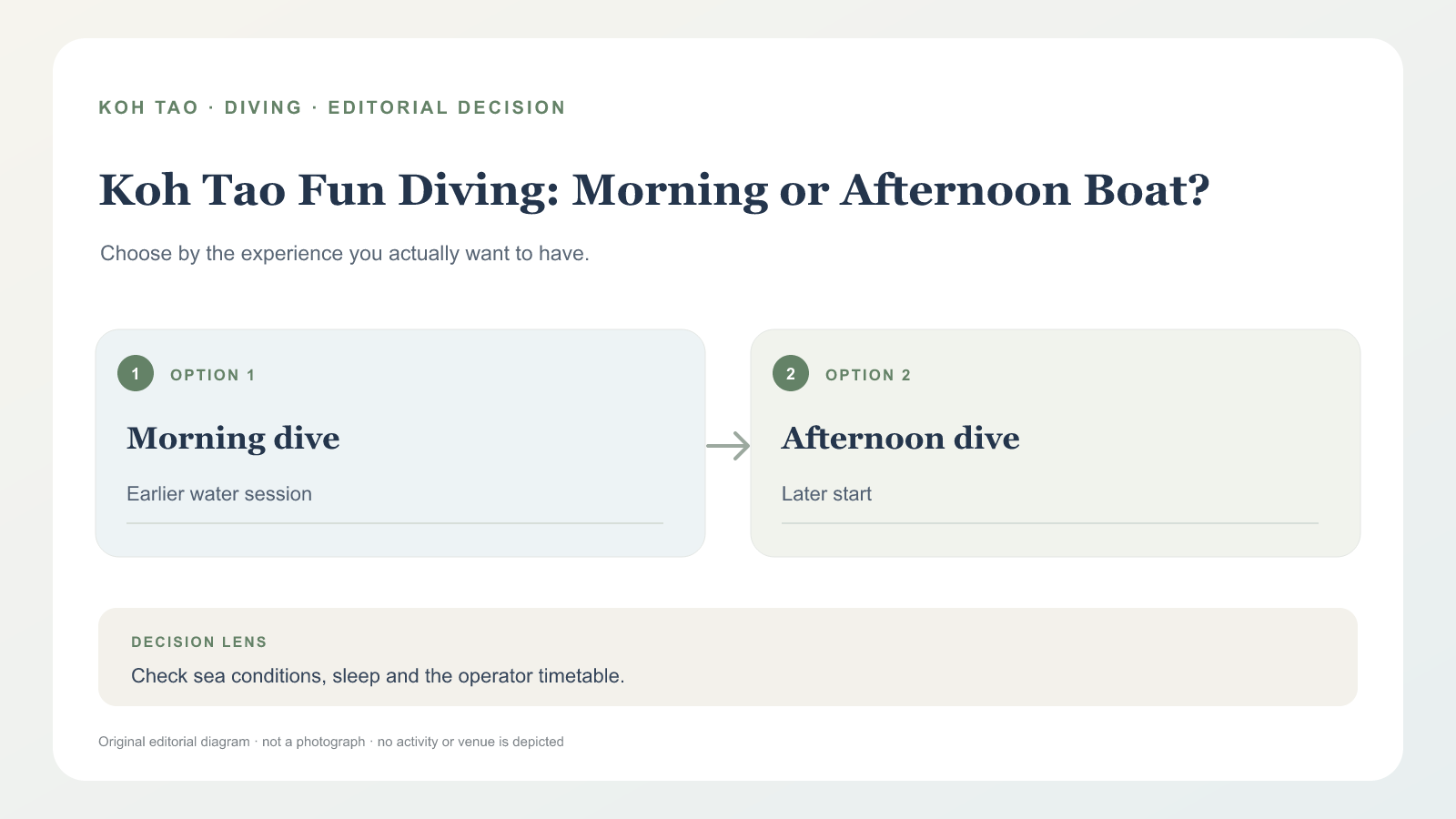
Morning versus afternoon sounds like a sleep question. On Koh Tao it is often a product question. The two operators checked for this guide currently run two-dive morning and afternoon trips, but their published patterns are not identical copies of the same half-day: morning boats are commonly used for deeper pinnacles, wrecks or more ambitious sites, while afternoon boats commonly lean toward shallower reefs.
That does not mean the morning guarantees better visibility, bigger animals or a specific dive site. Dive centres change the plan for sea state, weather, diver level and operational conditions. Think of the time slot as a probability shift in the shape of the outing, not a wildlife promise.
Choose the product you want the half-day to become
Morning: site ambition first
Choose morning when an early start is easy for you, your certification and recent experience match the proposed sites, and you want the afternoon back for lunch, a nap, beach time or a second island plan.
Simple Life Divers currently advertises a 07:00 morning meeting for two dives and says morning trips commonly rotate through deeper sites such as Chumphon Pinnacle, Southwest Pinnacle, HTMS Sattakut and Green Rock. Roctopus currently runs a morning two-dive boat with the same broad deeper-site bias.
Afternoon: confidence and schedule fit first
Choose afternoon when you arrived on the island late, slept badly, want a slow breakfast, are returning after time away from diving, or simply prefer a shallower reef day before deciding whether you want more.
Simple Life currently advertises afternoon departures shortly after midday for two shallower reef dives, while Roctopus currently lists a 12:30–16:30 fun-diving block at two reef sites. Both operators checked also place their refresher-style re-entry work in the afternoon.
The real choice happens before you leave the hotel
Certification and recent comfort override every itinerary trick
A certified diver should still choose a boat that matches the limits of her certification, recent experience and comfort. A deeper morning site is not an upgrade when you are rusty, anxious, tired or not trained for the proposed depth or environment.
If you have been out of the water for a while, ask the dive centre what it requires before a standard fun dive. At the two Koh Tao operators checked, refresher programs are currently built around afternoon shallow-water or shallow-reef sessions. That makes the afternoon a useful re-entry shape, but it is an operator pattern rather than a universal rule for every dive shop on the island.
Do not book a morning boat because you are chasing one animal
Koh Tao is one of Thailand's best-known scuba destinations, but marine life is not a timetable. A morning slot can change the likely sites, but wildlife sightings remain unpredictable. Choose your dive for the route and conditions rather than a particular animal.
Before paying, ask the dive centre six boring questions
- What are the likely sites for this boat, and how often do they change?
- What certification or recent-experience level is appropriate for those sites?
- How many divers are normally assigned to one guide on this product?
- Is equipment included, and what exactly is included?
- What time must you arrive at the shop?
- What happens if weather or sea conditions force a different site plan?
The answers matter more than a generic “morning is better” rule.
Your three-night Koh Tao trip can absorb only so many early starts
Arrival day
Usually do not force the dive. Ferry timing, check-in, hydration, sleep and paperwork can make an afternoon boat look tempting, but only book it if the operator is comfortable with the connection and you arrive with enough margin.
Middle day
Best morning candidate. You control your sleep, can reach the shop predictably and still have the afternoon for Sairee, a room reset or an early night.
Final day
Work backward from onward travel. A dive should never be squeezed against a flight or altitude change just because the boat fits your hotel checkout.
Flying after diving is a hard schedule gate
Divers Alert Network currently recommends a minimum preflight surface interval of 12 hours after a single no-decompression dive and 18 hours after multiple dives in a day or multiple days of diving; dives requiring decompression stops need substantially longer. These are minimum intervals; decompression sickness remains possible.
For a typical two-dive day, follow your dive computer and operator guidance, and leave the required surface interval before flying; do not add an afternoon dive just to fit the schedule. If symptoms develop after diving, seek medical evaluation before air travel.
This experience decision should change where you stay
A 06:00–07:00 shop meeting makes hotel-to-dive-centre friction more expensive than it looks on a map. If your chosen operator is in Sairee and you plan multiple morning boats, the Sairee vs Mae Haad decision can tilt toward Sairee even if Mae Haad was attractive for ferry day. If you expect afternoon boats and ordinary Sairee evenings, the same logic becomes less about the alarm and more about the walk home while you are tired and carrying wet things.
Once Sairee has won, compare the actual hotel rhythm in Sairee Cottage vs Simple Life Cliff View. If Simple Life Cliff View is already your pick, the Ocean View vs Pool View room decision is more useful on a dive-heavy trip than another generic hotel list: extra room space can matter for wet gear and simultaneous getting-ready routines, while a private sea view only earns money if you still have awake room time to use it.
Use the Koh Tao Experience Decisions hub and Koh Tao destination hub to keep the chain connected. The wider Experiences hub, Transport hub and Thailand eSIM vs Airport SIM are useful only when those become the next real decision.
The rule I would use
Choose morning for site ambition and a free afternoon. Choose afternoon for confidence, sleep and schedule fit. Then let certification, recent experience, conditions and the operator's actual site plan overrule both.