
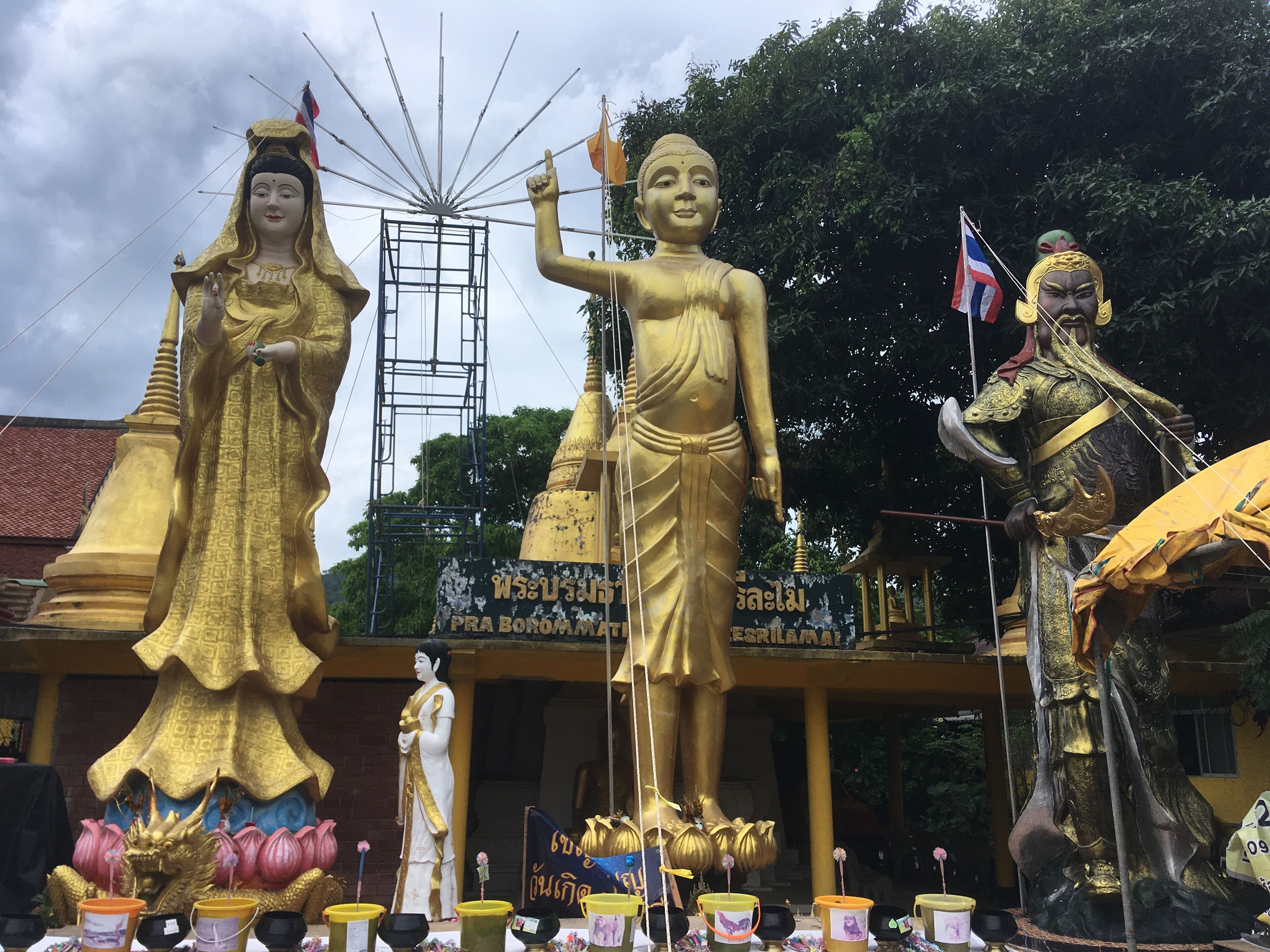
The useful answer: choose the cultural lens, not the prettier façade
These two sites sit in the same broad Mae Nam orbit but tell different stories. Mae Nam Chinese Temple — commonly listed in English as San Chao Jao Eng Sae Mae Nam — is a compact Chinese shrine tied to an active local worship tradition. Koh Samui City Municipality still included the shrine in its 2025 Chinese New Year round-up of six worship sites around the island.
Wat Phu Khao Thong is a Buddhist temple in Mae Nam with a more layered architectural story. Thailand's Office of Natural Resources and Environmental Policy and Planning records traditional Thai religious buildings alongside local timber architecture and details showing Hainanese-Chinese influence. If you want one site that makes you slow down and read the building fabric, Wat Phu Khao Thong is the stronger choice.
Choose Mae Nam Chinese Temple for community context
Pick it when the shrine is part of a Mae Nam walk rather than a standalone attraction mission. It works best with the beach, nearby lanes, food or the evening market atmosphere. The point is seeing a living Chinese religious layer inside a north-coast neighbourhood, not collecting a famous monument.
Choose Wat Phu Khao Thong for architectural context
Pick it when you want a functioning Buddhist temple whose buildings carry local history. The conservation record is unusually useful here: it notes a reinforced-concrete ordination hall with Thai decorative work, an old school building, raised timber monastic residences and Chinese-Hainanese influence in the local architectural vocabulary.
This is not “Chinese temple versus Thai temple”
The easy mistake is to reduce the choice to ethnicity: Chinese shrine on one side, Thai Buddhist temple on the other. Mae Nam's history is more mixed than that. The official conservation record for Wat Phu Khao Thong specifically notes the blending of Hainanese-Chinese and Thai cultural elements in parts of the temple complex. That makes the comparison more interesting: one site expresses Chinese religious community life directly; the other shows how cultural layers also entered a Buddhist architectural setting.
If Chinese-Samui history is the bigger theme of your trip, compare this small Mae Nam choice with the island's larger heritage branches. Nathon Hainan Shrine vs Guan Yu Shrine separates a west-coast town shrine from a monumental Hua Thanon landmark, while the Nathon Hainan Shrine worth-it guide helps if you are deciding whether Nathon itself deserves the detour.
If you only have an hour, use it differently
For Mae Nam Chinese Temple
Keep the shrine visit short and make the neighbourhood the second half. Look at the gate, altar spaces and how the compound sits inside Mae Nam, then continue to the beach or nearby streets. If you arrive only to photograph the red-and-gold façade and leave immediately, you have missed most of the reason to choose it.
For Wat Phu Khao Thong
Spend more of the hour inside the temple grounds. Look for the contrast between the ordination hall, older timber structures and small architectural details. This is the site where observation beats rushing to the next stop.
Do not use “hidden gem” as your decision rule
Both are lower-profile than Big Buddha, Wat Plai Laem or the Red Temple. That does not automatically make them more meaningful, more authentic or better for a first trip. The useful test is simpler: does the site add a cultural layer your itinerary does not already have?
If you still need the obvious first-time temple anchor, Big Buddha vs Wat Plai Laem is the more relevant comparison. If you have already done those and want a quieter local-temple contrast, Wat Kiri Wongkaram vs Wat Samret goes deeper into two different Buddhist histories.
What current sources actually prove — and what they do not
Koh Samui City Municipality's January 2025 Chinese New Year guidance specifically listed Chao Eng Sae Mae Nam Shrine among six active worship locations on the island. That is a stronger reason to treat the shrine as living religious culture than an old tourist-list description.
For Wat Phu Khao Thong, Thailand's official cultural-environment inventory documents the temple's local architectural features and Chinese-Hainanese influence. Koh Samui Tourist Police activity listings in 2026 also show the temple continuing to function as an active Buddhist community site.
What the sources do not give me is a robust current tourist timetable for either site. I would not cross the island based on a third-party opening-hours box. Visit in daylight when Mae Nam is already part of the day and verify access locally if a ceremony, maintenance or private religious activity is underway.
Women travelling solo: reduce the friction before you arrive
Respect is the practical rule at both places
These are functioning religious sites, not themed attractions. Wear something that covers shoulders and knees if you plan to enter sacred interiors, remove shoes where indicated, keep your voice low and avoid blocking people who are praying or making offerings. Do not assume every altar, monk or worshipper is available for close-up photography.
The bigger solo-travel issue is transport, not the site itself. If you are making a multi-stop north-coast day, settle the return plan before the last stop. For a route that extends beyond Mae Nam, compare a private driver vs individual taxis. If your evening is mainly about food and an easy walk rather than heritage, Central Samui vs Fisherman's Village may be a more useful use of limited energy.
What to pair with each stop
Mae Nam Chinese Temple: keep the pairing local. Mae Nam Beach, the walking-street area when it is operating, a meal or a slow north-coast evening. If you are choosing a whole town rather than a single shrine, Nathon vs Fisherman's Village shows how much more the experience changes once the neighbourhood itself becomes the destination.
Wat Phu Khao Thong: use it as a calm daytime cultural insert rather than the start of a temple marathon. If you want a visually stronger Buddhist stop later in the trip, Wat Plai Laem vs Red Temple handles a very different temple decision.
Final decision
Choose Mae Nam Chinese Temple if you want the cultural stop to belong to a Mae Nam neighbourhood walk. Choose Wat Phu Khao Thong if you want the temple itself — its Buddhist use, local buildings and blended architectural history — to be the reason you stop.
For most first trips, the smartest move is not to rank them island-wide. Only choose between them once Mae Nam is already in your day. Continue with the Koh Samui Experiences hub or the Koh Samui destination guide if the bigger question is what deserves your limited island time.
Sources checked
Koh Samui City Municipality — 2025 Chinese New Year worship-site round-up naming Chao Eng Sae Mae Nam Shrine
Thailand ONEP cultural-environment record — Wat Phu Khao Thong, Mae Nam
Koh Samui Tourist Police — January 2026 activity archive showing continuing community religious activity at Wat Phu Khao Thong
Expedia current attraction listing — Mae Nam Chinese Temple location context
Verification boundary: no permanent opening hours, admission fee, crowd level or ceremony schedule is asserted for either site. Both are functioning religious places; verify access on the day and let worship take priority.