
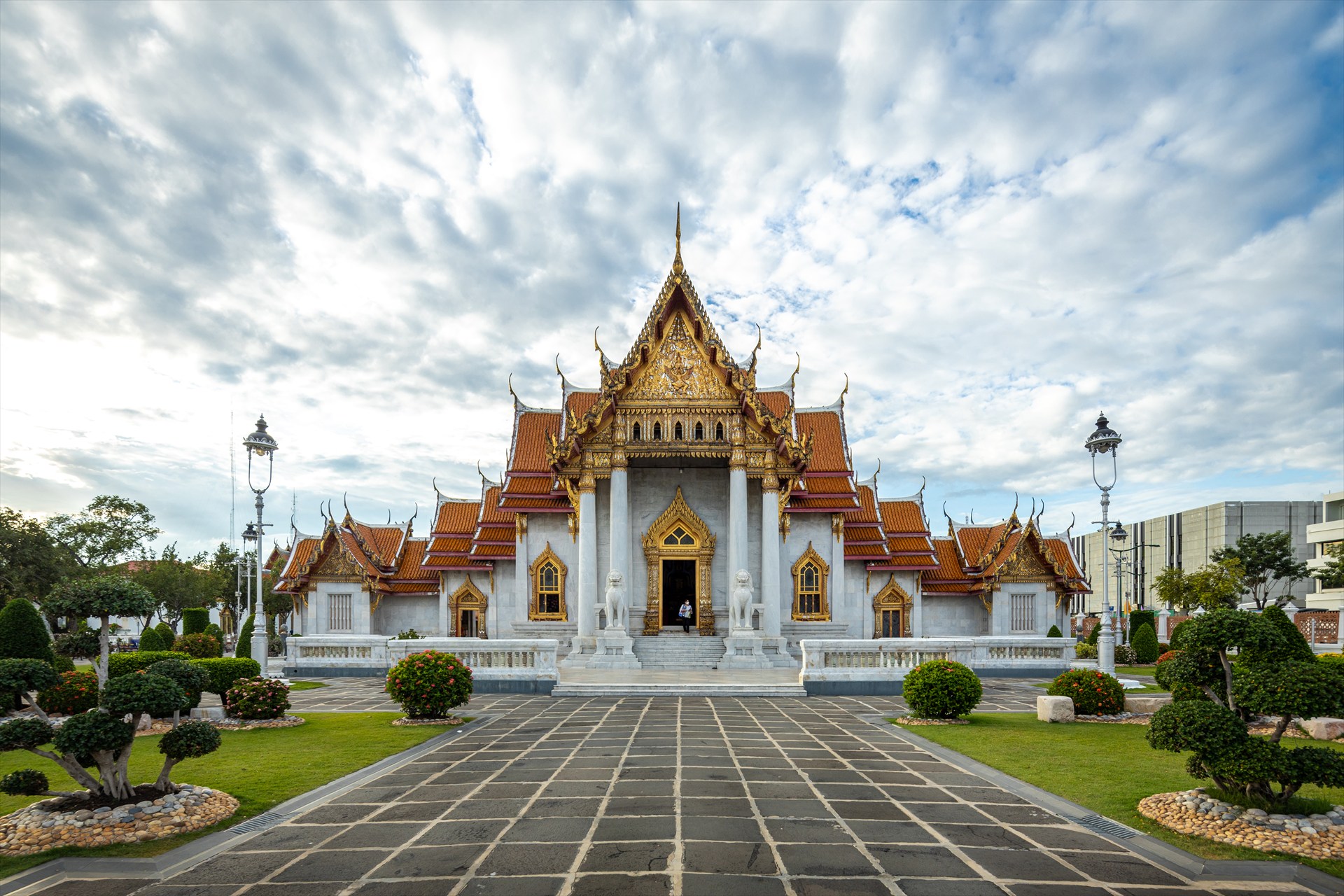

This is not a ranking of sacred places. It is an itinerary choice between two very different kinds of Bangkok memory. Wat Benchamabophit — the Marble Temple — is about proportion, polished surfaces and late-19th-/early-20th-century royal design. Wat Ratchanatdaram's Loha Prasat is about an architectural form you are unlikely to confuse with anything else on the trip: a tiered metal-spired structure rising above the Rattanakosin side of the city.
Choose the Marble Temple
If Italian marble, Rama V-era design, a formal cloister and a quieter Dusit setting sound more interesting than squeezing another Old Town stop into an already dense day.
Choose Loha Prasat
If you want the more unusual silhouette, a walkable Old Town pairing and a temple stop that feels visually different after the Grand Palace, Wat Pho or Wat Arun.
The easiest decision: ask what is already on your map
Loha Prasat wins on route efficiency when you are already in Old Town. Tourism Authority of Thailand's current Japan site lists Wat Ratchanatdaram about a 15-minute walk from MRT Sam Yot. It also sits in the same broad historic geography as Golden Mount and Mahakan Fort, so you can add it without inventing a separate cross-city mission.
If your day already includes the classic river temples, first check the Grand Palace, Wat Pho & Wat Arun order guide. If that route is already long, adding Loha Prasat only makes sense when you still have energy for another architectural stop. If you are debating whether Old Town should occupy your first proper sightseeing day at all, solve that earlier with Bangkok First Full Day: Old Town or Stay Central?.
The Marble Temple is more deliberately off-axis. It is in Dusit rather than in the tight Sam Yot–Grand Palace–river cluster. Current TAT information suggests a short taxi connection from Phaya Thai rather than treating it as a neat walk-off-rail stop. Allow for a taxi from Phaya Thai and visit when the architecture itself is a priority.
The 90-minute test
If you only have around 90 usable minutes, including the approach from the surrounding area, choose the place that needs less explanation in your itinerary.
Already around Sam Yot, Golden Mount or Ratchadamnoen: Loha Prasat is the cleaner choice.
Already in Dusit or deliberately doing a Rama V / royal-architecture route: Marble Temple becomes much more logical.
Starting from Siam or Sukhumvit with no other nearby plan: neither is “free.” Decide which architectural story actually earns the taxi or transfer. If hotel geography is repeatedly making Old Town awkward, the broader Siam vs Old Town stay guide explains the trade-off.
Why the Marble Temple is more than a pretty white façade
Wat Benchamabophit is famous internationally as the Marble Temple because the ordination hall uses imported Italian marble. Current Thailand 2026 visitor material describes the temple as a Rama V-era project built in 1900 and highlights the blend of traditional Thai form with Western material and detailing. TAT's current Japan page also points to Carrara marble, stained glass and the carefully ordered architecture as part of the temple's identity.
The strongest reason to choose it is not “it looks elegant in photos.” The visit has more depth than that. The current Thailand 2026 page highlights a replica of Phra Buddha Chinnarat inside the ordination hall and a cloister displaying 52 Buddha images representing different artistic traditions. If you enjoy comparing Buddhist art rather than only collecting temple façades, that cloister can be the part that justifies the detour.
It also gives you a Bangkok mood that is quite different from the crowded historic core. If you have already spent a full day negotiating landmark density, the Marble Temple can work as a more controlled architectural visit before switching to something non-temple, such as Benjakitti Forest Park vs Lumphini Park.
Why Loha Prasat is the stronger “only one extra temple” pick
Loha Prasat is the part of Wat Ratchanatdaram that changes this comparison. TAT's current Japan site describes the structure as 36 metres high with 37 spires, the central tower containing relics, and the 37 surrounding spires representing the 37 factors leading to enlightenment. It also describes it as the only surviving example of this metal-monastery form.
That rarity matters because first-time Bangkok itineraries usually already contain several roofs, chedis, prangs and richly decorated halls. Loha Prasat adds a different silhouette and a different interior logic rather than simply giving you “one more beautiful temple.” TAT currently notes a 67-step climb inside the central tower to the upper level, so there is also a small vertical component rather than a purely courtyard-based visit.
If elevation and city context are what you are really after, compare it with Golden Mount vs Wat Arun before you go. Golden Mount is the better deliberate skyline experience; Loha Prasat is the more unusual architectural object. Doing both can work because they answer different questions, but you do not need to treat proximity as an order to collect both.
Loha Prasat day
Old Town morning → Sam Yot / Ratchadamnoen area → Loha Prasat → decide whether you still want Golden Mount or whether your temple quota is already full → continue toward Chinatown or another evening district.
If Chinatown is next, use Old Town & Chinatown: Same Day or Separate? to avoid turning “nearby” into a 12-hour endurance test.
Marble Temple day
Central Bangkok or Dusit-side morning → Marble Temple as the main architectural stop → move to a park, museum, food district or hotel reset rather than trying to recreate an Old Town temple crawl in another part of the city.
If dinner is the next decision, Banthat Thong vs Yaowarat helps decide whether you want food-first convenience or a bigger Chinatown sense of place.
Opening hours matter because neither is a late-evening rescue stop
Current official visitor information keeps both experiences firmly in the daytime. TAT Japan currently lists Loha Prasat at 09:00–17:00 daily. For Wat Benchamabophit, TAT Japan says the main hall is open until 17:00, while Thailand's official 2026 Annual Meetings visitor page currently lists 08:00–17:00 Monday–Saturday and 10:00–17:00 on Sundays and public holidays.
Check again on the day you visit, especially around public holidays or religious events. I am deliberately not using admission price as a decision factor here because current official sources do not present the same foreign-visitor fee. When two official pages disagree on a changeable detail, the right editorial answer is to flag the mismatch rather than invent certainty.
The temple-fatigue test is more useful than a “must-see” list
If you have already seen the Grand Palace, Wat Pho and Wat Arun, ask what you still want from another temple.
More royal polish and Buddhist-art detail: Marble Temple.
A form that looks genuinely different from the temples you have already seen: Loha Prasat.
No more sacred architecture today: skip both. Walk a heritage neighbourhood instead with Talat Noi vs Song Wat, or save your attention for a later-night experience such as Pak Khlong Talat.
Can you visit both on the same trip?
Yes, but they should not compete for the same small slot. If you have four or more Bangkok days and architecture is genuinely one of your interests, place Loha Prasat inside an Old Town block and give the Marble Temple its own Dusit-side stop. That preserves the reason each temple is worth visiting.
What I would not do is cross Bangkok simply because both are saved in your phone. The city rewards coherent geography. A first trip becomes easier when you stop asking “Can I fit it?” and start asking “Does this stop make the day better?”
Practical notes for women and solo travellers
Dress for a functioning Buddhist temple. Cover shoulders and knees, and wear shoes you can remove easily where required. The current Thailand 2026 Marble Temple visitor page specifically advises modest clothing.
Do not let a short temple stop create a messy late return. Loha Prasat has the cleaner rail-linked Old Town context; the Marble Temple is more likely to involve a taxi or another road connection. Decide the onward route before you are tired.
Photographs are not the whole visit. Give worshippers and monks space, keep voices low inside sacred areas and avoid treating a quiet religious compound as a set.
If the day is already overloaded, leave. There is no prize for squeezing in another temple before dinner. Bangkok's better evenings often begin because you stopped sightseeing in time.
Which one fits your trip?
- First Bangkok trip, only one extra temple: Loha Prasat.
- Architecture student, design lover or Rama V interest: Marble Temple.
- Already near Golden Mount / Sam Yot: Loha Prasat.
- Already planning Dusit: Marble Temple.
- Already temple-saturated: choose neither and change the texture of the day.
If this decision is happening because you are still designing your first Bangkok days, use the Bangkok destination hub and the Bangkok Experiences index to keep the rest of the trip from becoming one long landmark list.
The short answer
Choose Loha Prasat for a first trip unless the Marble Temple's architecture is specifically what you want to see. Loha Prasat is the more distinctive add-on to an Old Town day. Marble Temple is the better deliberate detour for travellers who care about Rama V-era design, Italian marble and the formal Buddha-image cloister.
Sources checked
Tourism Authority of Thailand Japan — Wat Ratchanatdaram / Loha Prasat
Tourism Authority of Thailand Japan — Wat Benchamabophit
Thailand 2026 Annual Meetings — Wat Benchamabophit visitor information
Fine Arts Department Digital Center — Loha Prasat, Wat Ratchanatdaram
Tourism Authority of Thailand — Bangkok destination overview