
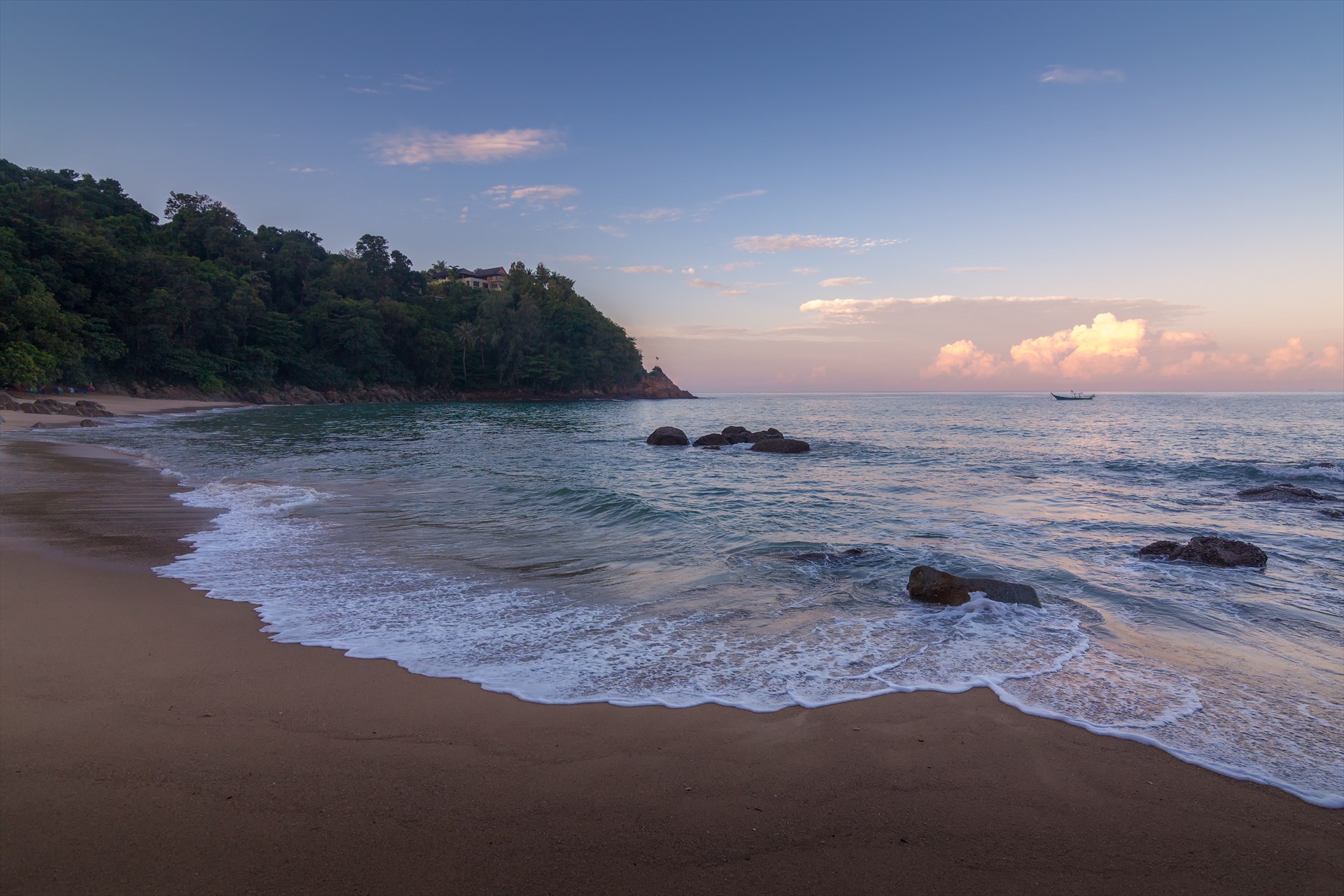
The short answer
Nai Thon is the better default for most first trips. It gives you a broad, recognisable beach stop on Phuket's north-west coast, and Phuket Provincial Government still describes the bay as a place for relaxing and swimming in suitable conditions. Banana Beach is the more specific choice: go because you want a smaller cove and you have checked what the beach is actually like now .
There is one naming problem to solve before anything else. This guide compares Nai Thon with Banana Beach on Phuket's main island, between Nai Thon and Bang Tao. It does not compare Nai Thon with Banana Beach Koh Hey on Coral Island. The Tourism Authority of Thailand has a separate official page for Banana Beach Koh Hey, which is reached by boat from Phuket. If you actually mean that offshore beach, start with the Racha Yai vs Coral Island guide instead.
Why this comparison changed in 2026
For years, the standard internet description of Banana Beach was simple: tiny, hidden, difficult to find, reached by a steep path, much quieter than Phuket's better-known beaches. That is exactly the kind of travel advice that can survive online long after the ground has changed.
Banana Beach is not the same “secret beach” described in old guides
A June 2026 field update by Phuket101 reports that the old hillside access closed in late 2025 and a new north-end parking area opened. The same report describes expanded facilities, numbered sunbeds and a larger beach-club presence. This is independent reporting rather than a government access notice, so treat the exact parking arrangement and fees as something to verify on the day. The important planning point is broader: do not choose Banana Beach because you assume it still functions like an almost-unserviced hidden cove.
That change actually makes the comparison more interesting. Nai Thon is no longer simply “the easier beach” versus “the hard-to-reach secret beach.” The better question is now: do you want a full beach environment, or do you want a smaller cove whose appeal is its scale and shape?
Pick Nai Thon when ease matters
You want to arrive, find a long stretch of sand, choose where to sit, walk the shoreline and leave without making the beach itself a logistics project. It also fits especially well if you are already considering the north-west for accommodation; the Nai Thon vs Nai Yang stay guide explains how much quieter daily life can feel compared with more connected bases.
Pick Banana Beach when the cove is the point
You are not simply looking for “somewhere quiet.” You specifically want a smaller, enclosed-feeling beach and are willing to accept that access, facilities and atmosphere may keep evolving. If what you actually want is a north-west base rather than a half-day outing, compare Nai Thon vs Surin before turning one beach visit into a hotel-location decision.
Nai Thon gives you more margin when the group wants different things
This is the underrated reason Nai Thon works well for couples and small groups. One person can walk. One can lie down. One can look for food or shade. You do not need everybody to agree that “this tiny cove is amazing” for the stop to work.
That matters on a trip where some days are already high-commitment. If you have one or two proper marine days, a simple beach block can be more valuable than another place that needs a specific arrival plan. The Phuket first-full-day guide uses the same principle: a low-friction day is not wasted time when it protects the rest of the trip.
Banana Beach can still be the better memory if everyone genuinely wants it. But the cove works best when its smaller scale is a feature, not when somebody in the group expected a long walkable beach with lots of room to spread out.
Banana Beach is now a “check the current version” beach
Because its access changed recently, Banana Beach deserves a slightly different planning habit from Nai Thon. Do not screenshot an old map, save a blog from 2022 and assume you have solved the route. Check a current map, recent local update and what the entrance looks like close to your visit.
Recent independent reporting says the new access is from the north end and that the older steep hillside path has been closed. That is good news for some travellers — especially anyone who did not want a steep scramble — but it also means old advice about parking, facilities and “hidden beach” atmosphere is stale.
If that uncertainty annoys you, that is already useful information. Choose Nai Thon. Travel decisions get easier when you stop treating every inconvenience as part of the adventure.
Quiet does not mean safe to swim
Phuket Provincial Government explicitly says swimming at Nai Thon is not recommended during the monsoon season because of strong currents. Banana Beach is also on Phuket's west coast, so do not treat a prettier cove or smaller crowd as a safety signal. Check local flags, the water in front of you and current Thai Meteorological Department marine guidance. Recent 2026 Andaman forecasts repeatedly show how quickly south-west monsoon winds, thunderstorms and wave heights can change.
If conditions look wrong, keep the beach as a walk-and-rest stop or switch the day. The cancelled-boat Plan B guide is designed for exactly that kind of decision.
Which beach is better if you do not have a scooter?
Nai Thon is easier to justify. That does not mean public transport is perfect; it means the destination itself is clearer and the beach is less dependent on a particular access point. If you are using ride-hailing or a hired car, solve the return before you mentally switch off.
For Banana Beach, current access has become more organised according to recent reporting, but it is still smart to think about the whole loop: arrival, where the driver can drop you, where you will reconnect, whether mobile signal is reliable enough for your plan, and what happens if you leave later than expected.
If the only reason you are considering a scooter is to make one north-west beach easier, read the Phuket scooter vs Grab guide first. A single beach is not a good reason to learn to ride on unfamiliar roads.
The decision changes with where you are staying
Staying Nai Yang / near airport: Nai Thon is the obvious first test because it fits the same north-west orbit and gives you a clearer beach block without making the day too large.
Staying Bang Tao / Surin: Banana Beach can make more geographic sense if the cove itself interests you, but do not assume it is still the undeveloped detour described in old travel posts.
Staying Kata / Karon / Patong: neither is a casual “while we are nearby” stop. Ask whether a north-west beach is genuinely worth the cross-island time. The Where to Stay Phuket guide helps explain why daily geography matters so much here.
Already have a quiet south-east day: compare what you are adding. Ao Yon vs Cape Panwa may already give you the slow coastal contrast you wanted without another long relocation.
What I would do with a three- or four-day first trip
If Phuket is only one part of a wider Thailand itinerary, I would not create an entire day around choosing between these two beaches. I would keep the decision small.
For Nai Thon: make it a half-day reset. Arrive when you still have useful daylight, stay long enough to feel that you stopped moving, then leave without forcing a second distant attraction into the same block.
For Banana Beach: make the beach itself the experiment. Go because you want to see how the cove feels now. If you are disappointed by the current facilities or atmosphere, do not try to “save” the day by chasing another obscure beach. Move on.
If your Phuket trip is already full of beach decisions, that is a sign to diversify rather than keep comparing sand. You might get more contrast from Phuket Aquarium vs Thai Hua Museum, Kathu vs Bang Pae Waterfall or a viewpoint choice such as Karon Viewpoint vs Windmill Viewpoint.
For women travelling solo: the return plan matters more than the beach ranking
Both beaches can be perfectly reasonable daytime stops, but a quiet beach becomes less relaxing when you are watching your phone battery, wondering where the driver will meet you or leaving after dark without a clear pickup point. Save the exact pickup pin when you arrive, keep enough battery for the return, and avoid turning “I can probably get a ride later” into the plan.
On a monsoon-season day, do not swim alone simply because other people are in the water. Use flags and local warnings, stay out if the current looks wrong, and treat changing weather as a reason to shorten the beach rather than prove the outing was worth it. Thailand Tourist Police can be reached on 1155 if you need traveller assistance.
The easiest way to decide
Ask one question: if the water is not swimmable and the sky is only average, which place would still feel worth the drive?
If your answer is “I would still enjoy a long beach walk, sitting under the trees and having space,” choose Nai Thon. If your answer is “I specifically want that smaller cove and I am curious about how Banana Beach feels now,” choose Banana Beach.
My first-trip pick: Nai Thon
Nai Thon makes a straightforward rest block and depends less on access arrangements that changed recently. Choose Banana Beach when the cove itself is the draw, after checking current access.
If this beach decision is actually exposing a bigger accommodation question, move next to Nai Thon vs Nai Yang, Nai Thon vs Surin or the broader Phuket planning hub. For more activity decisions, use the Experiences hub.
Sources checked before publication: Phuket Provincial Government — Nai Thon Beach and Sirinat National Park; Thai Meteorological Department — Shipping Weather Forecast; Tourism Authority of Thailand — Banana Beach Koh Hey (used only to disambiguate the separate Coral Island beach); Phuket101 — Banana Beach Phuket 2026 access update (recent independent practical context where no equivalent first-party access notice was available); Thailand Tourist Police.
Phuket Provincial Government: Nai Thon Beach · Phuket Provincial Government: Sirinat National Park · Thai Meteorological Department: Shipping Weather Forecast · TAT: Banana Beach Koh Hey · Phuket101: Banana Beach Phuket 2026 update