
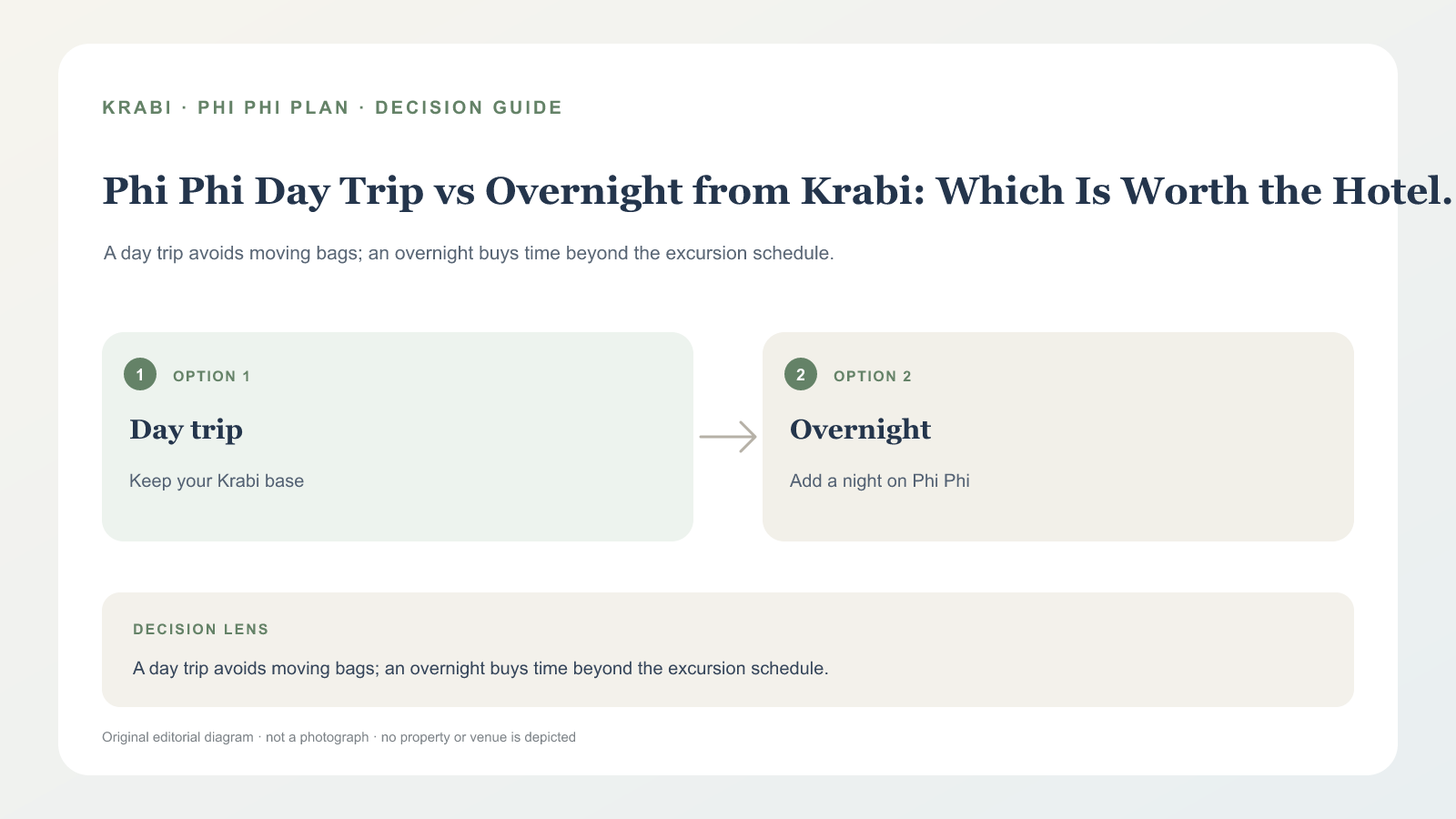
The decision in one minute
Ask whether you want Phi Phi sights or Phi Phi island life between the boats.
Choose the day trip
Best when Phi Phi is one headline marine day inside a wider Krabi trip.
- You have three to five Krabi nights and do not want to split hotels.
- You want a guided circuit rather than managing separate transfers.
- Your luggage can stay dry and untouched at your Krabi hotel.
- You care more about Maya Bay/Pileh/Bamboo-style sightseeing than a Phi Phi Don evening.
Choose one overnight
Best when being on Phi Phi Don after the day-tour rhythm ends is itself worth two calendar days.
- You want dinner, bars, a slower evening or an early island morning on Phi Phi Don.
- You can give up one Krabi hotel night without making the rest of the itinerary rushed.
- You are comfortable moving luggage through piers and checking into another property.
- You have verified transport on both your outbound and return dates.
If your real decision is the boat format rather than the hotel move, compare shared vs private Phi Phi speedboats from Krabi. If your problem is crowd timing, use the separate early-bird vs standard Phi Phi tour guide. Those decisions are not substitutes for deciding whether to relocate overnight.
A day trip is a finished product; an overnight is a mini relocation
That distinction matters more than the raw number of hours. Wangsai Speedboat’s current shared Phi Phi day-tour page publishes a seven-hour 09:00–16:00 programme with hotel pickup windows from several Krabi bases. Its current transfer page, by contrast, lists separate passenger transfers: Ao Nang to Phi Phi at 11:00–12:00 and 14:30–15:30, and Phi Phi back to Ao Nang at 12:45–13:45 and 16:00–17:00. Those are current operator-specific schedules, not universal island timetables, and weather can change marine operations.
The day trip asks one practical question: can you be ready for pickup and handle a full marine day? The overnight asks at least six: which outbound boat, which return boat, where your Krabi luggage goes, where your Phi Phi hotel is relative to Tonsai Pier, what happens if the sea changes, and whether the extra island hours are worth losing a night in your original base.
One hotel move consumes too much of a short trip unless Phi Phi is the main purpose.
Overnight works only when Phi Phi Don itself outranks another Krabi evening or activity.
You have more room to trade one mainland/resort night for a true island phase.
What the overnight actually adds
Tourism Authority of Thailand describes Phi Phi Don as the group’s main inhabited island, with hotels, a pier, restaurants and facilities. That is the real case for sleeping there: you get a different time-of-day relationship with Phi Phi Don. You are staying overnight and experiencing Phi Phi Don at a different pace.
A one-night stay can give you a relaxed dinner after your day bag is back in the room, an evening in Tonsai Village or on Tonsai Beach, and a morning when you are already on the island before your return boat. If your accommodation is away from Tonsai, however, the value equation changes again because some island properties require an additional boat or coordinated transfer. Check the exact hotel’s arrival instructions before assuming “Phi Phi overnight” means you simply wheel a suitcase five minutes from the pier.
Think in usable blocks, not “one night”
The mistake: booking overnight because you want a quieter Maya Bay
Maya Bay is on Phi Phi Leh, not at your hotel on Phi Phi Don. Sleeping on Phi Phi Don can make an early boat product easier to join, but it does not itself grant access, remove national-park rules or guarantee that you reach the bay before other boats. If a quiet Maya Bay experience is the only reason you are considering the hotel move, compare the exact early-boat product first rather than treating the room night as a shortcut.
Thailand’s 2026 national-park closure schedule tells travellers to verify site-specific seasonal status before travel. Maya Bay, Loh Samah Bay and Lo Ko Bay have an established annual 1 August–30 September rehabilitation/safety closure, and the current date sits inside that window. An overnight on Phi Phi Don does not override a protected-site closure. If travelling in August or September, choose between day trip and overnight based on the open itinerary you can actually book, not a Maya Bay photo.
If you are building an August or September trip, check your operator’s replacement route before payment. Wangsai’s current Phi Phi tour page still presents the standard headline circuit while Thai park authorities publish seasonal closures separately. That is exactly why the traveller—not the marketing image—needs to reconcile the two.
The overnight friction is mostly luggage and pier timing
Luggage
A day-tour traveller can leave a full suitcase at the hotel. An overnight traveller turns it into a marine-transfer problem. Pack lighter if possible and confirm baggage rules with the exact carrier.
Two tickets
You need an outbound and a return that both exist on your dates. Do not plan an island night by looking at only one direction.
Hotel handoff
Arrival at Tonsai Pier is not automatically arrival at your room. Check walking distance or any required resort transfer before booking.
Weather margin
Marine schedules are more exposed to sea conditions than a road hotel move. Avoid putting the return from Phi Phi immediately before a flight or another hard, non-refundable connection.
If your next move after Phi Phi is Railay rather than Ao Nang, the current Wangsai transfer page also lists Railay–Phi Phi and Phi Phi–Railay options. That can make an island chain logical, but it is a different trip shape from returning to the same Krabi hotel. The Railay vs Ao Nang before Phi Phi guide is the better place to solve that origin/connection problem.
For a solo woman, evening value needs to be concrete
If you are travelling alone, decide what you will actually do with the Phi Phi Don evening and how you will get back to your room. Tonsai’s core has restaurants, shops and nightlife, but an accommodation pin away from that walkable centre can turn the night into another transport question. Check the final route in daylight on the map, ask the property about arrival from Tonsai Pier, and avoid assuming a beach-looking hotel is an easy walk with luggage after dark.
The day-trip version has a different female-traveller advantage: you return to a room you already know, with your main luggage left behind. That matters after a wet, salty day when the appealing option is often a shower, dry clothes and an easy dinner rather than another check-in.
Do not spend two calendar days on Phi Phi if Krabi is still unfinished
Every overnight has an opportunity cost. If you still want Hong Islands, Railay, a quiet Klong Muang/Tubkaek resort day or an inland day, the overnight can crowd out something that is more distinct. The Krabi four-day islands vs inland guide helps when the real issue is itinerary bandwidth. If you are choosing where to sleep around a long Phi Phi excursion, see Klong Muang vs Ao Nang for a Phi Phi day trip.
For travellers based in Ao Nang without a scooter, the day-trip case is especially strong because a large share of the logistics can be bundled into pickup and return. The Ao Nang without a scooter guide covers the hotel-location side of that convenience. If you are deciding between mainland Ao Nang and Railay more broadly, use Ao Nang vs Railay rather than forcing Phi Phi to answer the whole trip.
When one night on Phi Phi is genuinely worth it
The overnight has a clear win condition: you want to spend a night on Phi Phi Don rather than visit only during a tour stop. It suits travellers who enjoy a trip changing gears—mainland/resort Krabi, then one island night, then onward—more than travellers who value an unpack-once base.
It also makes more sense when you plan a separate morning activity from Phi Phi Don, such as a properly verified early boat, diving or snorkeling product. If underwater time is the real priority, first resolve Krabi scuba vs snorkeling for beginners; you may find that the activity decision matters more than sleeping on the island.
The booking rule
Day trip: choose it when you want Phi Phi’s headline marine circuit and then want your Krabi trip back that evening.
Overnight: choose it when you can name at least two pieces of Phi Phi Don time you genuinely want—usually the evening plus the next morning—and you have verified transport in both directions.
If the only extra benefit you can name is “maybe fewer crowds at Maya Bay,” keep the Krabi hotel and solve the timing/product question instead.
Three checks before you pay for the overnight
- Open two transport tabs. Verify the exact outbound and exact return on your actual dates. Current Wangsai listings show multiple daily speedboat transfers, while Aonang Travel’s current ferry pages demonstrate that some ferry services are seasonal. Never generalise one operator’s timetable to all boats.
- Read the hotel arrival instructions. Confirm whether you walk from Tonsai Pier or need another transfer. This is where a romantic-looking remote beach can become a practical luggage decision.
- Check park status separately from your accommodation. A hotel can be open while a protected marine stop is seasonally closed. In August and September, that distinction is critical.
If the overnight fails any of those three checks, the day trip is not a compromise. It is the cleaner product: one marine day, one hotel base and less dependency between moving parts.
Sources checked
Keep the Krabi loop connected
 Phi Phi format
Shared vs private speedboat
Choose passenger format after you know a day trip is the right shape.
Read guide →Alternative marine dayHong Islands day vs sunset
Compare another Krabi marine day before spending two calendar days on Phi Phi.
Read guide → Connection night
Railay or Ao Nang before Phi Phi?
Choose the better origin when the island transfer is already fixed.
Read guide →