
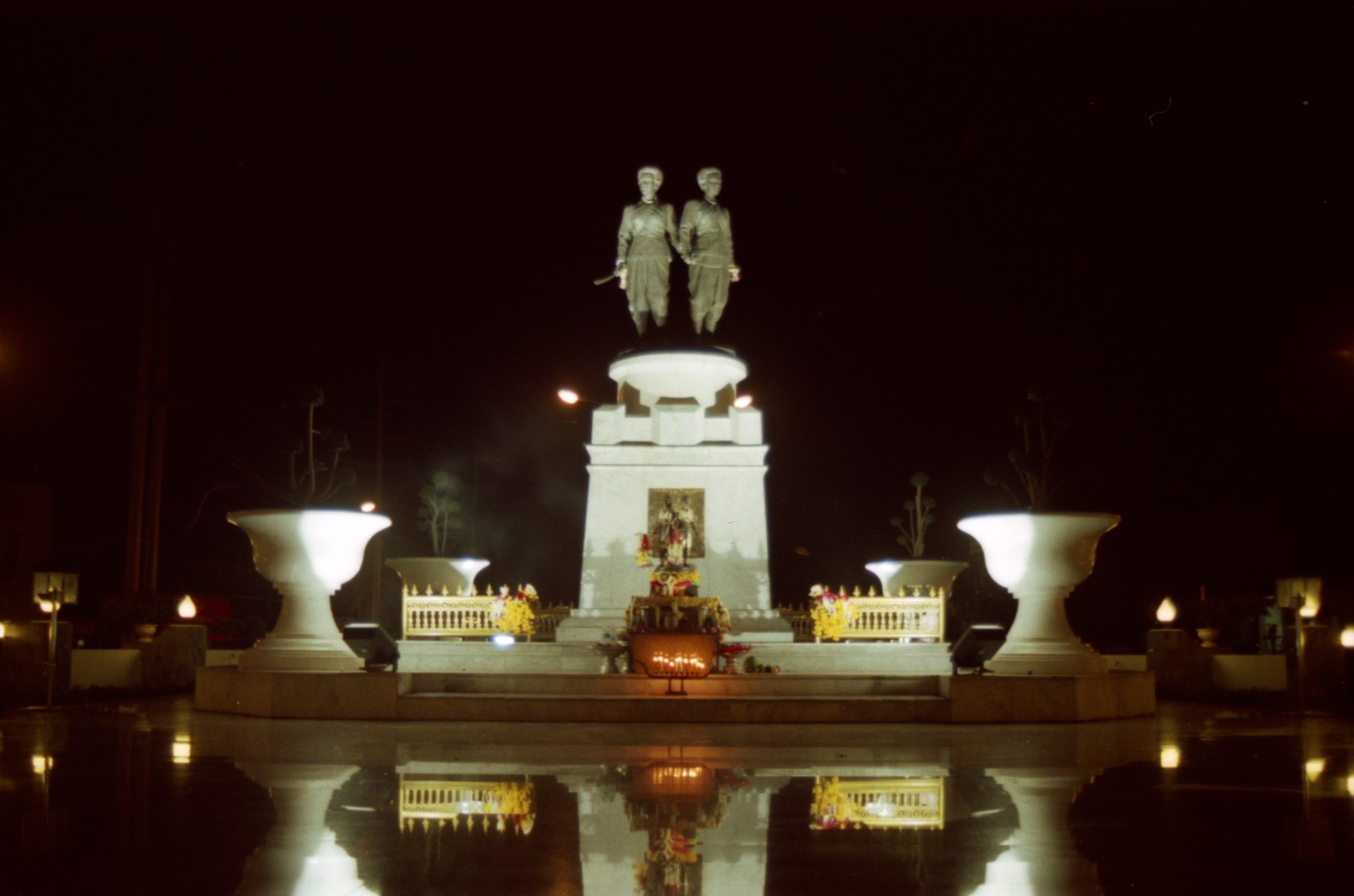
These two places are physically close and historically connected, which makes them easy to confuse as substitutes. They are not. The Heroines Monument is a public memorial in a traffic roundabout. Thalang National Museum was created, in part, to give the Battle of Thalang and Phuket's wider archaeology and culture an actual interpretive setting. If you only have time for one, decide whether you want a symbol or an explanation.
Choose the Heroines Monument
You are already driving through Thalang, want to see the landmark associated with Thao Thepkasattri and Thao Sri Sunthorn, and do not need a full museum visit to make the stop worthwhile.
Choose Thalang National Museum
You want exhibits, context and a clearer explanation of the battle, archaeology, tin mining, local communities and the wider Andaman story. This is the stronger first-trip choice when history is the actual reason for stopping.
If you are already building a north-Phuket day, this decision can sit naturally beside Wat Phra Thong vs Wat Chalong, Mai Khao plane spotting or a quieter-beach decision such as Nai Thon vs Banana Beach. Do not create a separate cross-island journey simply because two heritage pins happen to look important on a map.
The Heroines Monument is a powerful symbol—but a very small visitor experience
Phuket Provincial Government says the monument commemorates the two sisters Thao Thepkasattri and Thao Sri Sunthorn, daughters of the Thalang governor, who helped defend Thalang against Burmese forces in 1785 during the reign of King Rama I. The monument was constructed in 1966 and stands at the Tharue intersection in Thalang, roughly 12 kilometres from Phuket Town.
That civic importance is real. Phuket's current provincial emblem uses the image of the two heroines, and the site remains part of official commemorations. On 13 March 2026, the provincial governor's published schedule again listed a wreath-laying and tribute ceremony at the monument as part of the annual Thao Thepkasattri–Thao Sri Sunthorn commemoration.
What the monument gives you
A direct encounter with Phuket's public memory. It tells you which historical episode the province chose to monumentalise and continues to honour. What it does not give you is much room to understand the battle, the people, the archaeology or the broader social history behind that memory. For that, the museum is the better tool.
Thalang National Museum gives the story enough space to make sense
The Fine Arts Department's current Thalang National Museum material explains that the museum was created around the 200th anniversary of the Battle of Thalang. Its permanent displays go beyond the heroines themselves: the collection covers the Battle of Thalang, archaeology from Phuket and the Andaman coast, local ways of life, art and cultural material from communities in the region.
That wider frame is the museum's strongest advantage. Phuket history extends beyond Old Town shophouses and tin-mining heritage. A visitor can place the Thalang battle beside prehistory, coastal archaeology, mining, rubber, local ethnic communities and the island's changing economy. If that sounds like the kind of context you want, the museum gives you much more value per historical stop than the roundabout monument.
If your main interest is specifically Phuket's industrial history, compare Phuket Mining Museum vs Thai Hua Museum. If you are more interested in Chinese-Phuket community history and domestic life, Thai Hua Museum vs Chinpracha House is the more useful fork.
Use the Fine Arts Department for current museum hours
The current Fine Arts Department page lists Thalang National Museum as open Wednesday–Sunday, 09:00–16:00, closed Monday, Tuesday and national holidays, with the current foreign admission listed as 100 THB. An older Phuket provincial tourism page still says the museum is open every day except public holidays. Because those official sources conflict, use the Fine Arts Department—the museum's operating authority—as the planning baseline and re-check before you leave.
The route decision: when does either stop actually fit?
Airport / Mai Khao day
Potentially good fit. If you are already moving between Phuket Airport, Mai Khao or the north-west coast and the rest of the island, Thalang is not a wild detour. Pairing the museum with a north-side route can be more coherent than adding another Old Town museum later.
Bang Tao / Surin / north-west stay
Reasonable if history matters. You are geographically closer than travellers based in Kata, Karon or Rawai. A structured museum visit can work on a weather-compromised morning before returning to the coast.
Patong / Kata / Karon short trip
Higher friction. If you only have three or four usable days, do not open a long road journey for a 10-minute monument photo. Either protect a proper Thalang Museum visit or spend that time on a more route-coherent experience. Start with Phuket Old Town vs Kata Beach if your base decision itself is still unresolved.
When the monument alone is enough
There are good reasons to stop at the monument without entering the museum. You might be passing the intersection anyway. You might already know the historical story and simply want to see the civic memorial. Or you may be travelling on a day when the museum is closed.
In those situations, treat the monument as a brief contextual stop, not an attraction that needs an hour. The useful move is to understand the two names before you arrive, notice how prominently the heroines sit in Phuket's official identity, then continue your route.
The closest comparison in spirit is not another museum—it is deciding whether a small landmark deserves a detour at all. The same logic appears in Khao Rang vs Phuket Old Town: a compact landmark can be worthwhile when it sits naturally in the route, but weak when it forces a new journey.
When the museum is clearly worth the extra time
Choose the museum if you want to leave with answers rather than only a photograph. That is especially true if you care about the Battle of Thalang, Phuket before mass tourism, Andaman archaeology or the way different communities shaped the island.
You already have Old Town history
Museum still adds something different. Old Town explains later urban and Chinese-Phuket history. Thalang Museum gives you a stronger northern-island and battle/archaeology layer.
Rain has weakened a beach plan
Museum can be a deliberate substitute. If you need a wider indoor-learning decision, use Phuket Aquarium vs Thai Hua Museum rather than automatically turning every rainy block into Old Town.
You only want one history museum
Choose the subject, not the ranking. Thalang Museum for battle/archaeology/Andaman history; Mining Museum for industrial systems; Thai Hua for Chinese-Phuket social history.
Do both if you are already there?
Yes—if the museum is open. Phuket Provincial Government says Thalang National Museum is around 200 metres from the Heroines Monument on the Pa Klok road. Because the monument is so brief and the historical themes overlap, this is one of the rare cases where doing both does not automatically mean overplanning.
The best sequence is simple: see the monument first for the public symbol, then use the museum to unpack the story. If you leave the museum with appetite for more Phuket history, continue later with how long to spend in Phuket Old Town rather than trying to make one Thalang morning explain the whole island.
Women travelling solo: the practical issue is traffic and return planning, not a fake “safety ranking”
The Heroines Monument is physically located at a major traffic roundabout. Do not turn a ten-minute history stop into a risky road crossing for a better photograph: use a legal parking/drop-off point and follow the current pedestrian layout rather than stepping into traffic. Thalang National Museum is a staffed, time-bounded attraction, which makes the visit easier to structure, but you should still know how you are leaving before the museum closes. If you are using a driver or ride-hailing service, save the exact museum pin and keep enough phone battery for the return. Thailand Tourist Police currently lists 1155 for traveller assistance.
What if your Phuket trip is already history-heavy?
Then skip both unless Thalang is genuinely the story you want. Phuket has a dense history cluster now: Mining Museum vs Thai Hua, Thai Hua vs Chinpracha, Wat Chalong, Old Town and Thalang can easily become a museum-and-monument checklist.
A first trip usually benefits more from contrast. If you have already spent serious time on heritage, protect a different layer of the island—perhaps Kathu vs Bang Pae Waterfall, Koh Sirey vs Rawai, or simply return to the coast.
Final answer
Choose Thalang National Museum if history is the reason you are stopping. It turns the 1785 story into a proper museum visit and adds archaeology and Andaman context. Choose the Phuket Heroines Monument if you are already passing, want the civic memorial itself, or the museum is closed. If both are open and you are already in Thalang, do the monument first and the museum second—the two stops are close enough that this pairing is unusually efficient.
For the next layer of planning, use the Phuket destination hub or browse more Do Thailand experiences.