
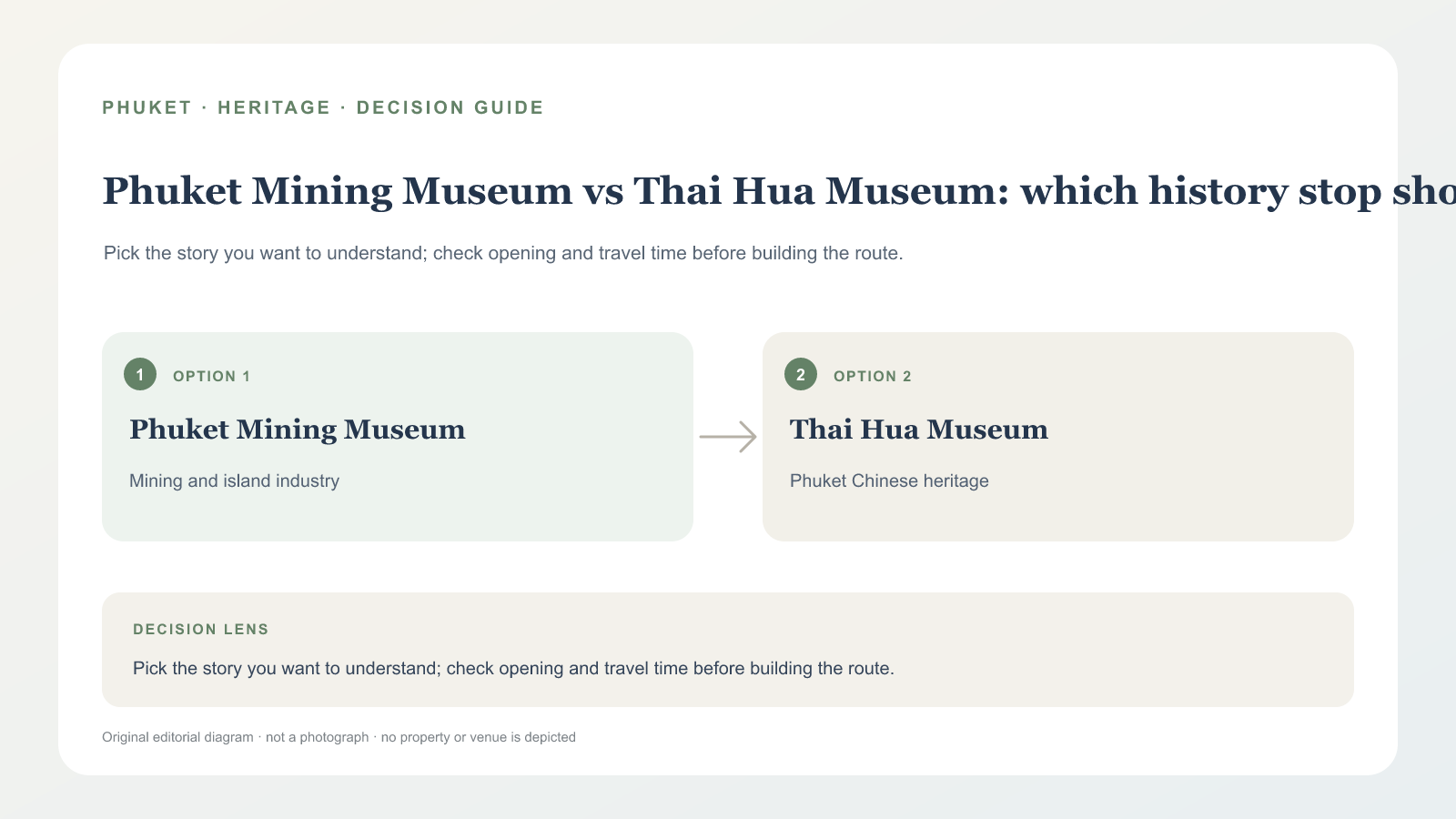
These museums overlap on one important fact: tin mining helped shape modern Phuket. They do not tell the same story. Phuket Mining Museum starts with extraction—the methods, equipment and working life behind the tin economy. Thai Hua starts with people—the Hokkien community, education, festivals, food and the way a mining-era migrant society helped build the island you now walk through.
Choose Phuket Mining Museum
You want the industrial system: how tin was mined, what different mining methods looked like, what miners' lives involved and why Kathu mattered to Phuket's economy.
Choose Thai Hua Museum
You want the human system: migration, schooling, community institutions, local dress, food, festivals and how Chinese-Phuket society evolved from the mining era into modern Phuket.
If you have not yet decided how much daytime Old Town deserves, solve that first with how long to spend in Phuket Old Town. If your choice is specifically between Thai Hua's broad social history and a preserved family residence, use the narrower Thai Hua Museum vs Chinpracha House comparison.
The most useful way to compare them: production story vs community story
Phuket Provincial Government describes Phuket Mining Museum as a learning centre created in Kathu because the district was once covered with tin-mining activity. The museum has both outdoor displays of mining methods and indoor exhibitions about the history of mining and miners' lives. Its current Kathu municipal listing still places the museum on the Kathu–Ko Kaew road and describes a Sino-Portuguese-style museum building built around the island's mining history.
Thai Hua is a different lens on the same boom. The museum's own current site says the institution exists to explain the history of overseas Chinese settlement on Phuket, including livelihoods, customs, knowledge and the history of the island's early Chinese school. Phuket Provincial Government adds the details that make the museum particularly useful on a first trip: Hokkien migration, local food, clothing, festivals, prominent Phuket figures and the island's economic evolution from tin mining through rubber and tourism.
The non-obvious answer: Thai Hua can make the Mining Museum easier to understand—and vice versa
Mining Museum answers “how did the industry work?” Thai Hua answers “what kind of society grew around that industry?” If you are deeply interested in Phuket history, the two museums are complementary. If you only have one, pick the question you actually want answered instead of treating them as interchangeable rainy-day attractions.
Route friction is the real first-trip tiebreaker
Thai Hua
It sits on Krabi Road inside Phuket Old Town. That means the museum can be one chapter of a larger day rather than the reason for the entire transfer. You can learn the context, then immediately see the streets, façades, food and community layers the exhibits were explaining.
Mining Museum
It is in Kathu on the Kathu–Ko Kaew road. For most visitors it works best as a deliberate stop rather than something you casually add while walking Old Town. The detour becomes much more logical if Kathu or central Phuket is already part of your day's geography.
What this means
Do not compare only the time spent inside the building. Compare door-to-door commitment. A 90-minute museum that requires a dedicated transfer can cost more itinerary space than a two-hour museum already embedded in the neighbourhood you planned to explore.
If your wider question is whether an inland culture block should be a temple or a heritage district, the Wat Chalong vs Phuket Old Town guide handles that decision. If you are choosing a Phuket Town viewpoint instead, use Khao Rang vs Phuket Old Town rather than forcing a museum into a scenic afternoon.
Current visitor information: use hours as a constraint, not as the reason to choose
Kathu Municipality's current Phuket Mining Museum page lists daily opening from 09:00 to 16:00 and currently shows foreign admission at 100 baht. Museum Thailand independently carries the same 09:00–16:00 schedule and identifies the operator as a local administrative organisation. These are the current published figures; check for special closures before your visit.
Phuket Thai Hua Museum's own current website lists 09:00–17:00 Monday–Sunday and gives the Krabi Road address and contact details. Older government and travel pages do not always agree on admission or weekly closure details, so this guide does not use ticket price as the winner. Re-check the museum's own site or contact channel for the day you plan to go.
If it rains, Thai Hua is the cleaner weather-proof choice
Both museums have indoor exhibition space, but Phuket Mining Museum also has an outdoor component explaining mining methods and equipment. In persistent heavy rain you may still learn a lot inside, but you can lose part of the attraction's intended experience. Thai Hua is easier to treat as a contained indoor stop—although your Old Town walk afterwards will still depend on the weather.
If a cancelled marine day is forcing a larger itinerary change, use the dedicated Phuket cancelled-boat Plan B instead of pretending one museum can automatically replace a full island excursion.
Which museum fits the rest of your Phuket plan?
Thai Hua pairs naturally with
Old Town streets, cafés, heritage buildings and an evening in town. If it is your first complete Phuket day, compare beach recovery vs Old Town before committing the whole day inland.
Mining Museum pairs naturally with
A Kathu or central-island route where the industrial-history stop is already geographically sensible. If you are choosing between different inland outdoor detours, the Kathu vs Bang Pae Waterfall guide helps keep nature and history blocks separate.
If you only want one indoor learning attraction but are not sure history is the subject, compare Phuket Aquarium vs Thai Hua Museum. If your evening is still open after the museum, Chillva Market vs Naka Weekend Market solves a very different question: how much shopping and market energy you actually want.
Practical notes for women travelling solo or with a friend
Thai Hua's Old Town location makes it easier to finish the museum and continue on foot in an active neighbourhood. Mining Museum is the one where I would plan the return ride before going inside rather than assuming a car will appear exactly when you leave. For either museum, keep your phone charged and use a licensed or trackable transport option if you are returning after the surrounding area has quietened down. Thailand Tourist Police assistance is available on 1155.
For the broader question of where transport friction is worth paying for across the island, start with Where to Stay Phuket rather than solving every day as a separate taxi problem.
Who should pick which?
Pick Thai Hua Museum if you are on a first trip, you want one history museum, you are already visiting Old Town, or you care about Hokkien migration, Baba-Peranakan culture, education, food and how the mining economy shaped the city's social fabric.
Pick Phuket Mining Museum if industrial heritage is a real interest, you want to see mining methods and miners' lives rather than just hear that “Phuket used to mine tin,” or you have a Kathu/central-island route that makes the detour sensible.
Do both only if Phuket history is one of the reasons for the trip. The museums become stronger as a pair when you consciously use one to explain production and the other to explain community. Do not spend half your short island trip collecting museums just because the themes overlap.
The decision rule
For one first-trip Phuket history museum, choose Thai Hua when you want the museum to deepen the neighbourhood you are already visiting. Choose Phuket Mining Museum when tin extraction, technology and miners' lives are important enough to justify a dedicated Kathu detour.
Continue with the Phuket destination hub or browse the Do Thailand Experiences guides.