
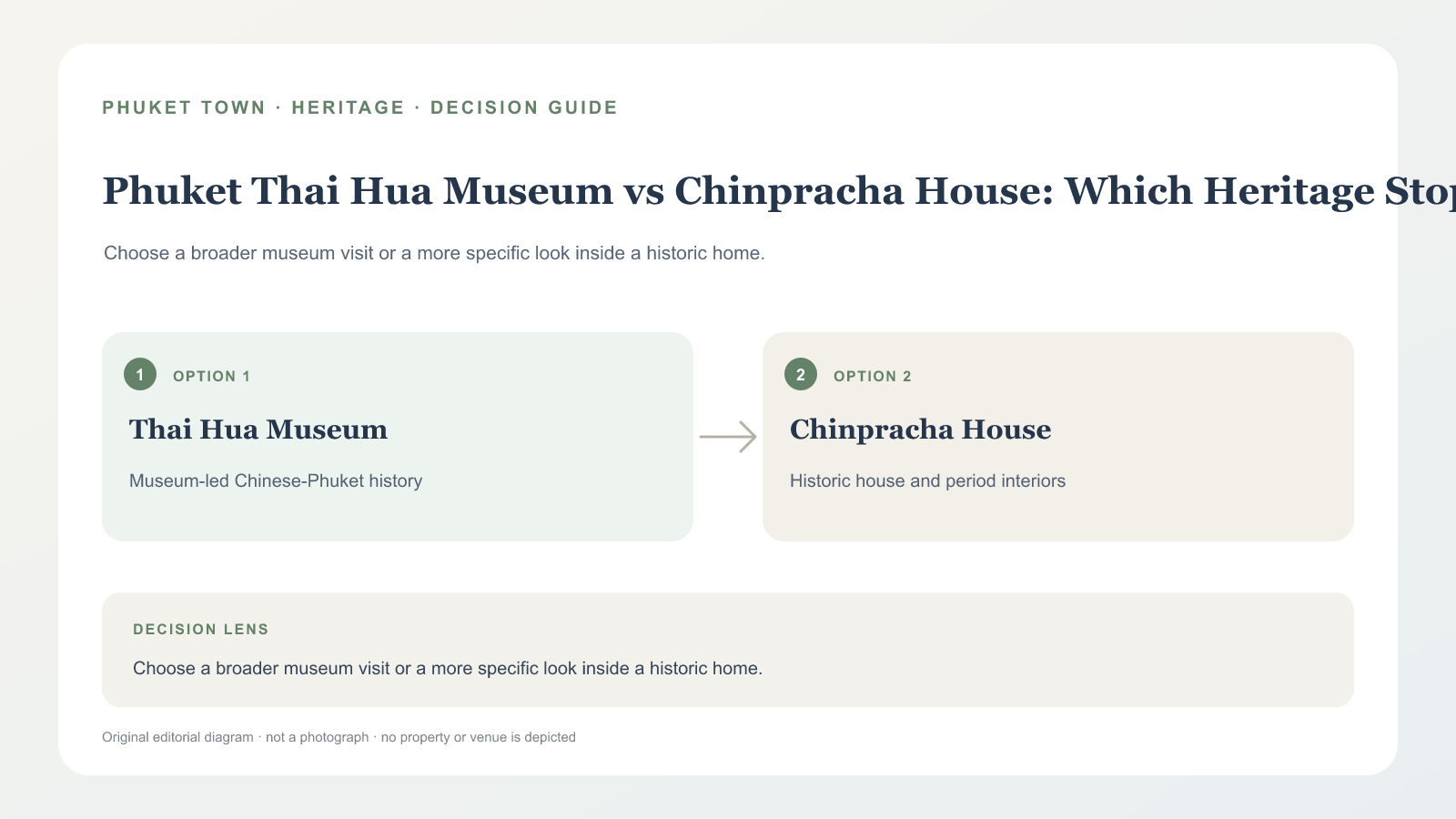
These two stops are easy to confuse because both sit on Krabi Road and both connect to Phuket's Sino-European built heritage. They are not duplicate museums. They answer different questions.
Thai Hua asks: how did Chinese migration, education, tin mining, food, festivals and economic change shape Phuket? Chinpracha House asks a much more intimate question: what did life inside one prosperous old Phuket family home actually look like?
The quickest way to choose
Choose Phuket Thai Hua Museum if this is your first serious heritage stop in Phuket. Its displays give you context that carries into the rest of Old Town.
Choose Chinpracha House if you already understand the broad story and want architecture, original household objects and the feeling of stepping inside a preserved residence rather than reading a citywide narrative.
If you are still deciding whether Old Town deserves a daytime block at all, solve that larger question first with the Phuket Old Town full-day vs evening guide. This page assumes you have already protected some daytime and are now deciding which interior deserves it.
Thai Hua = context first
The current Phuket provincial museum page describes the building as Phuket's first Chinese school, with the present Sino-European structure built in 1934. Inside, the story expands beyond the school itself into Chinese migration, notable Phuket figures, local dress, food, festivals and the island's economic shift from mining through rubber and tourism.
That makes Thai Hua useful before a wider Old Town walk: the façades outside stop being just pretty façades.
Chinpracha = house first
Phuket provincial material describes Chinpracha House as a preserved Sino-European family home more than a century old. The point is not a broad timeline. It is the house: gilded Chinese-character doors, a central open-air courtyard and well, Italian floor tiles, Chinese mother-of-pearl furniture, family photographs and household objects.
It works best when the residence itself is the exhibit you care about.
The real choice is breadth versus intimacy
You want to understand Phuket
Thai Hua. Its subject is wider than one building or one family. The museum helps connect Hokkien migration, mining wealth, local culture and the modern tourism economy.
You notice interiors more than timelines
Chinpracha House. The courtyard, materials, furniture and household layout do more of the storytelling than exhibition panels.
You are doing your first Old Town walk
Thai Hua. Tourism Authority of Thailand material specifically presents it as a place to learn the island's Chinese-Phuket history before exploring the surrounding streets.
You have already read the broad history
Chinpracha House. It adds physical, domestic detail rather than repeating another overview.
You dislike uncertain visitor access
Thai Hua is the easier planning default, but verify both. Current official visitor information for Chinpracha is more conditional because the house remains connected to the family and access details can change.
Why Thai Hua is usually the better first-trip pick
A first visit to Phuket Old Town is unusually easy to flatten into coloured shutters, café stops and a few streets. Thai Hua fixes that problem. Phuket provincial material traces Chinese settlement, clothing, local food, festivals and the economy from tin mining into tourism. That context changes how you read the neighbourhood.
This is also why Thai Hua pairs so well with the Sunday-market vs weekday Old Town decision. Whether you visit on a busy Sunday or a quieter weekday, understanding the community before the evening makes the district feel less like a decorative set.
If your Phuket trip is mostly beaches, boats and resort time, one well-chosen cultural interior can do more for variety than squeezing in several minor stops. The Wat Chalong vs Phuket Old Town guide handles the bigger cultural choice if you have not yet committed to the city at all.
When Chinpracha House is the more memorable stop
Chinpracha becomes the better answer when your interest is architectural rather than explanatory. The provincial description highlights the ventilation-friendly central opening, small water well, imported Italian tiles and Chinese furniture. These are details you cannot get from looking at shophouse façades from the pavement.
The house is also useful for travellers who already know the broad Chinese-Phuket story and want to see how wealth, trade and design translated into domestic space. In that sense, it complements rather than competes with a broad museum.
But treat the house as a preserved residence, not a theme attraction. The Tourism Authority of Thailand's current Japan-language visitor page says descendants still live there, advises contacting ahead, and notes that photography without permission is not allowed. That is a meaningful practical difference from a conventional museum visit.
Do not use opening hours as the tie-breaker without checking again
Current official sources are not perfectly aligned. TAT's current Japan-language page lists Phuket Thai Hua Museum as 09:00–17:00 with Monday closure, while an older Phuket provincial museum page still says it is open daily. For Chinpracha House, TAT currently lists 09:00–16:00, irregular closing days and advance contact, while Phuket provincial material says it opens daily.
Use this article to choose the experience, then verify the exact access details directly before you travel. Do not build a tightly timed Old Town day around a heritage interior just because one official page looks definitive.
Can you do both? Yes—but only when Old Town is genuinely a priority
Tourism Authority of Thailand's current one-day Phuket route includes both Phuket Thai Hua Museum and Chinpracha House in the same Old Town-focused sequence. They are both on Krabi Road, so doing both is geographically reasonable.
That does not mean every first trip needs both. If you have only a four-to-five-hour Old Town block and still want street walking, coffee or lunch, architecture and dinner, two heritage interiors can consume the part of the day that gives the district its wider texture.
If you choose Thai Hua
Do the museum while it is open, then let the exhibits improve the rest of your walk. If the evening is Sunday, continue into the market; otherwise keep the district slower. The Naka Market vs Sunday Walking Street guide helps if you are choosing between Phuket's two weekend-market formats.
If you choose Chinpracha House
Place it inside a daylight architecture block rather than treating it as a late-evening add-on. The experience makes more sense when you have just been looking at Old Town's built heritage and want to see what the inside of a historic house adds.
If weather has wrecked a boat day
Do not automatically turn one museum into an entire rainy-day plan. Use the cancelled-boat Plan B guide first; a marine cancellation and an island-wide bad-weather day are not the same problem.
What if your hotel is on the west coast?
Do not let a museum choice quietly become a transport problem. If you are staying in Patong and finishing Old Town later, the Old Town to Patong Smart Bus vs Grab guide is the better place to settle the return. If you are still deciding whether the repeated geography of Old Town suits your stay at all, compare Phuket Old Town vs Kata Beach or start with Where to Stay in Phuket.
If your first usable day is the one you are trying to fill, do not use an indoor museum as an excuse to ignore arrival fatigue. The first-full-day beach recovery vs Old Town guide solves that sequencing decision before you commit to any museum.
Women travelling solo: the practical difference is control
Thai Hua is the more conventional museum-style stop. Chinpracha House asks for a little more awareness because it is a preserved family residence with current official guidance about advance contact and photography permission. Follow instructions inside, do not assume every room is visitor space, and avoid planning an extremely tight connection immediately afterward.
If you are returning to a beach base after dark, decide the return before dinner rather than after your phone battery and patience are both lower. Neither heritage stop is worth turning the evening into a transport gamble.
If you only remember one rule
Thai Hua tells you why Phuket Old Town looks and feels the way it does. Chinpracha House shows you what one part of that history felt like from inside a home.
For most first-time travellers, explanation beats detail on the first visit, so Thai Hua wins. Chinpracha becomes the smarter choice when architecture, interiors and domestic history are already the thing you are chasing.
The Do Thailand pick
First visit, one indoor heritage stop: Phuket Thai Hua Museum. Choose Chinpracha House instead when a preserved historic residence interests you more than a citywide cultural narrative.
Then keep the rest of the trip in proportion. If your city afternoon is still competing with a viewpoint, use Khao Rang vs Phuket Old Town; if you already have enough Phuket Town scenery and want another hill stop, Khao Rang vs Monkey Hill solves that separate decision.
Continue planning from the Phuket destination guide or browse more Thailand experiences.