
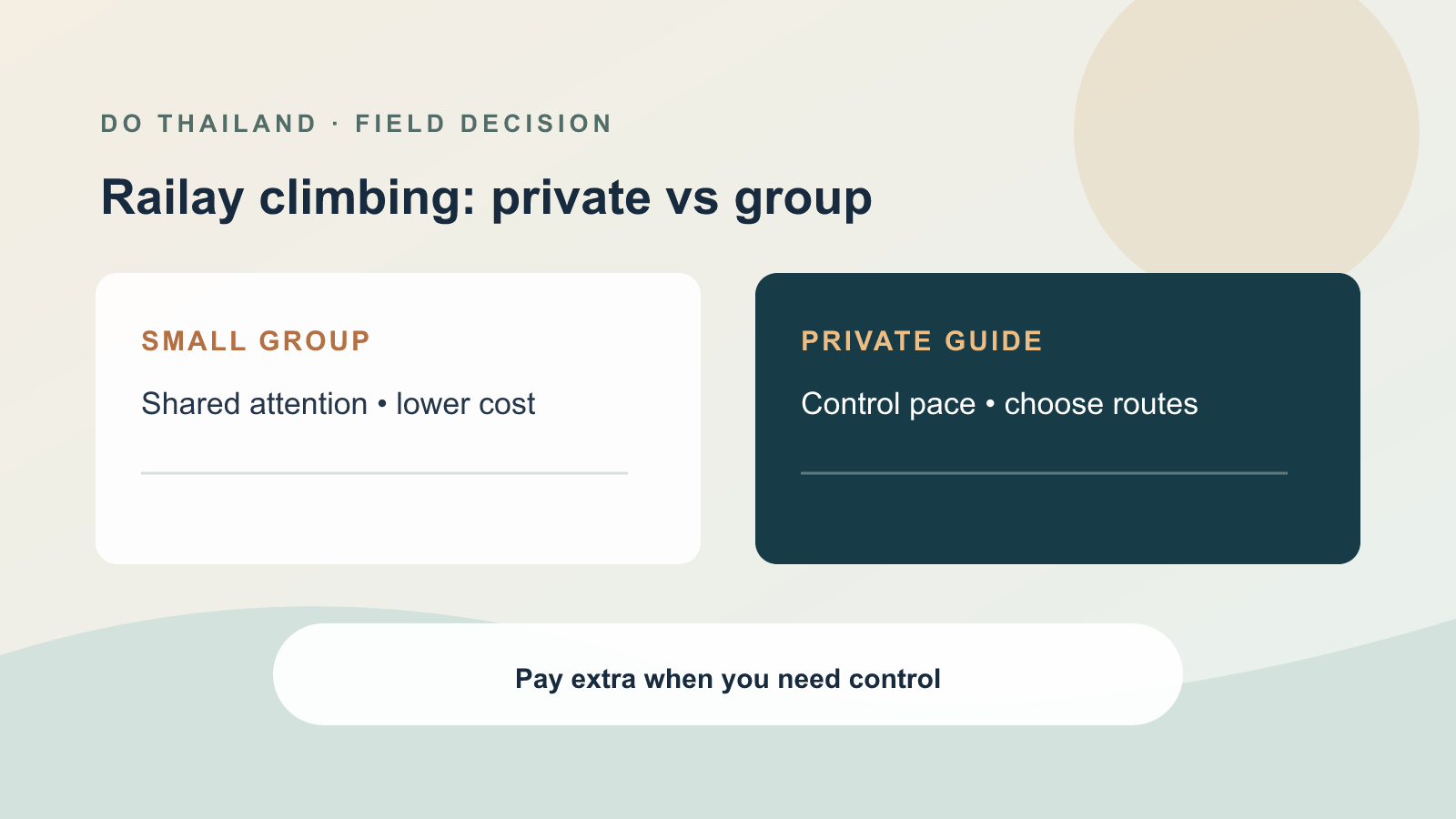
Railay's limestone makes climbing look like one of those activities where paying for the premium version must create the “proper” experience. That is not automatically true. Thailand's official tourism material still identifies Krabi's limestone cliffs as a major draw for climbers, and current operators sell both group and private formats on Railay. The useful question is narrower: what do you need the guide to control for you?
If you are still deciding how much of the day to give climbing, read our Railay half-day vs full-day climbing guide first. Duration and format are separate purchases. A private half-day can be more useful than a shared full day for one traveler, while a small-group half-day can be exactly enough for another.
The private-guide verdict in 30 seconds
Book the group course when you are a beginner who wants a real introduction, you do not mind taking turns, and you would rather keep budget for another Krabi day. Real Rocks currently states a maximum of three to four climbers per guide on its group trips, which is already a fairly intimate coaching ratio compared with many mass-market excursions.
Book private when you need the session to bend around you: a nervous first-timer who wants more direct reassurance, an indoor climber who wants route choice rather than a general introduction, or two friends with noticeably different ability who do not want the stronger climber waiting while the beginner catches up.
Do not pay for private just because “group” sounds crowded. Check the operator's actual guide ratio first. The premium is much easier to justify when it buys control over pace and route selection rather than simply fewer strangers in the photo.
The biggest surprise: the group can already be small
Real Rocks currently publishes a maximum of three to four climbers per guide for its group trips. That changes the economics of the decision. You are not necessarily choosing between one guide for you and one guide for twenty people. You may be choosing between one-to-one or one-to-two attention and a small rotation of three or four climbers.
For a complete beginner, that small group can actually be useful. You watch someone else climb before it is your turn, hear corrections that may apply to you, and get short recovery periods between attempts. If you are mildly nervous rather than deeply anxious, those pauses can feel better than being the only person under constant instruction.
The downside is obvious once your goals become specific. A group guide has to keep several people moving safely and fairly. Even with a small group, you cannot expect every route choice, coaching cue and rest period to revolve around your own project.
Shared rhythm
Good when you want a social introduction and are comfortable taking turns rather than maximizing every minute on the wall.
Controlled pace
Good when fatigue, fear, skill goals or route ambition mean the session needs to accelerate or slow down around you.
“Private must be safer”
Do not buy a format based on that assumption. Safety depends on the operator, guide, conditions, briefing, equipment and your own compliance—not simply whether strangers are present.
What private actually changes
Real Rocks describes its private course as genuinely private: you are not mixed with other climbers, and the climber can choose routes and difficulty subject to the guide's approval. That is the most important operational difference. It lets the day become more responsive instead of merely less crowded.
For an experienced indoor climber, this can matter quickly. You may not need a long introduction to basic movement, but you may need help reading unfamiliar limestone, choosing a sensible grade and adapting indoor habits to outdoor rock. A private guide has more freedom to keep adjusting the route sequence around how you are actually performing.
For a nervous beginner, the value is different. The point is not climbing harder. It is removing the pressure to keep up with people you do not know. If you need extra time to understand the commands, check your harness, repeat the first easy route or simply stand at the bottom for a minute before starting, private time can make the session feel less like a queue you are delaying.
Use this four-signal private-premium audit
1. Your goals are specific
You already climb, have a grade or technique goal in mind, or want the guide choosing routes around your ability rather than running a general introduction.
2. Your confidence needs its own pace
You know you may need more explanation, repetition or recovery time and would be distracted by feeling that other guests are waiting.
3. Your group has a real skill gap
One friend is experienced and another has never climbed. Private guidance can make it easier to alternate difficulty without the whole session serving the average ability.
4. Climbing is a headline experience
If this is one of the main reasons you came to Railay, buying control makes more sense than if you simply want one adventurous morning between beach and boat days.
Two friends with different abilities are the strongest private case
Couples and friends often assume private guiding is mainly a luxury for solo travelers. In Railay, the better case can be two people who want to climb together but need very different things from the guide.
Imagine one person climbs indoors every week and the other has never worn a harness. In a group session, the experienced climber may spend more time on easier introductory terrain than she wanted, while the beginner may feel pressure watching stronger people move quickly. A private booking gives the guide more room to alternate routes and attention without trying to keep unrelated guests on the same rhythm.
That does not mean the two climbers will automatically get completely separate routes or unlimited simultaneous climbing. Real Rocks' current private pricing structure specifies one guide and one rope for two or three climbers. The useful upgrade is the guide's attention and route planning around your party, not the fiction that everyone gets a personal climbing lane.
If your friend is only coming because you asked her, keep the day smaller
Do not use private guiding to solve a lack of interest. If one person genuinely does not want to climb, paying more for a private full day can turn a mismatch into a more expensive mismatch. A half-day climbing session is often the better compromise: the enthusiastic climber gets a substantial experience, while the rest of Railay still has room for Phra Nang, lunch, kayaking or a slow hotel afternoon.
If you both want an active but less vertical activity, compare independent vs guided Railay kayaking instead. The physical and confidence demands are different enough that “we want something active” should not automatically become rock climbing.
Beginner vs experienced climber: the private premium buys different things
Complete beginner
Start with group unless you know you need extra confidence support. Real Rocks' current group half-day is explicitly positioned for people who have never climbed before, and the published guide ratio is already small. Private becomes rational when social pressure, pace or learning style would otherwise get in the way.
Indoor or returning climber
Private becomes easier to justify. You are more likely to notice the value of route choice, more continuous feedback and less time spent repeating material you already understand. If you want formal skill progression rather than a guided outing, check whether a dedicated study course is actually the better product.
Solo female traveler: private is a comfort choice, not an automatic default
If you are traveling alone, a private guide can remove the uncertainty of who will be in your group and let you communicate directly about confidence, rest and pace. But that does not make it automatically better value. A published three-to-four-person guide cap means the group option can still be compact, and some solo travelers prefer having other participants around between climbs.
The more practical check is the whole handoff: where you are collected, whether you are joining at the operator's shop or traveling by boat, what you need to carry, and how you will get back to your hotel with dusty clothes and tired arms. Confirm the current pickup point and return process rather than assuming “private” also means door-to-door private transport.
Your Krabi base can erase part of the value
Real Rocks currently includes Railay transfers from several Ao Nang-side areas and Ao Nam Mao, while it lists additional transport charges for Krabi Town, Klong Muang and Tubkaek. Exact fees and availability can change, so check the operator for your date rather than using an old screenshot as a budget.
This is why hotel location matters even though the climbing itself happens on Railay. If you are still choosing a base, Ao Nang vs Railay is the broad decision. Sleeping on Railay removes the mainland boat handoff from your morning, while Ao Nang gives you much more flexibility for the rest of the trip.
The activity is already where you sleep. Your main trade-off is whether climbing deserves your best luggage-free hours. Use one night vs two nights on Railay and Railay East vs West to protect the rest of the stay.
These are currently the simpler mainland pickup zones for Real Rocks. Compare Ao Nam Mao vs Ao Nang if repeated Railay access is already shaping your hotel choice.
The resort may be the bigger investment than the activity. A private climbing booking makes less sense if you are also giving away a large chunk of the resort day to transfers. Our Klong Muang vs Ao Nang and Tubkaek vs Klong Muang guides explain that isolation trade-off.
If you are arriving into Railay close to the climbing day, do not underestimate luggage and boat timing. The Krabi Airport to Railay guide covers the Ao Nam Mao vs Ao Nang boat handoff.
Choose duration first, then decide whether to go private
This is the cleanest way to avoid overspending. First decide whether climbing should be a half-day highlight or the main event. Then decide whether sharing the guide weakens what you want from that block of time.
A beginner who wants one exciting morning can be perfectly matched to a small-group half-day. An experienced climber with a limited Railay stay may prefer a private half-day because it concentrates attention into the exact window she has. A couple who wants a full climbing day but has very different ability may find private worth paying for because the extra hours would otherwise magnify the mismatch.
If climbing is only one active day among several, compare the opportunity cost against Hong Islands kayaking or another marine day. Krabi makes it easy to book every physically interesting thing; the better trip usually leaves some recovery room between them.
Current product references: compare the format before you pay
Current King Climbers inventory on both Klook and KKday offers private and shared/join-in formats, while Real Rocks publishes its group and private course structures directly. Use these pages to confirm the package name, pickup, duration and inclusions for your date.
Five checks before you commit to private
- What is the actual group ratio? If it is already three or four climbers per guide, decide whether you truly need more attention than that.
- Can the private guide adapt routes to your ability? Current Real Rocks private-course material says route and difficulty choice can be tailored subject to guide approval; verify the operator you actually book.
- Are transfers identical? Private guiding does not automatically mean a private hotel transfer. Check the pickup and boat arrangement.
- Are you paying for coaching or avoiding strangers? Both are valid preferences, but only the first is likely to improve the technical value of the climbing itself.
- Would a shorter private session beat a longer group one? If attention matters more than total hours, compare those two purchases rather than always upgrading both duration and format.
My pick
For most first-time Railay climbers, I would book a small-group half-day before paying for private. The current published Real Rocks ratio is small enough that you can get a genuine introduction without buying exclusivity you may not use.
I would switch to private for a clear reason: mixed abilities in the same couple or friend group, a climber who already knows what she wants to work on, or a beginner whose confidence will improve materially when the pace belongs to her. Pay for a private guide when it changes your climbing pace, route or coaching.