
Red Temple: look closely
Go because the building itself is the experience. Wat Ratchathammaram, also known as Wat Sila Ngu, rewards slow attention to terracotta reliefs, sculptural detail and a very different palette from Samui's better-known golden landmarks.
Guan Yu: change the story
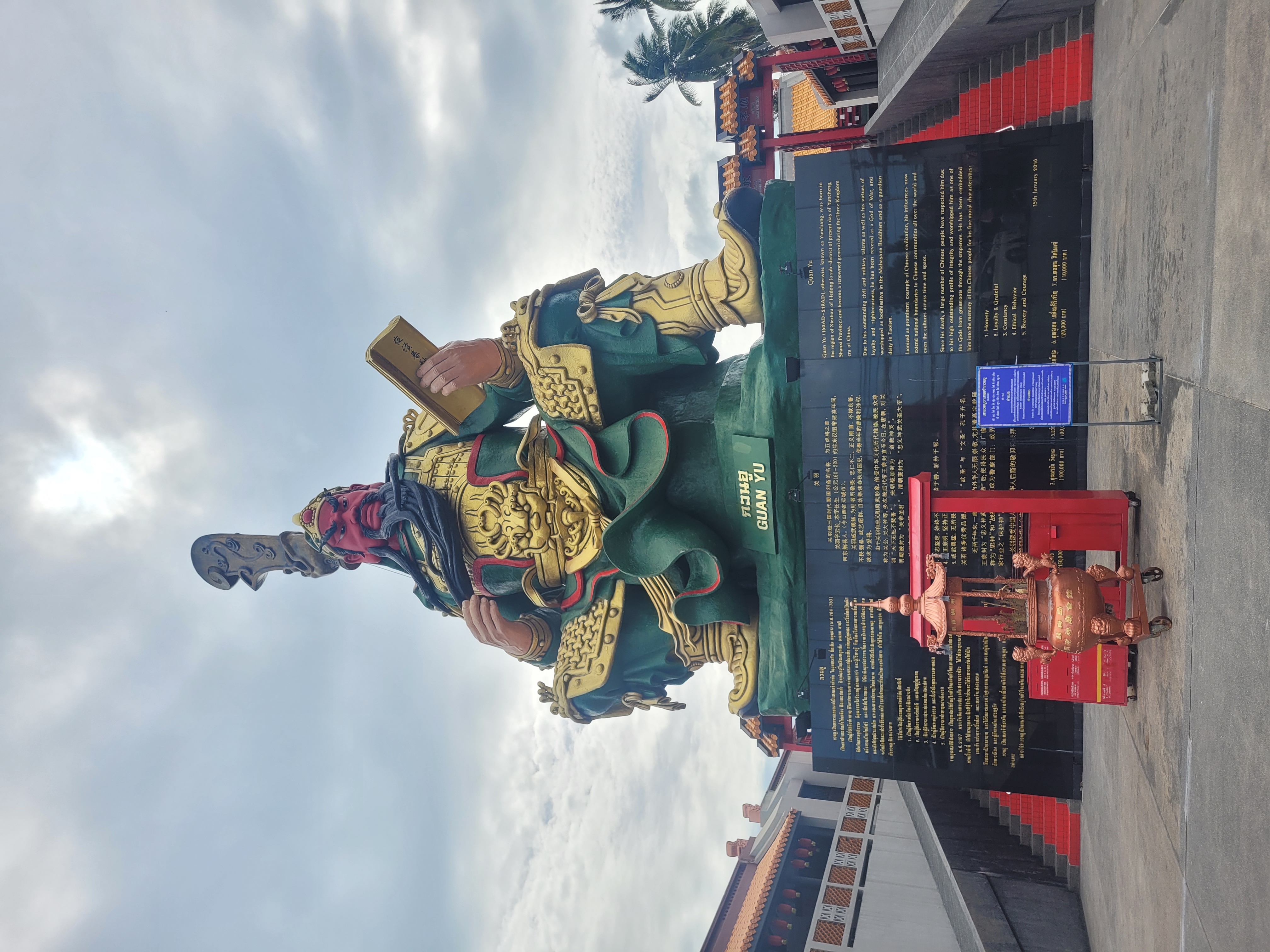
Go because it adds a Hainanese-Chinese layer to an island trip that can otherwise become a sequence of beaches and Buddhist temples. TAT links the shrine to Hainanese Chinese migration to Surat Thani and highlights the 16-metre Guan Yu statue.
This is not a ranking of religions or a search for the “best temple.” If you are comparing two Buddhist sites, use Red Temple vs Wat Khunaram instead. If your real choice is between Samui's north-east temple complex and the terracotta Red Temple, use Wat Plai Laem vs Red Temple. Here, the useful decision is architecture within one tradition versus cultural contrast across two different community histories.
Same corridor, different cultural job
If your trip already has two Buddhist temples, Guan Yu gains value
A short first trip often already includes Big Buddha or Wat Plai Laem. If that is true for you, another Buddhist stop has to earn its place through architecture, history or route logic. The Red Temple can absolutely do that if terracotta design is the point. But if you mostly want your cultural stops to teach you something different from one another, Guan Yu Shrine usually adds more contrast.
This is the same reason we would not automatically add every south-island sacred site to one day. Before building a checklist, use the broader temples vs south-island nature decision and ask what category your itinerary is missing.
If you would happily spend ten minutes on one wall, choose the Red Temple
The Red Temple is the stronger choice for travelers who enjoy visual detail even after the first wide-angle photograph. TAT's current page identifies Wat Ratchathammaram on Samui's ring road, notes the Wat Sila Ngu name and lists daily opening from sunrise to sunset. The relief work and layered terracotta surfaces reward a closer look than the red facade alone suggests.
If your attention style is more “understand the community, then move on,” Guan Yu will probably feel richer. If your attention style is “I want to walk around the building and keep finding details,” Red Temple is the better use of the slot.
Use the real places, not an imagined mood board
What the first 20 minutes actually feel like
Arrive, orient yourself around the terracotta hall and decide whether the exterior detail is worth slowing the rest of the stop down for.
Look closely, move around the relief work and give the building enough time to become more than the wide shot.
The 16-metre figure establishes scale immediately. Then shift attention away from “big statue” and toward the shrine's community context.
Give worshippers space, look into the shrine interior where permitted, read available context and notice how different the visual language is from Samui's Buddhist temples.
If your Lamai-side day is already built around coast-and-viewpoint stops, Lad Koh Viewpoint vs Hin Ta Hin Yai can help you remove one more stop rather than stacking everything. If you are pushing farther south after Hua Thanon, Thong Krut vs Hua Thanon is the more useful geography question.
Can you do both? Yes — but only give each a different job
Because both fit the Lamai–Hua Thanon side of the island, doing both can be reasonable. The trap is treating them as “temple one” and “temple two.” A better sequence is:
Red Temple = architecture stop. You are there to look closely at the building and relief work.
Guan Yu = community-history stop. You are there to understand a Hainanese-Chinese layer of Samui and visit a living shrine respectfully.
If that distinction feels artificial and you are only adding both because they are nearby, choose one. Your day will usually improve. The same anti-checklist logic applies farther south in Khao Chedi vs Laem Sor Pagoda.
Respect changes slightly because these are not the same kind of sacred site
At the Red Temple
Thailand.go.th's current Buddhist-temple guidance recommends modest clothing, removing shoes before entering chapel/building areas where required, keeping quiet and photographing only where permitted. It also specifically asks visitors not to photograph people engaged in religious activities.
At Guan Yu Shrine
Do not copy Buddhist-specific ritual rules onto a Chinese shrine. Follow the shrine's posted instructions, give worshippers and incense/prayer activity space, keep clothing and behaviour respectful, and avoid turning active worship into a backdrop. TAT and Koh Samui Municipality both identify this as a living Guan Yu shrine, not a themed attraction.
Solo-woman practicalities: the cultural choice is easy; the route still needs ownership
Neither stop needs a paid tour merely to be understandable. If you are not self-driving, the practical question is how the visit fits into the rest of the day. Red Temple is especially easy to justify when you are already around Lamai; Guan Yu is a natural extension toward Hua Thanon. For a multi-stop south-side route, compare a private driver vs separate taxis instead of assuming the cheapest per-ride option will also give you the cleanest return.
Dress for sacred sites before leaving the hotel rather than carrying an elaborate change of clothes. A light shoulder-cover layer and something that covers the knees keeps the day simple. Keep your phone and small valuables on you rather than leaving them in a scooter basket or unattended bag, and if your final stop is late in the day, define the ride back before you become dependent on whatever happens to be nearby.
Six traveler profiles: which stop would you regret missing?
The shortest rule
Choose Red Temple if you want the building to be the experience. Choose Guan Yu Shrine if you want the cultural contrast to be the experience. If you already have two Buddhist stops elsewhere on the trip, that usually pushes the tie toward Guan Yu. If you could spend ten minutes happily looking at one terracotta wall, it pushes the tie back toward the Red Temple.
For the wider decision graph, continue to the Koh Samui experiences collection or return to the Koh Samui destination hub. Independent visiting is the editorial recommendation here; there is no reason to manufacture a tour CTA for two accessible cultural stops.