
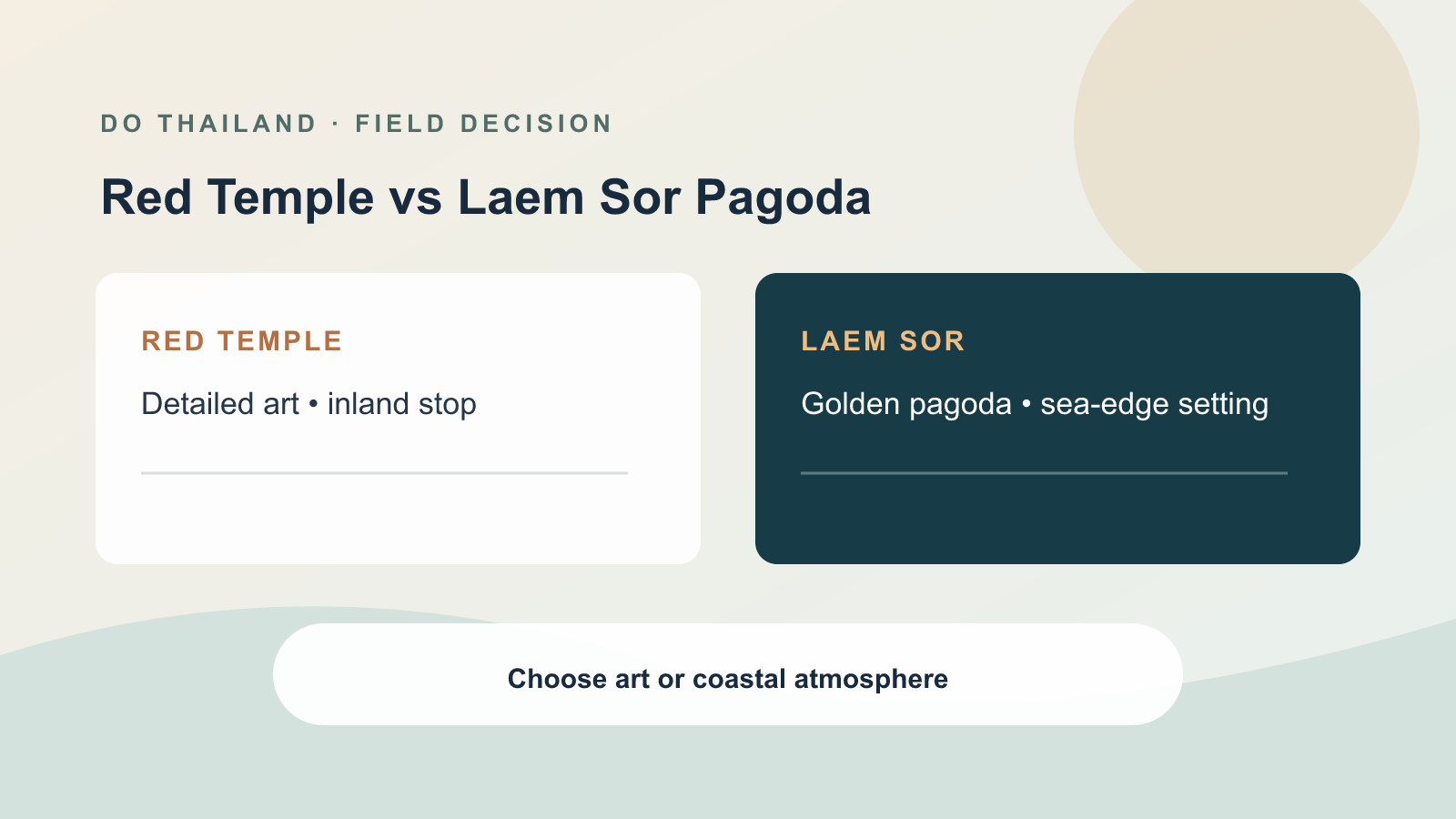
Red Temple: choose detail
Wat Ratchathammaram is one of those places where the value is in stopping close enough to notice the terracotta reliefs, figures and layered decoration. TAT currently lists the temple on Samui's ring road, also notes the Wat Sila Ngu name, and places it about six minutes by car from Lamai Beach.
Laem Sor: choose setting
Laem Sor Pagoda sits in Taling Ngam in the island's south. TAT describes the chedi as covered with countless small yellow tiles, containing Buddha relics and standing by the sea. The point is less “how many details can I inspect?” and more “do I want this quiet coastal place to anchor the southern part of my day?”
If you are actually choosing between the Red Temple and a preserved-monk stop, the better comparison is Wat Ratchathammaram vs Wat Khunaram. If Laem Sor is already your preferred monument and you are choosing a second far-south sacred place, use Khao Chedi vs Laem Sor Pagoda. This page answers a narrower question: one cultural slot, two very different visual moods.
One stop rewards your eyes; the other rewards your route
Delete the colour from the photos: which place still makes sense?
This is the quickest anti-Instagram test. If the Red Temple were not red, would the Lamai-side architecture and close-up carving still interest you? If Laem Sor were not gold, would you still want to travel farther south for a sea-edge sacred site? Choose the place whose job survives the colour. That is usually the one you will remember for more than the first photograph.
See the real places before you choose
The Red Temple is the easier add-on — but “easy” is not automatically better
TAT currently lists Wat Ratchathammaram from sunrise to sunset and puts it about six minutes from Lamai Beach. That makes it unusually easy to combine with a Lamai day, especially if you are already deciding between Lad Koh Viewpoint and Hin Ta Hin Yai or continuing toward the south.
But convenience can turn sacred sites into checklist stops. If the only reason you are adding the Red Temple is “it is nearby,” you may get more from doing fewer cultural stops properly. The same logic applies to Laem Sor: do not drive to the far south merely because the pagoda looks good in a saved photo.
Laem Sor earns its detour when the far south is already the plan
Laem Sor makes much more sense when your day already points toward Taling Ngam, Thong Krut or other south-coast stops. If you are building that kind of route, compare Laem Sor Pagoda vs Guan Yu Shrine and Thong Krut vs Hua Thanon before adding another cross-island detour.
If you only have one land-sightseeing day in total, the broader question may be more important than this temple comparison. Use temples vs south-island nature for one sightseeing day first. A waterfall or landscape stop may give your day more contrast than a second or third sacred site; Hin Lad vs Na Muang Waterfall is the useful next decision if that sounds like you.
Could you visit both? Yes — but only if they have different jobs
Use it as a short, attentive Lamai-side pause. Look closely. Do not rush in, take one front-facing photo and leave.
Let it justify the southern route rather than treating it as “the next temple.” Pair it with the landscape and rhythm of the south.
If Wat Khunaram, Khao Chedi or another sacred site is already in the plan, a third temple often adds less than extra time at the places you actually care about.
Respect changes the practical plan
Thailand.go.th's current temple guidance recommends modest dress, including covered shoulders and clothing to around/below the knee, and says shoes should be removed before entering temple buildings. It also asks visitors to keep noise down and respect worshippers. Pack a light cover-up even if the rest of your south-island day is beach-oriented.
For women traveling solo, the less obvious issue is the return leg. The official Laem Sor page lists the attraction as open 24 hours, but that does not make a late-night visit the smartest independent plan. Daylight is the cleaner editorial choice for both respect and transport simplicity, especially at the far-south site. If your route depends on multiple remote stops, compare a private driver vs taxis on Koh Samui rather than assuming an immediate ride will be waiting at the exact moment you finish.
Which stop will you regret missing?
If both feel “nice,” use geography as the tiebreaker
The two places are not competing versions of the same attraction. The Red Temple is the more efficient cultural stop for a Lamai/east-south route; Laem Sor is the more deliberate choice for a far-south day. That is also why I would not pay for an organised tour solely to make this decision. Independent routing is usually the better fit unless you are bundling several southern stops and specifically want the transport handled.
Still undecided about the spiritual atmosphere you want? Wat Khunaram vs Secret Buddha Garden compares a very different pair: a serious temple context versus a hillside sculpture-garden experience.
The shortest answer
Pick the Red Temple for the art. Pick Laem Sor for the setting. If you cannot name which of those two things you want, choose the one that already sits naturally on your route — and give it enough time to feel like a place of worship, not a colour-coded photo stop.
Continue planning with the Koh Samui experiences library or return to the Koh Samui destination hub.
Sources checked
Tourism Authority of Thailand — Wat Ratchathammaram
Tourism Authority of Thailand — Laem Sor Pagoda
Thailand.go.th — Thai Temple Travel Guide
Official opening/access information can change. Re-check the source pages before a time-sensitive visit.