
These landmarks are often placed on the same “Chiang Mai must-see” list, but they solve different problems. Tha Phae Gate helps you understand where you are. Three Kings Monument helps you understand what story the city tells about itself. If you only have twenty minutes, the distinction matters more than which one looks better in a photograph.
Choose Tha Phae Gate
You want to orient yourself fast, see the relationship between wall, moat and Old City streets, then continue walking without creating a separate sightseeing stop.
Choose Three Kings Monument
You want the founding narrative first, plan to visit the museums around the civic square, or prefer to begin in the historical centre rather than at the eastern edge.
Tha Phae Gate explains the city layout faster
Tourism Authority of Thailand’s current Chiang Mai moat guidance identifies Tha Phae Gate as the eastern wall/gate of the Old City and describes it as a natural entry point for exploring the historic core. That makes it unusually useful for a first visit: you can see the brick gate, the edge of the old city, the traffic outside and the pedestrian route continuing west at the same time.
If you are the kind of traveller who understands a city by walking it, this is the stronger first stop. Stand at the gate, look west into the Old City, and the rest of the day becomes easier to picture. Ratchadamnoen Road carries you toward the central temple zone, while the moat gives you a clear boundary instead of an abstract map line.
That is also why Tha Phae works well with the Chiang Mai Gate vs Tha Phae Gate stay guide. A landmark can be convenient for one walk without being the best area for every night of your trip. If you are comparing eastern Old City with the quieter western side, the Tha Phae vs Wat Phra Singh area guide handles the accommodation decision separately.
Three Kings Monument explains why Chiang Mai is here
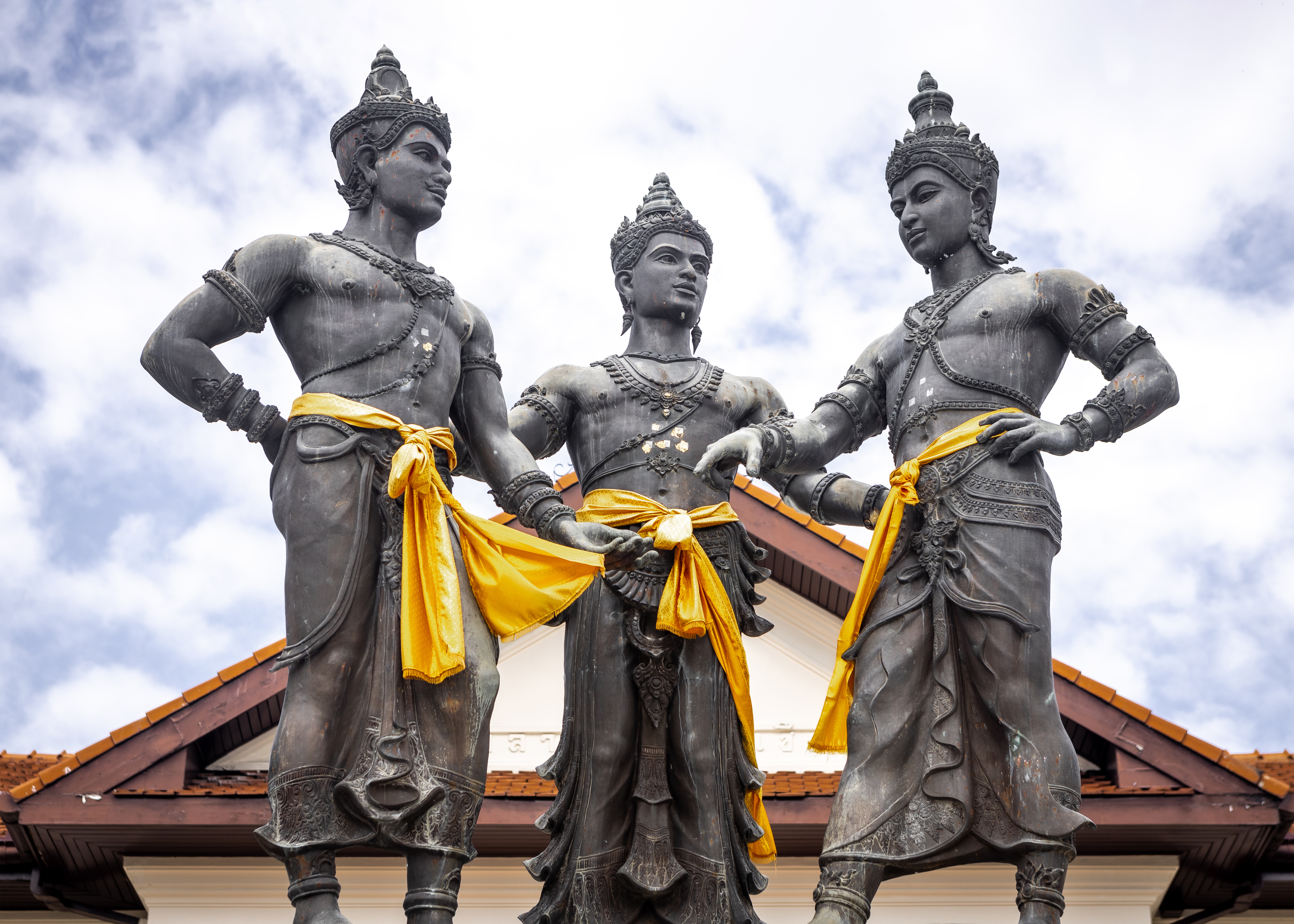
Chiang Mai Province’s official city history describes the alliance of King Mangrai, King Ramkhamhaeng and King Ngam Muang in the story of planning the new city. The Three Kings Monument turns that founding narrative into a civic landmark: three rulers presented together at the centre of modern Chiang Mai’s historical district.
The plaza matters beyond the statues. Chiang Mai City Heritage Centre material places the City Arts & Cultural Centre directly behind the monument, while the Lanna Folklife Museum sits opposite. That creates a very different type of orientation from Tha Phae. Instead of asking “which street do I follow?”, you can ask “what was Lanna, how did Chiang Mai develop, and what am I looking at when I enter temples later?”
If that is what you need, the separate City Arts & Cultural Centre vs Lanna Folklife Museum guide is the useful next decision. For a broader historical contrast, Wiang Kum Kam vs Chiang Mai Old City separates archaeology from a living historic district.
The counter-intuitive detail: both present-day landmarks are also modern civic-history projects
It is easy to stand at either place and assume you are looking at an untouched medieval object. The current city-history record is more interesting. Chiang Mai Municipality’s heritage timeline says the Three Kings Monument project began in the 1970s, the sculpture was designed in 1982 and King Bhumibol Adulyadej and Queen Sirikit opened the monument on 30 January 1984.
The same municipal timeline records that Tha Phae Gate and its lawn were rebuilt by Chiang Mai Municipality with the Fine Arts Department in 1985. The gate still represents the historic eastern entrance and surviving wall tradition, but the present landmark is part of a modern heritage-making project too.
That does not make either place “fake.” It makes them useful in a more honest way: one tells you how Chiang Mai remembers its founders; the other shows how the city reconstructed a legible gateway to its historic core.
If you only have 30, 60 or 120 minutes
If temples are the real priority, use the Wat Chedi Luang vs Wat Phra Singh comparison rather than making the gate or monument compete with them. If you are deciding when to schedule the temple block, the Old City temples timing guide handles that question directly.
On Sunday, Tha Phae becomes the stronger orientation stop
TAT’s current Old City guidance continues to identify Tha Phae Gate as the starting area for the Sunday Walking Street route into Ratchadamnoen Road. If Sunday market is already part of your plan, the gate stops being “one more landmark” and becomes the beginning of the evening geography.
That does not mean you should arrive at the busiest moment just to prove you saw the gate. If you want to understand the place itself, see it earlier and let the market become the second act. If you are still choosing your market evening, compare Sunday Walking Street vs Night Bazaar. If Saturday is also possible, use Saturday Wua Lai vs Sunday Walking Street.
Three Kings is better when the museums are part of the answer
Three Kings Monument by itself is a short stop. Its value rises sharply when you use the surrounding museum cluster. That is the main reason I would not recommend crossing the Old City just for a five-minute photo if you are not interested in the story behind it.
For a history-focused morning, the square can be the opening chapter before Wat Chedi Luang, Wat Phra Singh or other Old City sites. For a general first trip with limited time, however, you may get more practical value by starting at Tha Phae and letting the city reveal itself through the walk.
If you are still deciding how much of your accommodation life should happen inside the moat, use inside the Old City vs outside the moat. If the bigger choice is Old City versus the contemporary west side, Old City vs Nimman is the more important decision than either orientation landmark.
Do not turn an orientation stop into an itinerary bottleneck
The fastest way to waste time is to treat every labelled landmark as a separate destination that deserves a dedicated ride. Three Kings and Tha Phae are both best when they improve a route you were already going to walk.
A four-day trip has enough room for that logic. The Chiang Mai 4-day itinerary is designed around geographic blocks rather than collecting isolated sights. That same principle should govern this choice: pick the landmark that makes the next two hours easier, not the one with the longer list of reviews.
For women travelling solo, plan the transition rather than worrying about the landmark
Both stops are central public landmarks, so the useful practical question is what happens immediately after them. Around Tha Phae, road traffic, event crowds and Sunday-market density can change the feel quickly. Around Three Kings, the issue is more often whether you are continuing into museums, temples or a quieter Old City walk.
Keep your phone charged, keep your bag closed in dense event crowds, and decide where you will meet a ride before you are tired rather than standing at a busy junction trying to negotiate the next move. Thailand Tourist Police currently lists 1155 as its traveller-assistance hotline.
If you want a low-key evening rather than another Old City history block, Mae Kha Canal vs Ping River gives you a completely different city texture.
My first-trip rule
Choose Tha Phae Gate when orientation means movement. You want to understand the edge of the Old City, step through it and keep walking.
Choose Three Kings Monument when orientation means context. You want the founding narrative, the civic square and the museum cluster to explain the city before you continue.
If you are still undecided, start at Tha Phae Gate
It has the cleaner first-trip job: it turns the Old City from a shape on your phone into a place with an entrance, a wall, a moat and a direction of travel. Three Kings Monument is the better second choice when you know you want history context rather than just spatial orientation.
Continue with the Chiang Mai decision hub or browse the Chiang Mai experiences index for the next choice.
Sources checked
Chiang Mai City Heritage Centre — municipal history timeline
Chiang Mai Province — city history and the three-kings founding narrative
Tourism Authority of Thailand — Chiang Mai moat and Tha Phae Gate guidance
Chiang Mai Province — 2026 city ceremony at Three Kings Monument
Thailand Tourist Police — current contact information