
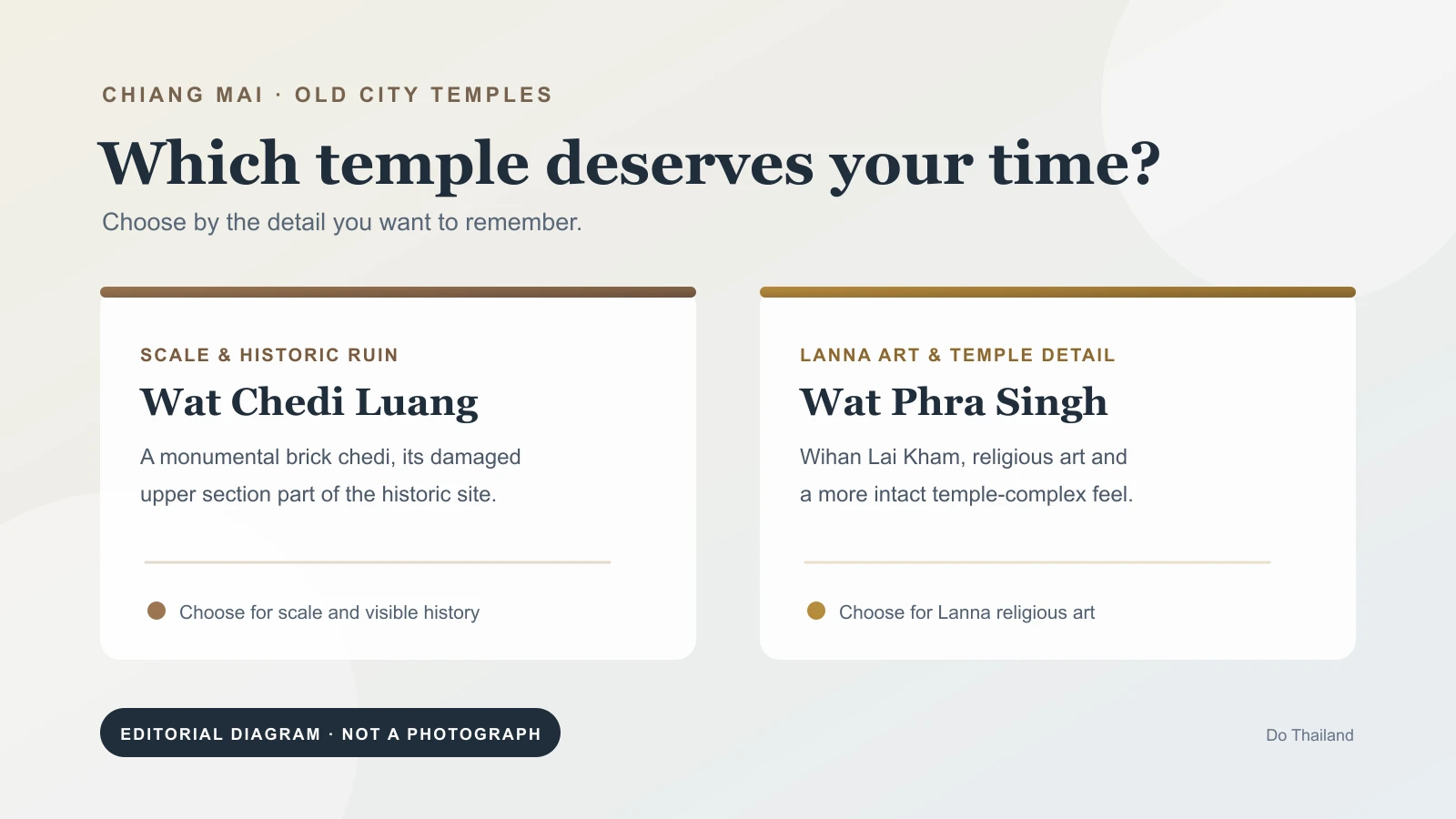
This is not a ranking of which temple is “more beautiful.” They do different jobs. Wat Chedi Luang makes its strongest impression through scale and absence: the enormous chedi was damaged centuries ago, and the missing upper section is part of what makes the monument feel historical rather than polished. Wat Phra Singh is the stronger choice when detail, active religious significance and Lanna interiors are what you actually want to notice.
When the monument is the memory
Chiang Mai Province’s current tourism page describes the temple’s large chedi as a defining feature of the Old City and records the structure’s damage in the 1545 earthquake. The result is visually unlike Chiang Mai’s more intact gilded temple complexes: broad brick mass, exposed age and a strong sense that the city changed around it.
If one photograph or one architectural memory needs to say “historic Chiang Mai” without requiring much explanation, Chedi Luang is the cleaner choice.
When detail is the memory
The same provincial source identifies Wihan Lai Kham as the home of Phra Phutthasihing, one of Chiang Mai’s most sacred Buddha images. Official Fine Arts material also treats the temple’s mural tradition as historically important for understanding local life and visual culture.
If you slow down for carved wood, paintings, devotional spaces and the relationship between art and living religion, Phra Singh rewards that attention more clearly.
The one-temple test
Do not ask, “Which one is more famous?” Ask which sentence sounds more like your trip.
If your real question is not which temple but when to do the Old City, use the separate Old City temples: early morning or daytime guide. Chiang Mai Province currently lists both Wat Chedi Luang and Wat Phra Singh as open from 8:00am to 5:00pm, so there is little value in setting a dawn alarm purely to arrive before their published opening time. Recheck hours close to your visit because religious access can change for ceremonies or local events.
What you notice first is completely different
If this is your first Chiang Mai temple, I would start with Chedi Luang
That recommendation is about clarity, not superiority. A first-time visitor can understand Chedi Luang’s visual argument immediately: this was a major Lanna-era monument, it was physically transformed by history, and the surviving mass still anchors the Old City. It gives you a strong baseline before you start comparing more ornate or intimate temple spaces elsewhere.
That also makes it easy to pair with a wider Old City walk. If you are still deciding where to sleep, inside the Old City vs outside the moat matters more to your daily walking pattern than choosing a hotel for one temple. If your shortlist is specifically around the historic core, the Tha Phae vs Wat Phra Singh area guide separates eastern-gate convenience from a quieter western Old City base.
If you already know you like religious art, reverse the order
Wat Phra Singh deserves priority when “temple” means more to you than a monumental ruin. Chiang Mai Province highlights Wihan Lai Kham and Phra Phutthasihing; the Fine Arts Department’s Chiang Mai library describes the temple’s murals as significant works that preserve visual evidence of local customs, clothing and everyday life. That gives you something to look for rather than simply moving from hall to hall.
It is also the better choice if you want the temple to feel connected to contemporary devotion rather than only to architectural history. The provincial source notes the Phra Phutthasihing image’s role in Songkran traditions, when it is carried in procession for public veneration. You do not need to visit during the festival for that context to change how the space reads.
Can you do both in one morning? Yes—if you stop adding temples
TAT’s 2025 Chiang Mai self-drive itinerary groups Wat Chedi Luang and Wat Phra Singh within the same Old City cultural day, alongside the Three Kings Monument and city museums. That is a useful planning signal: the two temples are complementary enough to combine geographically.
The trap is treating “both” as the beginning of a five-temple checklist. Pick one as your anchor, give the second a lighter visit, then change the texture of the day. Lunch, a museum, a café or a market evening will usually add more to a first trip than a fourth similar religious stop.
If you have four full days, the broader Chiang Mai four-day structure is a better guardrail than another temple list. It keeps Old City culture, mountains and neighbourhood time from collapsing into one long sequence of sacred sites.
When you should choose neither
Skip both only when your temple quota is already full and your remaining Chiang Mai time is scarce. If you have already prioritised Doi Suthep and a quieter forest-temple experience such as Wat Pha Lat or Wat Umong, another urban temple block may add less than a completely different experience.
This is especially true if your dates include a fixed weekly event. A usable Sunday can make the Sunday Walking Street vs Night Bazaar decision more time-sensitive than fitting in one extra temple. Likewise, if you are choosing between Saturday Wua Lai and Sunday Walking Street, protect the market that fits the rest of the trip rather than exhausting yourself on a dense temple morning.
For women travelling solo: the useful practicalities are ordinary ones
Neither temple needs a fear-based safety narrative. The practical issues are respect, heat, footwear and energy. Wear clothing appropriate for Buddhist religious spaces, keep shoulders and knees covered, and use shoes you can remove easily where required. Carry a light layer if your daytime outfit is more exposed.
More importantly, do not let a “must-see” list push you into staying out when you are tired, overheated or no longer enjoying the details. A solo traveller has the advantage of being able to leave after the one temple that mattered without negotiating a group checklist.
When both are genuinely worth it
Do both when Old City history is one of your top Chiang Mai priorities and you can give the morning enough attention to notice the contrast. Start with the temple you care about more, walk rather than resetting the transport chain, and treat the second as a different lens rather than another box.
If your hotel is in Nimman or another area outside the historic core, the Old City vs Nimman guide can help you decide whether to stay in the Old City after lunch or move on. If the day begins on Doi Suthep instead, use the separate Nimman vs Old City after Doi Suthep decision rather than forcing this temple morning onto a mountain day.
Final call
Choose Wat Chedi Luang if you want one unmistakable historic landmark. Choose Wat Phra Singh if you want one richer Lanna-art and devotional-space visit. If you have a comfortable Old City morning, see both—but stop there unless another temple is a genuine personal priority.
Continue with the Chiang Mai destination guide or browse more Thailand experience decisions.
Sources checked
Chiang Mai Province tourism information · Tourism Authority of Thailand: Chiang Mai itinerary · Fine Arts Department: Wat Phra Singh mural heritage