
The mistake is deciding by fame alone. Wat Chalong is more prominent on first-trip itineraries, but that does not automatically make it the better use of time for someone based near the airport, Nai Yang, Mai Khao or northern Phuket. Wat Phra Thong is smaller and more specific, yet its Thalang location can make it the cleaner cultural stop on a north-island day.
Pick Wat Chalong for the stronger first-trip default
You get a larger temple complex, the local history of Luang Pho Chaem and Luang Pho Chuang, and a Buddha-relic connection. It also fits naturally into the south-island cultural geography already used by official Phuket itineraries.
Pick Wat Phra Thong for a more specific Thalang story
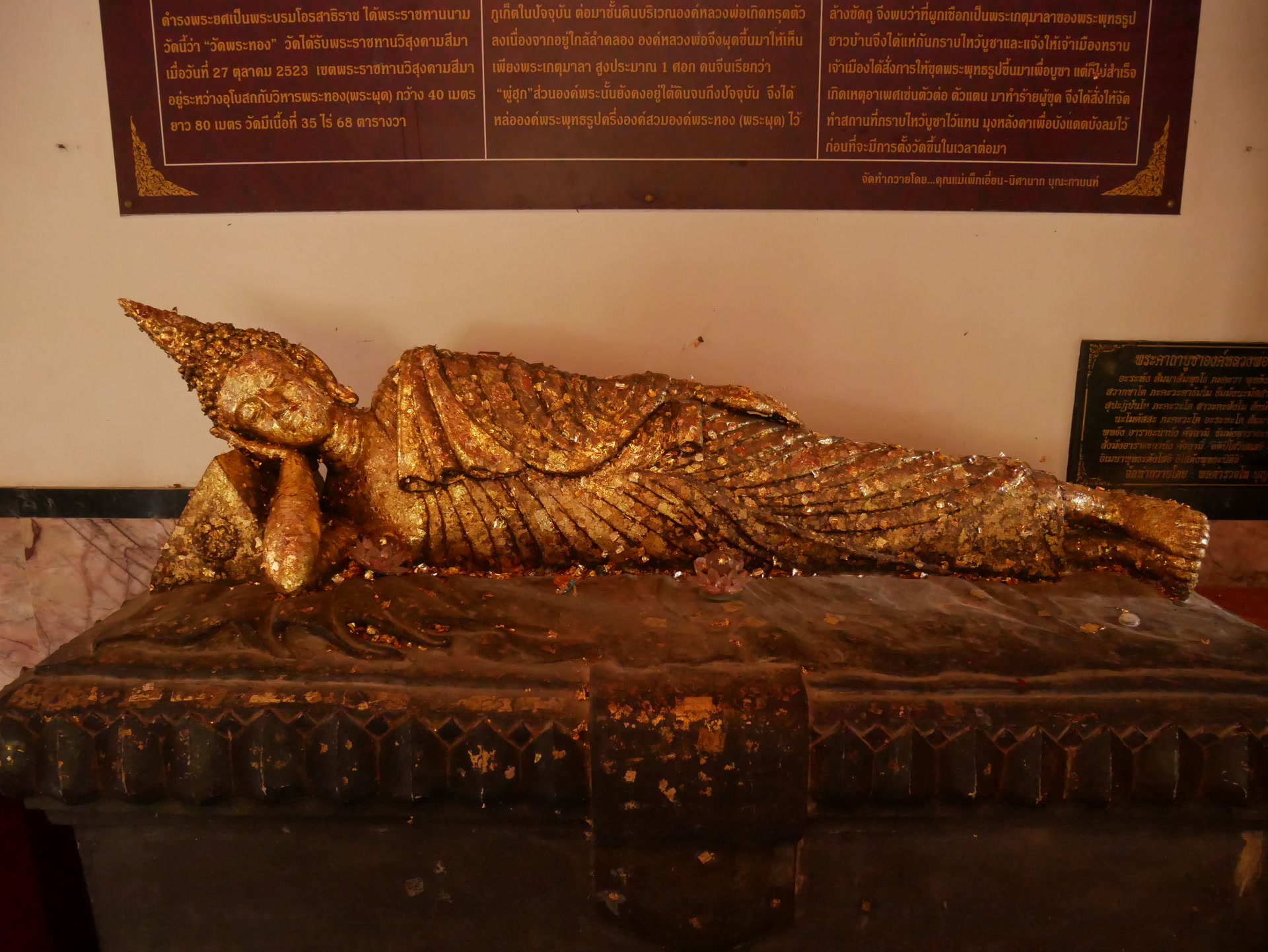
The point is the partially buried Buddha image, known locally through the Phra Phut / Phra Thong story, plus a small temple museum. It makes most sense when northern Phuket is already on your route rather than as a special cross-island mission.
First decide what kind of temple memory you want
Wat Chalong works even if you know almost nothing about Phuket before arriving. Phuket Provincial Government describes the temple—also called Wat Chaitaram—as the island's best-known temple and records the venerated abbots Luang Pho Chaem and Luang Pho Chuang, as well as Buddha relics enshrined at the site. The result is a temple visit with several layers: local religious devotion, Phuket history and a larger complex to move through.
Wat Phra Thong is different. Phuket Province describes the temple around the image that remains partly buried in the ground and the local story that attempts to excavate it failed. The same official source also notes a small museum displaying historical objects. That makes the visit unusually concentrated: if the half-buried Buddha and its story interest you, the temple feels distinctive; if they do not, the site may feel too slight to justify a long detour.
The half-buried Buddha is the reason to choose Wat Phra Thong
Wat Phra Thong is also commonly presented under the name Wat Phra Phut. Phuket Province's English tourism material says the Buddha image remains half-buried and links the temple legend to the 1785 Thalang war. Treat that as local religious-historical tradition rather than an archaeological certainty. The practical point for your itinerary is simpler: Wat Phra Thong has one memorable story that you are unlikely to confuse with another Phuket temple.
If your travel style is to remember one specific object or story rather than a whole complex, that can matter more than size.
Wat Chalong earns its time through breadth
Wat Chalong is larger and also fits into a wider day of Phuket sightseeing. TAT's current Phuket route still places it inside a wider one-day Phuket sequence alongside Old Town, Thai Hua Museum, Chinpracha House, Karon Viewpoint and Promthep Cape. That does not mean you should copy the route stop for stop; it does show why Wat Chalong is easy to integrate into a south-island day rather than treating it as a standalone expedition.
If your cultural time is already competing with Phuket Old Town, use the dedicated Wat Chalong vs Phuket Old Town guide. That is a different decision: one focused temple versus an entire heritage district. If you already know you want Old Town, the Old Town full-day vs evening guide tells you how much daylight to protect before adding another inland stop.
60–90 minutes
Wat Chalong is easier to justify if you are already on a south-island route. The complex can feel complete within a bounded visit without turning into a separate half-day.
About two hours including transfer
Choose by geography. Thalang / airport-side day: Wat Phra Thong becomes plausible. Chalong / Rawai / Kata-side day: Wat Chalong is usually cleaner.
A full inland day
Do not force both temples into the schedule just because you have time. Use the extra hours for a different layer of Phuket—Old Town, a museum or another part of the island—unless temple history itself is the theme.
Geography is the tie-breaker most people ignore
Phuket Province places Wat Phra Thong about 21 kilometres from Phuket Town on Thepkasattri Road in Thalang. That makes it a much more logical stop when your day already runs through northern Phuket. Travellers staying around Nai Yang, Mai Khao or an airport-side first or last night should not automatically drive south for Wat Chalong just because every first-trip list mentions it.
Wat Chalong, by contrast, sits in Mueang Phuket on the Chaofa-road side of the island. Phuket Province's directions and TAT's current one-day route both make the south-island logic obvious. If your day already includes Chalong, Rawai, Nai Harn or south-coast viewpoints, Wat Chalong usually adds less transport friction.
Route-fit shortcut
- North Phuket / airport / Thalang day: give Wat Phra Thong a serious look.
- Old Town + south-island day: Wat Chalong usually fits better.
- Kata or Karon base with one inland trip: Wat Chalong is normally the cleaner first temple unless you are deliberately heading north.
- Staying in Phuket Old Town: the bigger question may be whether you need a separate temple transfer at all. Start with Old Town vs Kata Beach or where to stay in Phuket if your base is not fixed yet.
Do not confuse “quieter” with “better”
Wat Phra Thong's lower profile can sound attractive when you are tired of headline attractions. But a quieter stop only wins when the content itself interests you. If you arrive mainly because you wanted somewhere less famous, you may leave wishing you had used the transfer time on a fuller cultural block.
Likewise, Wat Chalong being popular does not make it automatically shallow. It remains an active religious site with strong local historical meaning. The better question is whether you want a broad, recognisable temple complex or one narrow but unusually memorable story.
Skip Wat Phra Thong if...
- you would cross the island only to say you saw a less-famous temple;
- the half-buried Buddha story does not particularly interest you;
- you already have a full Thalang-free south-island itinerary;
- you are trying to squeeze temple, Old Town, beach and sunset into one short day.
Skip Wat Chalong if...
- you are already based far north and the south-island transfer is the main event;
- you have already chosen a different Buddhist stop and temple collecting is not your priority;
- your only free cultural block is really meant for Phuket history rather than religious architecture;
- you would rather use the time for the Thai Hua Museum vs Chinpracha House decision inside Old Town.
What changes if your trip is mostly beaches and islands?
A beach-heavy Phuket itinerary often benefits from one cultural stop because it changes the visual and mental rhythm of the trip. Wat Chalong usually wins here because its scale and story feel substantial enough to stand apart from the coast. If your sea time is already packed, compare Racha Yai vs Coral Island before sacrificing another land block just to collect attractions.
If you are already doing a south-coast afternoon, the temple can also be paired carefully rather than stacked indiscriminately. The Nai Harn & Ya Nui vs Rawai afternoon guide helps decide whether that road day should remain coast-led. And if the actual goal is a viewpoint rather than another sacred site, compare Karon Viewpoint vs Windmill Viewpoint instead.
If the weather changes, neither temple is an automatic rainy-day solution
Both are land-based alternatives to marine activities, but neither should be marketed as a perfect bad-weather attraction. Temple grounds still involve outdoor movement, footwear changes and exposed walkways. If a boat trip is cancelled, use the broader Phuket boat-tour cancelled Plan B guide before defaulting to a temple simply because it is inland.
If you need a more genuinely indoor learning block, Phuket Aquarium vs Thai Hua Museum is the more relevant comparison.
Women travelling solo: make the temple stop easy, not heroic
- Dress for a functioning Buddhist site. Carry a light layer that covers shoulders and choose bottoms that cover the knees rather than arriving in beachwear and assuming a cover-up will always be provided.
- Give worshippers and monks space. These are active religious places, not photo sets. Avoid blocking prayer areas or touching religious objects without clear permission.
- Do not create a risky transport plan to save one attraction. If you are not already confident, licensed and properly equipped for Phuket roads, the Phuket scooter vs Grab guide is more useful than forcing self-driving into a one-temple day.
- For a remote-feeling return, solve the ride before dusk. This matters more for a north-island detour than for a centrally routed cultural day. Thailand Tourist Police currently lists 1155 for traveller assistance.
The strongest reason to choose Wat Phra Thong is not that it is “hidden”
Calling a place a hidden gem often hides the real trade-off. Wat Phra Thong is worthwhile when the half-buried Buddha, Thalang history and north-island route genuinely suit your trip. It is not automatically superior because fewer first-time visitors build their day around it.
The strongest reason to choose Wat Chalong is also not that it appears on more lists. It wins because it carries enough cultural, religious and historical substance to work as a complete first-trip temple stop while fitting naturally into a wider south-island day.
The bottom line
Choose Wat Chalong if you want one Phuket temple and do not have a strong reason to choose otherwise. It is the more complete first-trip answer. Choose Wat Phra Thong when northern Phuket is already part of the route and the half-buried Buddha story gives you a reason to visit.
Then stop collecting temples. Use the saved time for a different Phuket layer: a Phuket Town viewpoint, a heritage interior, a beach or simply a slower meal.
Keep planning with the Phuket destination hub or browse the Experiences hub for the next decision instead of building a generic must-see checklist.
Sources checked
Phuket Provincial Government — Pra Thong Temple (PraPud)
Phuket Provincial Government — Chalong Temple
Tourism Authority of Thailand — Recommended Route for One Day in Phuket
Tourism Authority of Thailand — Wat Chalong (Wat Chaitaram)
Thailand Tourism Directory — Wat Phra Thong / Wat Phra Phut
Thailand Tourist Police — contact / 1155