
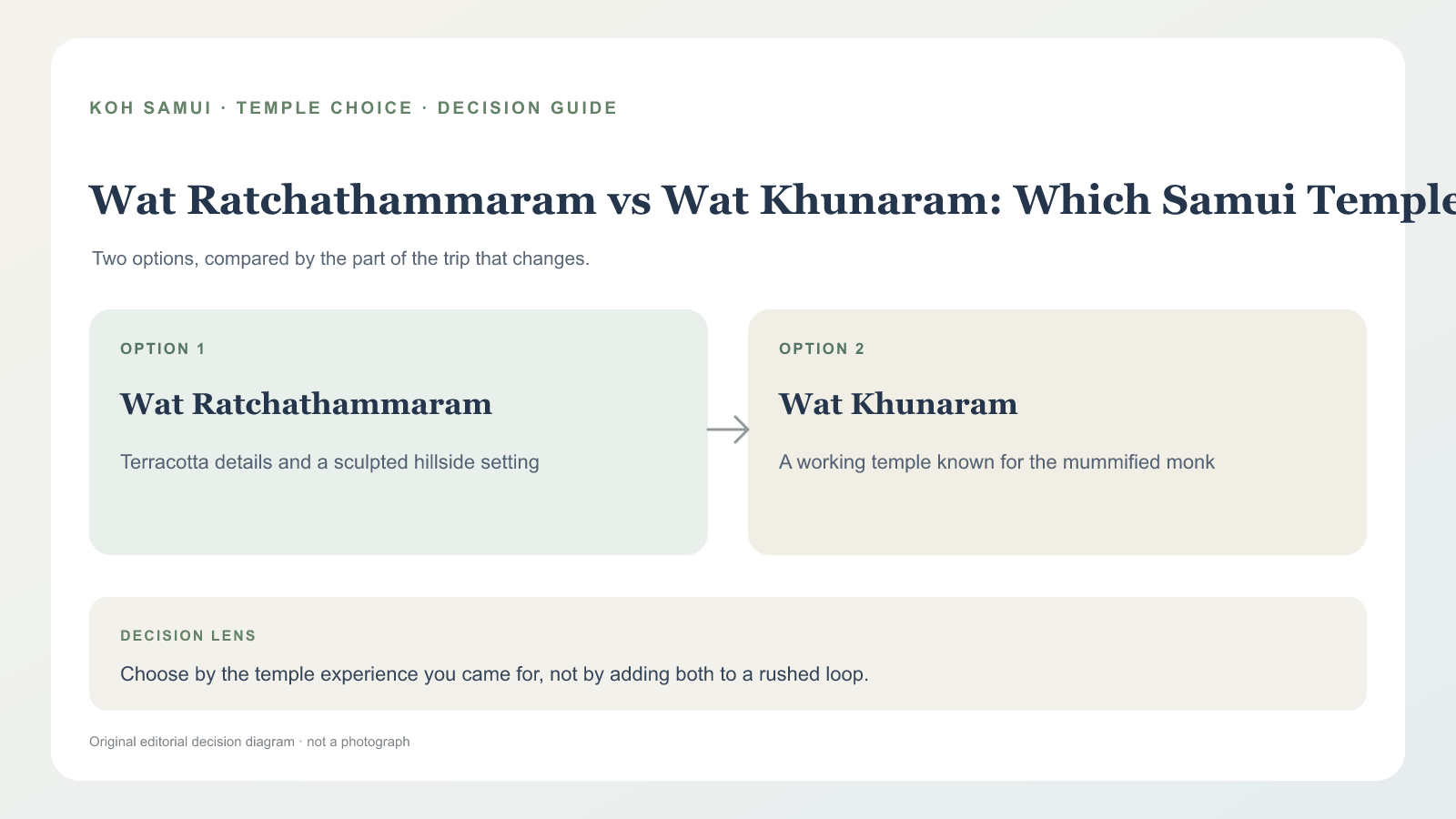
If your answer is “the red temple, relief work, a seaside reliquary complex and a visually distinctive Buddhist site,” choose Wat Ratchathammaram. If your answer is “the story of a monk whose preserved body remains seated in meditation posture, and what that means in a Buddhist setting,” choose Wat Khunaram. That distinction is more useful than trying to rank two sacred places as attractions.
Tourism Authority of Thailand has actually placed these two stops together in an official Samui inland route: pay respects at Wat Khunaram, then visit Wat Sila Ngu, which TAT calls the “red temple”. So yes, you can see both in one sightseeing day. But a short island trip does not improve automatically because you add every temple that happens to sit on the same road. Start with the broader one-sightseeing-day temples vs south-nature decision before you turn a land day into a collection exercise.
Wat Ratchathammaram vs Wat Khunaram: the decision in four signals
Choose Wat Ratchathammaram when the place itself is the draw
Wat Ratchathammaram is also known as Wat Sila Ngu. TAT’s official Japanese site uses both names, while TAT Newsroom calls Wat Sila Ngu the atypical “red temple”. The Koh Samui municipality’s own page focuses on Phra That Sila Ngu: a golden seafront reliquary stupa where Buddha relics were enshrined on 12 June 1935. The municipal record also notes a royal visit by King Rama IX and Queen Sirikit on 24 April 1962.
For a first-time visitor, this creates a layered stop rather than one photo prop. The red architecture may be what gets you off the road, but the complex also has a religious history that is easy to miss if you arrive, take one symmetrical photo and leave. If you are already moving around Lamai and Hua Thanon, this also pairs geographically with the kind of east/south-coast sightseeing decision covered in Lad Koh Viewpoint vs Hin Ta Hin Yai.
Wat Khunaram is not a “strange thing to see”
Koh Samui Municipality identifies Wat Khunaram, also known locally in connection with Luang Pho Daeng, near Na Muang. Its current tourism record says Luang Pho Daeng died on 6 May 1973 at the age of 79 years and eight months and that his preserved body remains in a glass case in a seated meditation posture.
TAT explains why this matters beyond the obvious physical fact. Its Samui cultural material describes the preserved monk as a reminder of Buddhist teachings, and older TAT guidance notes that the life and death of Luang Pho Daeng are regarded by Thai visitors as spiritually meaningful. That is the reason to choose Wat Khunaram: you want a focused encounter with a local Buddhist story that asks for a slightly different kind of attention.
The preserved monk is the deciding factor, not a bonus feature
If seeing a preserved human body would upset you, make you uncomfortable, or leave you feeling that you are intruding, choose the Red Temple instead. If you do go to Wat Khunaram, do not frame the visit as a macabre photo opportunity. Give worshippers space, keep your voice low and treat the glass case as part of a functioning temple rather than a museum curiosity.
This is also why the choice is different from Laem Sor Pagoda vs Guan Yu Shrine. That comparison is about two distinct cultural traditions and route styles. Here, the emotional comfort of the visitor is part of the decision itself.
Can you visit both? Yes. That does not mean you should.
TAT’s official “hidden gems” route literally links Wat Khunaram with Wat Sila Ngu. The Koh Samui municipality’s own attraction directory also cross-lists the two within the same south-island cluster. If temple culture is a priority, combining them is coherent.
But if your first trip already has a north-east temple block, one south-island cultural stop may be enough. Use your extra time for a different texture: Hin Lad vs Na Muang if you want nature, or Fisherman’s Village vs Na Muang if you are still deciding whether the spare half-day should be town-and-food or inland.
If you are based around Lamai
Wat Ratchathammaram is the cleaner first choice because its Wat Sila Ngu complex sits close to the Lamai/Hua Thanon side. It works naturally alongside a coastal route without turning the temple into a separate expedition.
If Na Muang is already in the day
Wat Khunaram becomes easier to justify. The municipality places it near Na Muang, so you can choose it for meaning without paying a separate cross-island logistics tax.
If a driver is turning the day into twelve stops
Cut the list before you optimise the route. The private driver vs taxis guide helps with transport structure, but Use a driver to group the temples and stops you genuinely want to visit.
For women travelling solo, temple etiquette is simple to plan for
TAT’s current sacred-site guidance recommends modest clothing at temples: shoulders covered and clothing extending below the knee. It also notes that women should not touch monks or their robes, and that shoes should be removed when entering spaces where that is required. None of this needs special shopping; a light overshirt or scarf plus a longer skirt or trousers is usually enough to make a beach-heavy island day temple-ready.
What if you already visited Big Buddha or Wat Plai Laem?
Do not assume that means you should skip every other temple. The question is whether the second temple adds something different. Wat Ratchathammaram can add very different architecture and south-coast geography. Wat Khunaram can add a very different religious story. But if you already feel culturally satisfied, protect your island time instead.
The broader four-day Samui resort-day decision exists for exactly this reason: an empty block is not a problem that sightseeing has to solve. If your trip needs a town evening rather than another sacred site, Nathon vs Fisherman’s Village gives you a completely different kind of cultural texture.
Skip both when the temple is only there to make the itinerary look complete
A beach-and-boat holiday does not fail because it contains only one temple. If neither red architecture nor Luang Pho Daeng’s story genuinely interests you, spend the time somewhere you actually care about. You can still build a balanced trip from the Koh Samui planning hub or browse the wider experiences index without manufacturing a cultural obligation.
The final rule
Choose Wat Ratchathammaram when you want to remember a place. Choose Wat Khunaram when you want to understand a story.
For a first-time visitor with no special interest in preserved remains, the Red Temple is the easier default. For a traveller who is specifically curious about Luang Pho Daeng and is prepared to approach the site as a living Buddhist temple rather than a spectacle, Wat Khunaram is the more meaningful choice.