
The answer in 30 seconds
Wat Sai Thai is the easier default for most first trips. It works as a focused temple pause rather than a project: see the reclining Buddha, behave respectfully in a functioning religious space, then continue the day.
The Shell Cemetery is the more specialised stop. It becomes worthwhile when you actually want to understand a fossil shoreline that Thailand's Department of Mineral Resources now dates more precisely to roughly 40–20 million years ago—not when you merely want another scenic coast.
| If this matters most | Choose | Why |
|---|---|---|
| Low-friction cultural contrast | Wat Sai Thai | A compact Buddhist stop centred on a reclining Buddha and limestone-hill setting. |
| Fossils and landscape formation | Shell Cemetery | The attraction is the fossil-rich rock platform and the geological story behind it. |
| You are mildly curious about both | Wat Sai Thai | The temple is easier to treat as a small stop; the fossil site is more satisfying when you care about the science and tide. |
| You already have a geology-focused road day | Shell Cemetery | Route fit removes the biggest downside: spending extra transport time on a specialist attraction. |
These stops solve different gaps in a Krabi itinerary
Wat Sai Thai is useful when a beach-and-boat itinerary needs one quiet Buddhist layer without turning the day into another major excursion. A current Andaman community-tourism listing places the temple at Ban Sai Thai and highlights its reclining Buddha, hillside setting and cave area. It is a functioning religious site, so the value is not “secret attraction” status; it is the chance to add a short cultural pause to a road day that already makes sense.
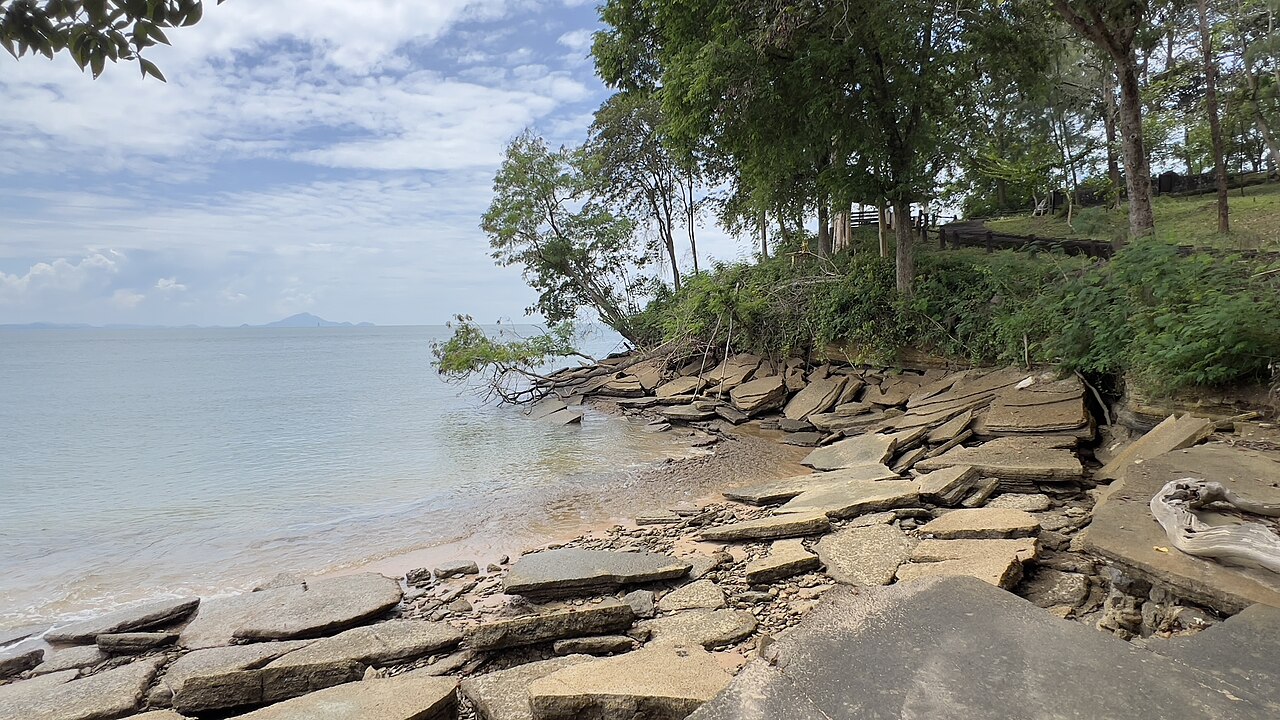
The Shell Cemetery at Laem Pho is different. The Department of Mineral Resources describes a fossil shoreline extending for about two kilometres, made from enormous numbers of freshwater gastropod shells cemented into rock slabs. You go to read the landscape. If the idea of fossil pollen, ancient freshwater environments and changing geological dating makes you curious, the detour has a purpose. If not, the famous name alone is rarely enough.
If your real question is simply whether Susan Hoi deserves any time at all, use the dedicated Krabi Shell Cemetery: worth it or skip it? guide first. This page is for travellers who have already narrowed the choice to one small non-boat stop.
Use one test: if the stop vanished tomorrow, what would you actually miss?
If your answer is “a quiet temple with a reclining Buddha and a short religious-cultural pause,” choose Wat Sai Thai. If your answer is “the chance to see a rare fossil coast and understand why the tourism label says 75 million years even though current geology is more precise,” choose the Shell Cemetery.
If your answer is only “I would miss ticking off another attraction,” choose neither. Krabi has too many higher-value experiences for a first trip to be built from weak yeses.
Wat Sai Thai is small—and that is its advantage
Do not inflate a working temple into a headline half-day
Current regional destination material describes Wat Sai Thai as a temple in Ban Sai Thai with a reclining Buddha around 16 metres long, a hillside setting and caves associated with the monastery landscape. Independent current visitor material also consistently identifies the reclining Buddha as the visual focus.
What I would not do is turn those details into invented opening hours, a promised monk blessing or a guaranteed “hidden gem” experience. First-party tourism information for the temple is comparatively thin. Treat it as an active place of worship, visit during a sensible daylight window, and let whatever religious activity is happening take priority over your photos.
For temple etiquette, Tourism Authority of Thailand guidance remains straightforward: cover shoulders and knees, remove shoes where required, do not point your feet toward Buddha images, and women should not touch monks or their robes. If you want a more substantial Buddhist stop rather than a short pause, compare Wat Kaew Korawaram vs Tiger Cave Temple. If you are already committed to Krabi Town, Wat Kaew vs Khao Khanap Nam is the more useful town-side decision.
The Shell Cemetery can be excellent—and still be the wrong choice for you
Thailand's Department of Mineral Resources explains that the familiar “75-million-year-old” name came from a much broader older age estimate. Fossil pollen and spores later narrowed the likely age of the Laem Pho shell-bearing layer to roughly 40–20 million years.
That makes the site more interesting, not less. It is a real example of tourism language surviving while scientific interpretation becomes more precise. But it also tells you what kind of attraction this is: the reward is understanding the rock, not finding a beautiful shell-strewn swimming beach.
Tide is a real decision variable here
The Department of Mineral Resources identifies three main exposed fossil areas. At high tide, seawater covers the rock platform; at low tide, visitors can move along much more of the exposed shoreline. The same department also documents ongoing wave erosion and the fragility of the fossil slabs.
So do not copy a generic “spend 30 minutes” itinerary and assume the experience will be identical at any hour. Check the local tide close to your visit, obey barriers and do not stand on undermined edges for a photograph.
If weather is already disrupting your day, do not automatically treat a coastal fossil platform as a universal rainy-day replacement. Use the broader Krabi rainy-day marine vs inland guide first. If you want freshwater nature instead, Klong Root vs Tha Pom is a much more direct comparison.
Route fit should decide any close call
Wat Sai Thai wins
If the temple sits naturally inside the road movement you were already making, a short respectful stop can add cultural contrast for very little itinerary cost.
Shell Cemetery wins
If you already have transport in that direction and the tide is useful, the fossil site becomes a specialist stop without becoming a separate logistics mission.
Choose neither
Do not spend a disproportionate amount of transfer time creating a detour to a place you only mildly want to see.
If you are still deciding whether Krabi Town itself deserves part of the trip, solve that first with is Krabi Town worth half a day from Ao Nang?. Once town time is protected, Krabi Town morning vs evening helps place it, while Khao Khanap Nam vs Ko Klang separates a compact landmark from a deeper community experience.
Do not let a minor stop steal a major Krabi day
On a three- or four-day first trip, the expensive resource is not the entrance fee. It is a usable block of daylight. Protect Railay, your chosen island day and one meaningful inland or local-life experience before you start collecting roadside stops.
The Krabi four-day islands-vs-inland guide is the better place to solve that large allocation first. If you want a more unusual nature detour after the big blocks are secure, compare the commitment of Khao Garos from Ao Nang or a full national-park day through Khao Phanom Bencha vs Than Bok Khorani.
For women travelling solo: the return plan matters more than the stop ranking
Neither attraction needs fear-based framing. The practical difference is that a small detour can become annoying if you arrive without a clean exit plan. Before leaving your base, know whether your driver is waiting, where your pickup point is, and whether you have enough phone battery and daylight margin if the stop takes longer than expected.
At Wat Sai Thai, dress for a functioning temple rather than a beach stop and ask before photographing people at prayer or close-up religious activity. At the Shell Cemetery, wear shoes that handle uneven coastal rock and obey barriers; the Department of Mineral Resources explicitly documents erosion and visitor trampling as conservation concerns.
If you need traveller assistance in Thailand, Tourist Police currently lists hotline 1155.
A better way to combine either stop
Wat Sai Thai: treat it as a short cultural layer inside an already sensible road movement. Do not build the entire day around it unless Buddhist art or local temple life is a specific interest.
Shell Cemetery: check tide first, then fit it into a road day. Its value rises dramatically when the geology is visible and the detour is already paid for in your route.
If what you really want is simply a relaxed coast block near your base, you may get more from Ao Nang Beach vs Nopparat Thara than from either of these minor stops.
The decision rule
Choose Wat Sai Thai for a compact Buddhist-cultural pause. Choose the Shell Cemetery for a deliberate geology stop with a useful tide. Choose neither if you are only trying to fill empty map space.
For the wider destination, continue with the Krabi guide hub or browse more Thailand experience decisions.