
The 30-second answer
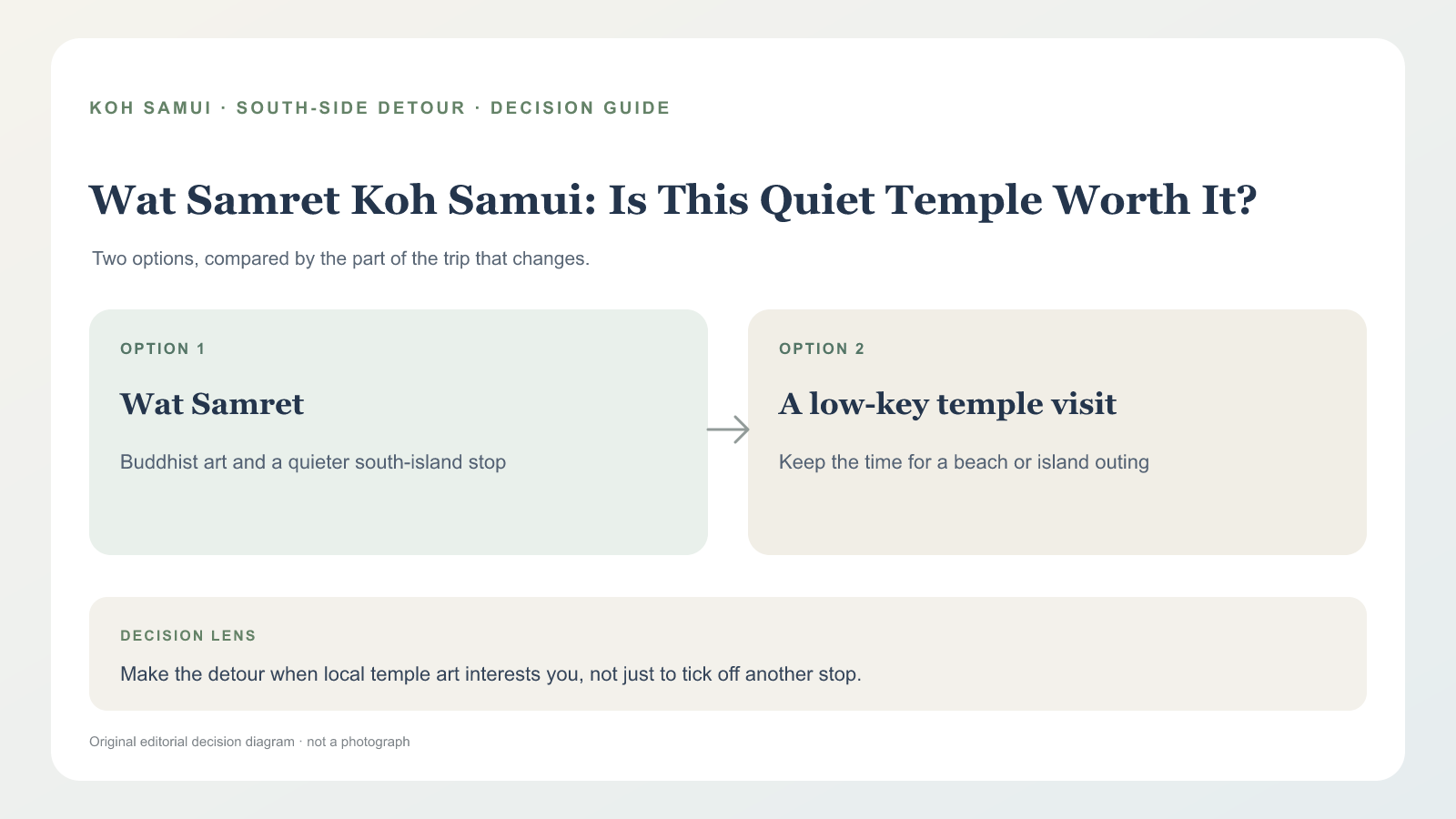
Go if you would be interested in a historic temple even without a big sea view: Wat Samret preserves a distinctive local collection of Buddha images and other religious objects, and Surat Thani authorities opened a local-art learning centre at the temple in 2023. Skip if you already have enough temple time and your remaining south-side hours would be better spent on a waterfall, coast stop or local community.
The useful test is simple: does the art history itself interest you? If yes, Wat Samret offers something different from Samui's better-known headline temples. If no, it is easy to turn the stop into temple fatigue.
Why Wat Samret is different from the temples most first-time visitors already know
A first Samui itinerary often starts with obvious temple names. You may already be comparing Big Buddha vs Wat Plai Laem, or deciding whether the south side needs the visual contrast in Red Temple vs Wat Khunaram. Wat Samret is useful only if it fills a different gap.
Thailand's Office of Natural Resources and Environmental Policy and Planning records Wat Samret as one of Samui's old temples, with significant local religious art in an old Buddha hall. The conservation record documents 74 Buddha images in that hall, including seated, reclining and standing figures. It also notes local construction and restoration traditions, including the use of coral stone in several religious objects and small spiral shells in some sculptural details.
That makes the attraction more specific than “another temple”. The value is in seeing a layer of local craftsmanship that is easy to miss if your temple list is built only around scale, colour or viewpoints.
Strong reason to go
You care about religious art, old island craftsmanship, coral-stone sculpture, temple collections or the way Samui's Buddhist material culture differs from Bangkok and Chiang Mai.
Weak reason to go
You saw “hidden temple” on social media and mainly want an uncrowded photo. Quiet is not the same thing as a compelling reason to spend road time.
Best route fit
You are already building a Lamai / Maret / south-side road day and can add Wat Samret without crossing the island solely for it.
The part most guides miss: the temple now has a local-art learning layer
In May 2023, Surat Thani provincial authorities recorded the opening of a local-art learning centre at Wat Samret. The official account describes Buddhist images in local Thonburi-period style, coral-stone religious art, palm-leaf scriptures, bronze objects, ceramics, household items and documents connected with King Chulalongkorn's 1888 visit.
That matters because it shifts the editorial answer. Wat Samret is not worth a detour because it is “secret”. It is worth considering because the site brings together religious art, local craft traditions and documented island history in one place. If you liked the everyday-life history in Wat Lamai Folklore Museum vs Wat Khunaram, Wat Samret pushes the story in a more explicitly Buddhist-art direction.
When Wat Samret is worth the stop
When you should skip it
Skip Wat Samret if the real problem is that you feel your itinerary needs “one more cultural thing”. Samui already gives you many ways to build a non-beach day. If you are deciding whether one land day should focus on temples or scenery, solve temples vs south-island nature first. If the answer is nature, a choice such as Hin Lad vs Na Muang may improve the trip more than another religious stop.
Also skip it if what you actually want is a visually immediate landmark. Big Buddha, Wat Plai Laem and Red Temple solve that need more directly. Wat Samret's strongest case is historical depth, not instant spectacle.
A sensible south-side sequence
Do not build a day around Wat Samret alone. Use it as one meaningful anchor inside a broader route. A coherent pattern is: Lamai or south-east coast → one cultural stop → one nature or community stop → dinner near where you plan to finish. The exact order should depend on where you are staying and current road conditions.
If you want a landscape marker rather than more temple time, Lad Koh vs Hin Ta Hin Yai compares two easier visual stops. If you are trying to keep the whole day low-friction, the broader Koh Samui 4-day resort-day decision can help you avoid turning every free hour into another road stop.
Do not plan this visit around unverified opening hours
Current government and conservation sources are strong on Wat Samret's history and collections, but they do not give a single, sufficiently robust 2026 visitor timetable for every part of the temple and learning centre. That means the safest planning approach is not to choose Wat Samret because a third-party map listing says it is open at a particular hour.
If the old Buddha hall or learning-centre collection is the main reason you are going, verify same-day access before making a dedicated detour. This is especially important because a functioning temple may have religious activity, maintenance or local access conditions that do not map neatly to commercial-attraction hours.
Women travelling solo: the practical part is simple
This is a functioning Buddhist site, not a themed museum. Dress conservatively enough that shoulders and knees are covered, follow local shoe rules and give worshippers space. Avoid treating old religious images as props. If a hall feels private, closed or actively in use, do not assume tourism access.
The bigger solo-travel issue is transport. If Wat Samret is part of a multi-stop south-side day and you do not ride confidently, a planned ride can be easier than trying to improvise each leg. Compare a private driver vs individual taxis before the day. Thailand Tourist Police currently lists 1155 as the traveller-assistance hotline.
Wat Samret or another culture stop?
If you want an explicitly religious-art stop, Wat Samret can be more rewarding than it looks on a generic “top attractions” list. If you want local everyday history through domestic objects and coconut-growing tools, Wat Lamai Folklore Museum is more direct. If you want a visually distinctive temple rather than a historic collection, Wat Plai Laem vs Red Temple is the better comparison.
The point is not to collect all three. Choose the one that answers the gap in your trip.
Final decision
Wat Samret is worth it for travellers who care about local Buddhist art and can place it inside an existing south-side route. It is not a must-see for every first trip, and that is exactly why the stop can work well when the interest is genuine. Go for the documented history, the old Buddha collection and the local-art context. Skip it if you would rather spend the same time on a beach, waterfall, community or one of Samui's more immediate landmark temples.
Continue planning with the Koh Samui Experiences hub or step back to the Koh Samui destination guide if your bigger question is still how to divide the island.