
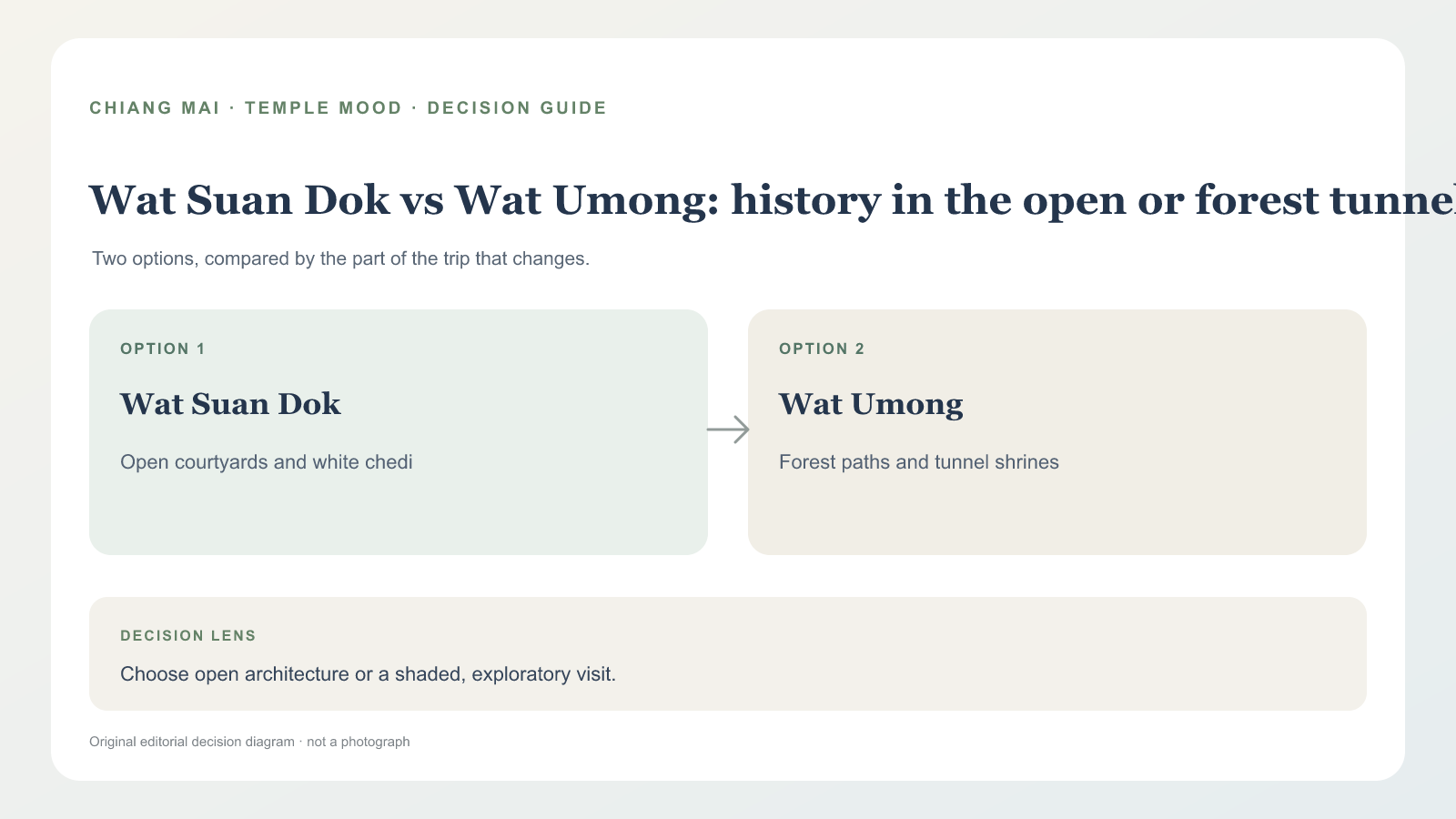
The short answer
This is not another “which temple is prettier?” ranking. The useful decision is what kind of contrast your Chiang Mai itinerary still needs. If you have already spent a morning around the Old City, Wat Suan Dok deepens the Lanna historical story. Wat Umong changes the physical atmosphere more dramatically.
Choose Wat Suan Dok when you want the history to be obvious
Chiang Mai Provincial Administrative Organization’s current heritage record identifies Wat Suan Dok, also known as Wat Buppharam, as a 14th-century temple founded on King Kue Na’s former royal flower garden. The same source highlights its principal chedi, large vihara and royal cemetery, where memorial stupas preserve the ashes of Chiang Mai rulers and important royal family members.
That makes Suan Dok especially useful if you enjoyed the Wat Chedi Luang vs Wat Phra Singh decision but want one more piece of the city’s political and religious history rather than another Old City walk. The open compound, golden chedi and white memorial structures give the visit a clear narrative without requiring a long detour.
Choose Wat Umong when you want the place to slow the day down
Wat Umong is a forest monastery at the foothill of Doi Suthep. Chiang Mai’s current heritage material describes its bell-shaped chedi and unusual brick tunnel system beneath the monument, a form the provincial heritage programme treats as distinctive within Lanna religious culture.
The practical difference is that Umong benefits from unhurried time. If you only want to walk into the tunnels, take a photo and leave, you are using the site at its shallowest level. If forest atmosphere, shaded grounds and the monastery setting are the point, the visit starts to feel genuinely different from an urban temple.
If you are actually deciding between two quieter forest-style temples, use the separate Wat Pha Lat vs Wat Umong guide. Suan Dok is a different comparison because its value is historical and monumental rather than forest-led.
The route test matters more than the map distance
Old City morning
If you have already done a focused temple morning, ask what is missing. Suan Dok adds royal memory; Umong adds atmosphere. The Old City temple timing guide helps prevent a short trip from turning into all-day temple hopping.
Nimman or west side
Both temples are west of the moat, but they do not create the same outing. If your base is still undecided, solve Old City vs Nimman before optimising one temple transfer.
Doi Suthep day
Do not automatically stack every western site into one day. Decide the mountain timing first with the Doi Suthep morning vs late-afternoon guide.
If you only have 60–90 minutes, pick Suan Dok
Suan Dok is the cleaner short-block choice because the major visual and historical elements are easier to read quickly. The principal chedi, vihara and royal cemetery all support the same story. You can leave after a focused visit without feeling that you cut the experience in half.
Umong is better when you are willing to give the setting room. Its tunnels are the obvious hook, but the forest-monastery character is what justifies choosing it over a more central temple.
If you already have Doi Suthep and an Old City temple morning, skip one more temple
This is the point where many first trips become over-optimised. Chiang Mai has enough important temples to fill several days, but that does not mean a four-day itinerary improves when every open space gets another sacred site.
The four-day Chiang Mai structure works better when each block has a different role. Old City heritage, one mountain commitment, contemporary Chiang Mai and a food or market evening create more contrast than repeating the same category.
Practical notes for women travelling solo or with friends
Dress for active religious spaces. A sleeved top and clothing that covers the knees keeps both visits simple. Remove shoes where required, keep voices low and avoid blocking worshippers for photographs.
At Wat Umong, settle the return plan before you wander. The forest setting is part of the appeal, but it is less like stepping out of a café and into an Old City temple. If you are travelling alone, keep the transport plan simple and avoid creating an unnecessary last-mile problem after dark.
At Wat Suan Dok, treat the white memorial stupas as a royal cemetery, not a decorative photo set. Photograph respectfully and give religious activity space.
Both are important to Chiang Mai’s current heritage nomination work
Chiang Mai’s provincial heritage programme includes both Wat Suan Dok and Wat Umong among significant monuments in the city’s current cultural-heritage nomination. A provincial PRD update dated 29 May 2026 listed both among the sites being prepared for expert evaluation.
That does not mean Chiang Mai is already a UNESCO World Heritage Site. For trip planning, the useful point is that both temples matter historically for different reasons: Suan Dok represents royal patronage and urban Lanna memory; Umong represents a forest-monastery and tunnel tradition.
When doing both makes sense
Do both only if the contrast itself interests you. A traveller who wants to understand Lanna religious history can justify Suan Dok for royal patronage and Umong for forest-monastery form. If you do that, separate them with food, coffee or another non-temple block instead of turning the afternoon into a checklist.
If your evening is still open, compare Sunday Walking Street vs Night Bazaar or Saturday Wua Lai vs Sunday Walking Street. A different category often adds more to the trip than a third temple.
The final choice
Pick Wat Suan Dok for a compact, historically explicit stop built around royal Lanna memory, a major chedi and the royal cemetery. Pick Wat Umong for forest atmosphere, tunnels and a monastery visit that deserves a slower pace.
If neither description feels essential, skip both and use the Chiang Mai destination hub to give the next part of the trip a different job.