
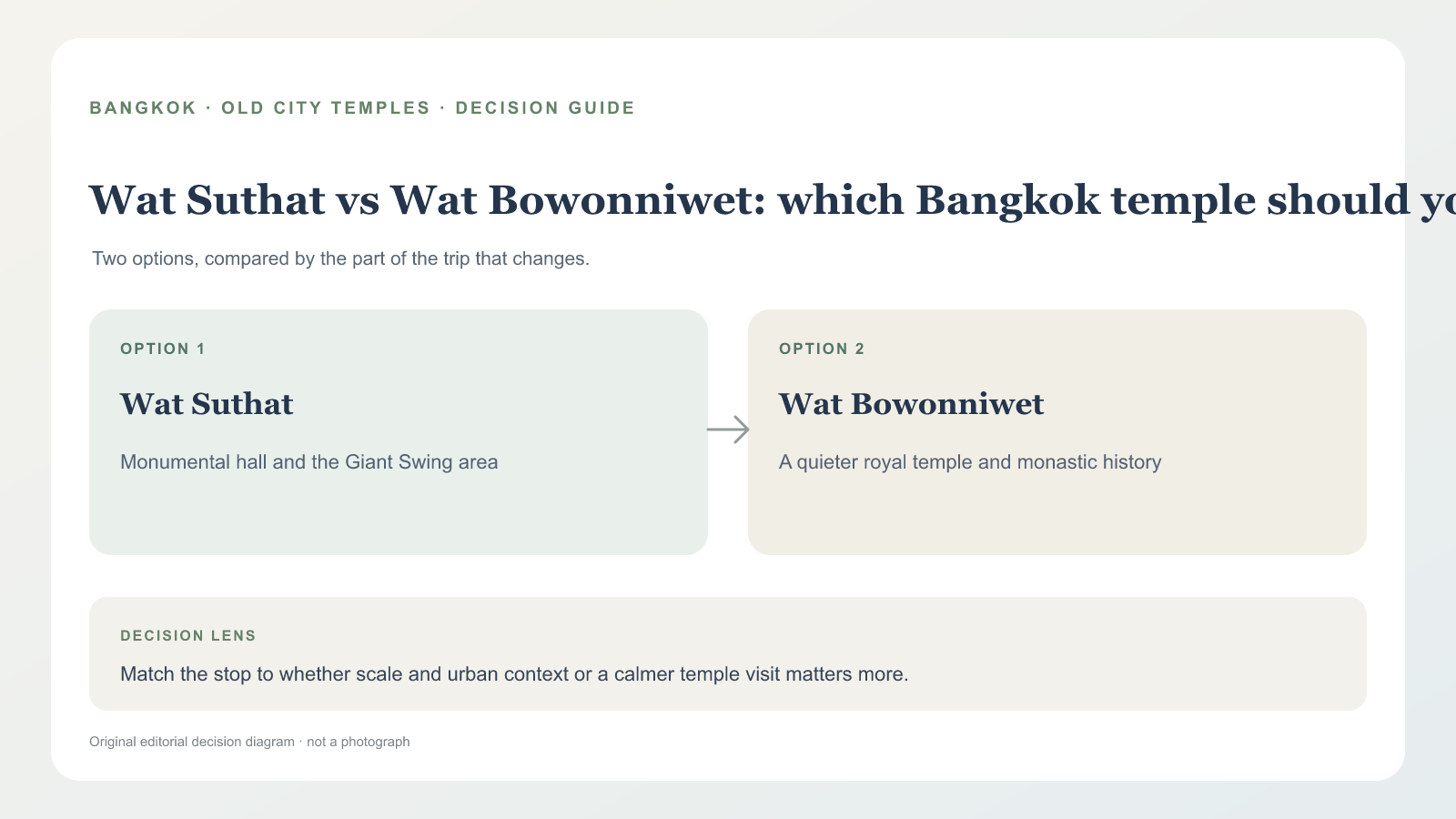
This is not a “which temple is better?” ranking. Both are first-class royal monasteries with serious historical weight. The useful question is which one adds a layer your Bangkok trip does not already have.
If your itinerary already contains the Grand Palace, Wat Pho and Wat Arun, first solve their geography with the Grand Palace, Wat Pho & Wat Arun order guide. Then use this comparison only if you genuinely want one more temple. Bangkok gets less interesting when every free hour turns into another sacred-site checklist.
Choose Wat Suthat for visual scale and Old Town art
Wat Suthat works when you want the extra temple to feel immediately legible: a major vihara, a famous Buddha image, Rattanakosin craftsmanship and the Giant Swing right outside the wider site context.
Choose Wat Bowonniwet for monastic and royal history
Wat Bowonniwet works when you care less about “one more landmark” and more about a monastery shaped by Prince Mongkut, the Dhammayut tradition, important Buddha images and an unusually strong royal-monastic story.
Wat Suthat is the cleaner choice when Old Town is already your map
Tourism Authority of Thailand’s current 2025 spiritual-sites guide places Wat Suthat on Bamrung Mueang Road and describes the temple as a project begun under Rama I, continued under Rama II and completed under Rama III. The temple’s identity is therefore bound to the formation of early Bangkok itself, not simply to the Giant Swing outside.
The current TAT description highlights Phra Sri Sakyamuni — brought from Wat Mahathat in Sukhothai — as well as exceptional Rattanakosin carved door panels. It also explains that Wat Suthat does not use a conventional chedi as its main commemorative focus in the same way many visitors expect; the temple instead incorporates the Sattamahastana, the seven places associated with the Buddha.
That makes Wat Suthat a good answer when you already chose Old Town for the day but do not want to repeat the exact Grand Palace/Wat Pho/Wat Arun experience. If you are still deciding whether Old Town deserves your first rested day at all, solve that earlier question with Bangkok First Full Day: Old Town or Stay Central?.
Transport friction is also comparatively easy to understand. BEM’s current Sam Yot station information directly lists Wat Suthat and Sao Chingcha among the nearby destinations. That does not make the temple “at the station,” but it gives you a reliable rail anchor before the final walk rather than forcing a vague taxi-only plan.
Use geography before you use a must-see list
Already around Sam Yot, Loha Prasat or the Giant Swing: Wat Suthat is the natural choice.
Already walking Banglamphu, Phra Sumen Road or the Khao San / Banglamphu side: Wat Bowonniwet is the natural choice.
Starting from Siam or Sukhumvit with neither district on your day: do not cross the city just because both temples are saved on a map. If hotel geography keeps creating this problem, the Siam vs Old Town stay guide shows why repeated cross-city temple trips become tiring.
Wat Bowonniwet rewards travellers who read the story before arriving
Wat Bowonniwet is less useful as a “quick visual icon” and more rewarding as a place where monastic history changes what you notice. The temple’s own official history describes it as a first-class royal monastery of the Dhammayut tradition on the north-east side of Rattanakosin, just inside the old city wall by Banglamphu canal.
The decisive historical layer is Prince Mongkut. The monastery’s official history records that he became abbot in 1836 while still a monk and later ascended the throne as King Rama IV. If that royal-monastic link interests you, the temple stops feeling like an extra decorative detour and becomes a specific Bangkok history stop.
The official Wat Bowonniwet material on the ordination hall adds another reason to choose it: Phra Buddha Jinasiha, a celebrated Sukhothai-period Buddha image, and murals by the painter In Khong from King Mongkut’s period. The monastery’s official chedi history also connects the major stupa directly to Mongkut’s design and building programme.
TAT’s September 2025 Banglamphu walking route reinforces the geography. It places Wat Bowonniwet inside a wider Banglamphu day with the Banglamphu Museum, local food and Phra Sumen Fort. In other words, Bowonniwet is strongest when you treat it as part of a neighbourhood, not when you parachute in for a single photo.
If you have 60–90 minutes
Wat Suthat: use the time for the main architectural and art layers, then let the Giant Swing complete the sense of place outside the temple.
Wat Bowonniwet: concentrate on the ordination hall, the Buddha images, murals and the monastery’s Mongkut story rather than trying to inspect every building in the precinct.
If you have half a day
Wat Suthat: pair it with a coherent Old Town walk rather than another three temples. The Marble Temple vs Loha Prasat guide is useful if you are still adding historic architecture.
Wat Bowonniwet: let Banglamphu be the second half of the experience. That is a better use of the location than rushing straight back to central Bangkok.
The opening-hour difference can decide a late-afternoon slot
TAT’s current 2025 listings publish Wat Suthat at 08:00–17:00 daily and Wat Bowonniwet at 08:00–16:30 daily. Treat those as current published guidance rather than a permanent promise. Religious events, ceremonies and access to specific buildings can change what is practically visitable, so recheck on the day.
This matters because neither is a good “we will squeeze it in after everything else” temple. If your afternoon has already become a long Old Town marathon, the better decision may be to stop adding monuments. The Old Town & Chinatown: Same Day or Separate? guide is more useful at that point than another must-see list.
Which one feels more different after Bangkok’s headline temples?
Wat Suthat feels different through scale, interior art and the Giant Swing context. It is still monumental Bangkok temple architecture, but the visual language and historical framing are strong enough to justify one additional sacred-site stop.
Wat Bowonniwet feels different through biography and institutional history. The link to Mongkut, the Dhammayut tradition, the important Buddha images and the Banglamphu setting reward a traveller who wants to understand how religion, monarchy and neighbourhood overlap.
If you are actually chasing an elevated city view rather than another interior, skip both and compare Golden Mount vs Wat Arun. If you are more interested in objects and historical interpretation than another active temple, Bangkok National Museum vs Museum Siam may be the better use of your attention.
For women travelling solo: make the return plan boring
Both temples are in active city districts, but “safe-feeling historic area in daylight” is not the same thing as having a good late return plan. Keep your phone charged, dress respectfully enough that you do not need to improvise cover-ups at a religious site, and decide how you are leaving before you get tired.
Wat Suthat has the clearer MRT anchor through Sam Yot. Wat Bowonniwet works well as part of Banglamphu, but your onward route may be road- or walk-based depending on the rest of the evening. If plans change or you need tourist-police assistance, Thailand Tourist Police currently lists 1155 as its traveller-assistance hotline.
What should come after each temple?
After Wat Suthat: keep the day geographically coherent. You can continue through Old Town, or switch texture completely rather than stacking more temples. If heritage lanes sound better, use Talat Noi vs Song Wat. If a late market is the real end point, Pak Khlong Talat at Night or Before Dawn? solves the timing question.
After Wat Bowonniwet: let Banglamphu breathe. The temple makes more sense when followed by a neighbourhood walk, food or a slower evening instead of a taxi sprint to another icon. If you want a deeper community-focused half-day on a different day, Khlong Bang Luang vs Kudi Chin offers a completely different cultural decision.
When I would skip both
Skip both if the Grand Palace, Wat Pho and Wat Arun already gave you enough sacred architecture for one trip. That is not a failure of cultural curiosity. Attention is a travel resource.
Use the free block for a museum, neighbourhood, park or food evening that adds a new layer. Bangkok becomes more memorable when the itinerary changes texture instead of repeating the same category because a guidebook said every temple was “unmissable.”
Final choice
Choose Wat Suthat when you want the stronger first-trip architectural stop, you are already in Old Town, or the Giant Swing / monumental vihara / Rattanakosin-art combination is the attraction.
Choose Wat Bowonniwet when you want a quieter monastery with a specific King Mongkut and Dhammayut story, and Banglamphu is already part of your day.
If neither description feels compelling, skip the extra temple and use the time somewhere that changes the shape of your trip. For the wider city sequence, return to the Bangkok destination hub or browse more Bangkok experience decisions.
Sources checked
Tourism Authority of Thailand — “Spiritural places to visit for blessing in 2025” (Wat Suthat history and current published hours): tourismthailand.org
Tourism Authority of Thailand — “Walking Tour @Banglamphu” (Wat Bowonniwet current published hours and neighbourhood route): tourismthailand.org
Wat Bowonniwet Vihara official site — monastery history, ordination hall and chedi: watbowon.org
Bangkok Expressway and Metro — Sam Yot station locality information (Wat Suthat / Giant Swing): metro.bemplc.co.th
Thailand Tourist Police — traveller-assistance hotline 1155: touristpolice.go.th
Facts and operating details rechecked 15 August 2026.