
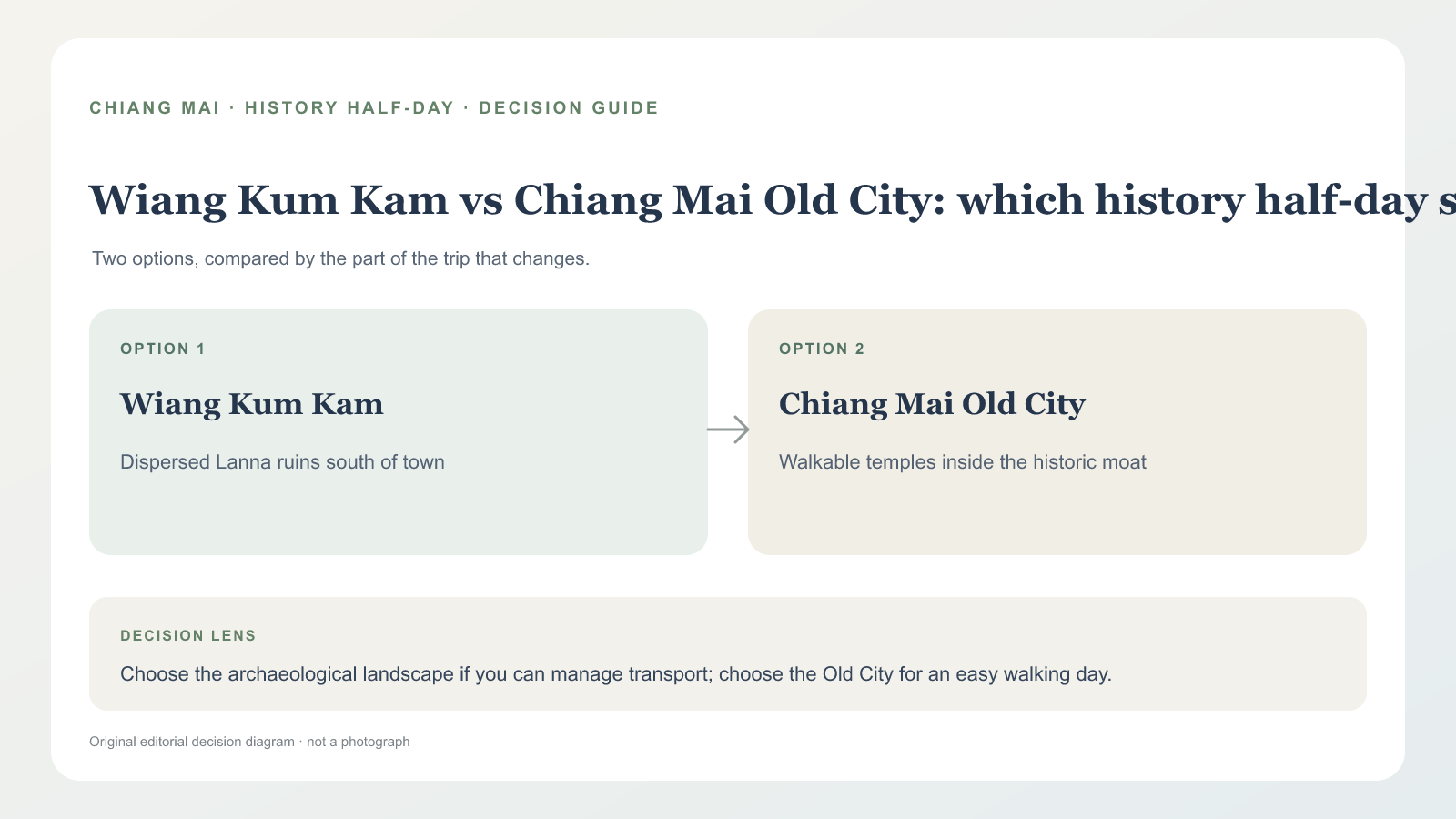
These two places both tell Lanna history, but they ask very different things from your day. Old City is a living neighbourhood where gates, moat, active temples, cafés, lunch, markets and ordinary city movement all overlap. Wiang Kum Kam is an archaeological landscape south of central Chiang Mai whose value rises sharply when you want to understand the city that came before Chiang Mai itself.
The short answer
- Pick Old City if this is your first Chiang Mai trip, you want history without giving up food and neighbourhood time, or you only have three to four full days.
- Pick Wiang Kum Kam if pre-Chiang-Mai urban history, excavated temple sites and the archaeology itself sound more interesting than another living-city walk.
- Do both only when history is one of the trip's main themes. Famous does not automatically mean compulsory, and neither does obscure.
The question is not “which one is older?”
That sounds like the obvious comparison, but it is not the useful one. The Fine Arts Department describes Wiang Kum Kam as an important ancient Lanna city associated with King Mangrai before the establishment of Chiang Mai. Archaeological work beginning in the 1980s identified and restored a large spread of sites; Fine Arts material lists 29 registered ancient monuments, with 24 inside the old city boundary and five outside it.
Old City, meanwhile, is not an archaeological park. Tourism Authority of Thailand still frames the moated city as a walkable living historic district, with Tha Phae Gate, active temples and the Sunday Walking Street occupying the same urban fabric. You are not choosing “old ruins versus newer ruins.” You are choosing archaeology as the activity versus history woven into a working city day.
Wiang Kum Kam
Best when the fun is piecing together how an earlier Lanna settlement worked, why temple remains appear across a wider landscape, and how river geography shaped the city. It rewards attention to fragments, site relationships and context.
Chiang Mai Old City
Best when you want major temples, walls, moat, streets, lunch and people-watching to occupy the same half-day. History is present, but it does not require you to make history the only subject.
Why Wiang Kum Kam is more interesting than the usual one-line story
There is a neat travel-brochure version of Wiang Kum Kam: old capital, big flood, city disappears. The Fine Arts Department's archaeological interpretation is messier—and much better. Its research notes that parts of the site were buried by substantial sediment, but evidence from excavations suggests the settlement had already been abandoned before the major flood deposits accumulated.
That matters because Wiang Kum Kam becomes more than a photogenic “lost city.” The site preserves questions about the old Ping River channels, changing settlement patterns and how temples related to water and movement. If that paragraph made you more interested rather than less, Wiang Kum Kam is probably your choice.
If it made you think, “That is fascinating, but I also want lunch and a massage,” Old City is probably going to make you happier. No shame. Holidays are not postgraduate seminars unless you specifically booked one.
Why Old City is the better default on a first trip
Old City gives one half-day several jobs. You can build a focused temple pair using Wat Chedi Luang vs Wat Phra Singh, adjust the timing with the Old City temple timing guide, then let lunch, cafés or a slow walk absorb the rest of the block.
That density is useful when your trip is short. The Chiang Mai 4-day itinerary works best when mountain, city, market and contemporary-neighbourhood time each do different jobs. Giving Wiang Kum Kam half a day can be excellent, but it is still a dedicated detour. Old City is easier to combine without turning the whole day into a transport project.
If your accommodation decision is still open, keep it separate from the sightseeing choice. Inside Old City vs outside the moat handles repeated daily convenience, while Old City vs Nimman handles the larger base decision. A good half-day does not automatically mean you should sleep there.
The four-hour reality check
You can begin with one or two heritage anchors, walk between them, stop for coffee or lunch and end the block whenever your energy drops. The geography is forgiving.
The transfer south of central Chiang Mai is part of the commitment, and the ancient sites are spread across a wider archaeological landscape. Treat the outing as a destination rather than a casual extra stop.
Old City is easier to shorten because food, cafés and indoor pauses sit inside the same urban area. At Wiang Kum Kam, the archaeology is the reason you came, so weather that makes outdoor site-hopping unpleasant reduces more of the outing's value.
Wiang Kum Kam rewards people who like context more than checklists
The Fine Arts Department records a large number of ancient sites rather than one single showpiece. That means the strongest visit is not “arrive, photograph one chedi, leave.” You get more from it when you understand why multiple temple remains, old ground levels and former river channels matter together.
That also makes Wiang Kum Kam a smart choice if your current plan is already temple-heavy inside the city. Instead of adding a sixth active temple because it is on a list, you can change the historical lens entirely. If you want an outside-the-moat temple rather than archaeology, compare Wat Suan Dok vs Wat Umong or Wat Pha Lat vs Wat Umong.
Old City is easier—but easy can still become too much
Old City has the opposite problem: because everything is nearby, it is very easy to keep adding “just one more” temple, gate or market. A strong half-day usually has one main heritage question, not seven famous pins.
If Sunday evening is in play, decide separately whether the Sunday Walking Street or Night Bazaar should own your market evening. If daytime market life matters more, the Jing Jai vs Warorot Market comparison gives that block a different job. This is how you stop “heritage day” becoming code for walking until everybody quietly hates the itinerary.
One trap: treating Wiang Kum Kam as the “more authentic” choice
Do not use obscurity as a quality score. Wiang Kum Kam is valuable because its archaeology tells a different chapter of Lanna history. Old City is valuable because it remains a living urban district with active religious and social life. One is not morally superior because fewer people on your feed tagged it.
A better test is simple: if nobody could see your photos, which place would you still want to spend three or four hours understanding?
Route friction should break a close tie
Wiang Kum Kam sits south of central Chiang Mai and functions as a more deliberate outing. Old City is already woven into many first-trip routes. If you are staying near the moat, Old City may require almost no strategic planning. If you are building a creative or west-side day instead, you may prefer to leave history for another block and use Baan Kang Wat vs One Nimman to protect variety.
When route friction is the only reason you are choosing Wiang Kum Kam, stop. Take the detour when Wiang Kum Kam offers an experience you want beyond another map stop.
Practical notes for women travelling solo or with friends
For Wiang Kum Kam, solve the return before you get tired. Because the archaeological sites are spread across a separate area south of central Chiang Mai, keep enough phone battery and data to arrange your onward ride rather than relying on a spontaneous end-of-day transport plan.
For Old City, watch the “I can just walk” trap. The district is easy to explore on foot, but heat can quietly turn a pleasant temple loop into a very long afternoon. Build in shade, water and a stop you are genuinely happy to sit in.
Respect active religious spaces. Some heritage stops remain working temples. Dress modestly where required and let worshippers have the space before the camera gets its turn. Thailand Tourist Police currently lists 1155 for tourist assistance if you need help.
Who should choose what?
When doing both makes sense
Doing both works best when Chiang Mai's history is one of the trip's headline interests and you have at least four or five usable days. Keep them separate rather than forcing both into one heroic “heritage day.” Old City benefits from wandering and food breaks; Wiang Kum Kam benefits from attention to the archaeological story.
If you still need to decide how much city time should compete with mountains and contemporary Chiang Mai, go back to the Chiang Mai destination hub or the Chiang Mai experiences index before adding another stop.
The final pick
Choose Chiang Mai Old City for your only history half-day on a normal first trip. Choose Wiang Kum Kam when the pre-Chiang-Mai archaeological story itself is what you came to understand.
That is the useful distinction: Old City lets history share the day. Wiang Kum Kam asks history to be the day.