
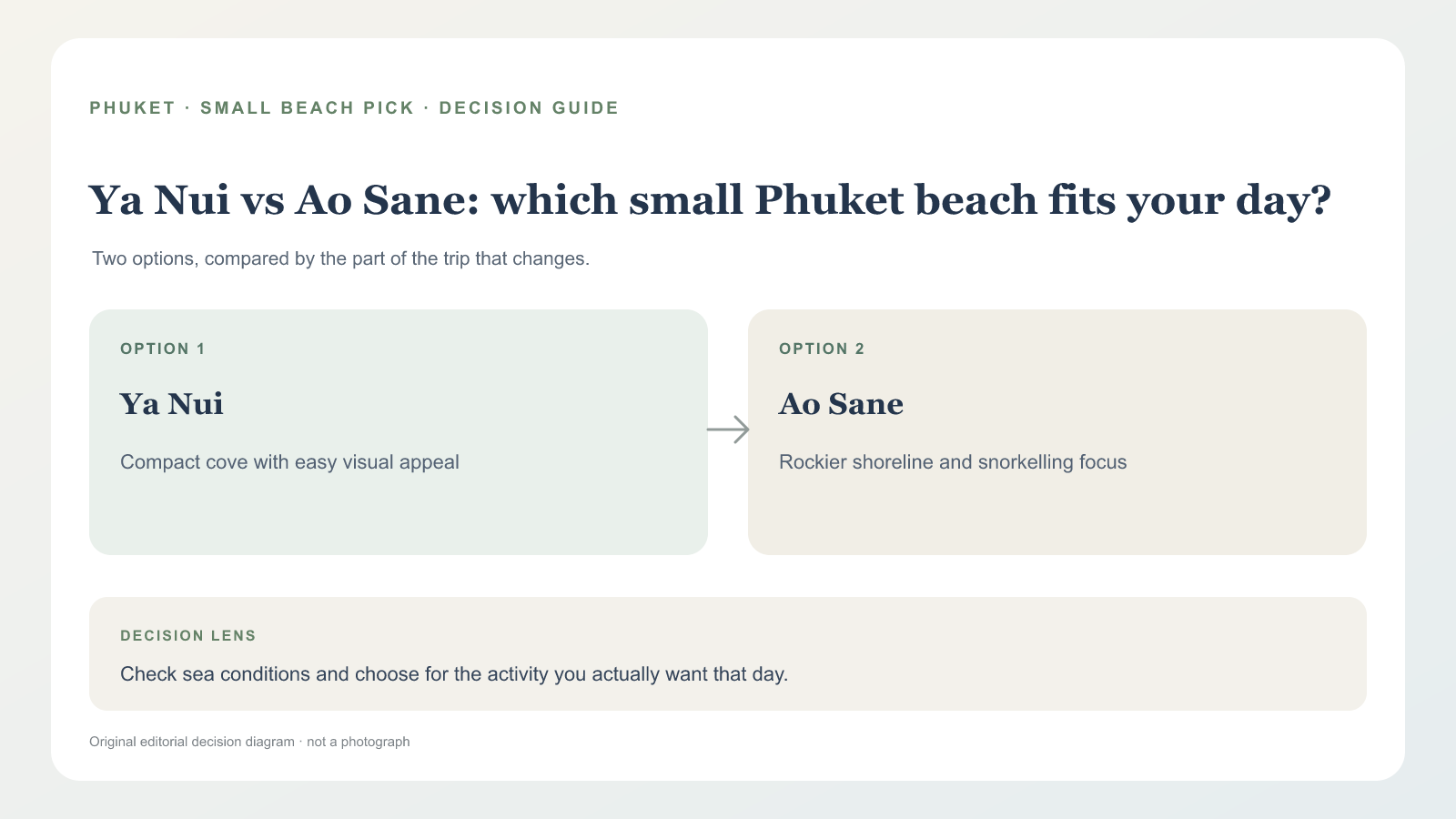
Ya Nui and Ao Sane are often grouped together as Phuket's smaller, quieter southern beaches. That description is true but not very useful. They solve different travel days. Ya Nui sits on the road between Nai Harn, Windmill Viewpoint and Promthep Cape, so it is easy to understand as part of a south-coast sequence. Ao Sane is tucked beside Nai Harn and makes more sense when you intentionally want a rocky little bay rather than another stop on a sightseeing loop.
If you are still choosing where to sleep rather than where to spend two or three hours, start with Nai Harn vs Kata. If Kata is already your base, the more relevant hotel-area decision is Kata Yai vs Kata Noi. This guide assumes your base is already chosen and you are deciding which small south-Phuket beach deserves the detour.
Ya Nui = route-friendly. It wins when the day already points toward the south tip of Phuket. Ao Sane = beach-first. It wins when you are happy to go to Nai Harn's orbit specifically for a quieter cove and you do not need the stop to connect neatly to a bigger sightseeing chain.
The beach is one piece of a south-coast afternoon
Phuket Province places Ya Nui between Windmill Viewpoint and Promthep Cape. That geography is its biggest planning advantage. You can give the cove a real swim-or-sit block, then continue south instead of creating a separate out-and-back beach mission.
You actually want the rocky-cove feel
Phuket Province describes Ao Sane as a tiny bay beside Nai Harn, with rocky boulders and swimming or snorkeling as its main draws. That makes it stronger when the cove itself is the experience, not when you are trying to collect three south-coast stops efficiently.
Do not decide from drone photos; use these four tests
1. What is the next place after the beach?
If the answer is Windmill Viewpoint or Promthep Cape, Ya Nui has the cleaner geography. The provincial visitor page explicitly places it between those two south-coast landmarks. If the answer is “back to Nai Harn, lunch nearby, then nowhere in particular,” Ao Sane becomes more logical.
2. Do you want sand time or water-and-rock texture?
Ya Nui is the simpler choice when you want a small cove without making the beach technically complicated. Ao Sane is described by the province as a small beach dotted with rocky boulders and suitable for swimming and snorkeling. That can be exactly what you want, but it also means the shoreline character matters more than at a plain sandy stop.
3. How much transport uncertainty are you willing to carry?
Neither beach should be treated like a giant resort strip with endless transport waiting outside. If you are not driving, solve the return before you settle in—especially if you are staying outside the south. The broader Phuket scooter vs Grab guide is useful if your whole beach plan keeps depending on “we can just rent a scooter.”
4. Would you still enjoy the stop if you do not swim?
This is the most important weather test. If local flags, waves or visibility make swimming a bad idea, Ya Nui still works more easily as part of a viewpoint-and-coast sequence. Ao Sane loses more of its reason for being if the water is the part you came for. Do not force either beach because a saved map pin says “snorkeling.”
Ya Nui is better for a mixed south-Phuket day
The official Phuket Province page calls Ya Nui a tiny cove between Windmill Viewpoint and Promthep Cape. That makes it unusually easy to give the beach a defined job: break up a south-coast afternoon with water, shade and a slower hour before continuing to a viewpoint or dinner.
This is particularly useful if you are based in Kata or Karon and do not want to turn a small beach into a full-day commitment. You can leave your main beach base, make one deliberate southbound movement, and keep the rest of the afternoon in the same broad corridor. If you are debating whether the final sunset is worth another move, use the separate stay on your beach vs Promthep Cape guide rather than assuming every Ya Nui visit should end at the cape.
A good Ya Nui day has one direction
Base → Ya Nui → one south-coast follow-up → dinner or return. Avoid turning it into Base → Ya Nui → north for lunch → south again for sunset. The point of choosing Ya Nui is not that the cove is “better.” It is that the route can stay coherent.
If that follow-up is a viewpoint, use Karon Viewpoint vs Windmill Viewpoint to decide whether the classic three-bay west-coast panorama or the south-coast Nai Harn–Ya Nui route is the better fit.
If the bigger question is whether to keep the whole afternoon beach-led or switch to a working waterfront and dinner, use Nai Harn & Ya Nui or Rawai.
That route logic also explains why Ya Nui can be a better choice on a short first trip. If your Phuket schedule already includes a proper Old Town block, an island day and a main beach day, the small-beach stop should add variety without consuming another full planning unit. The Old Town full-day vs evening guide helps protect that time budget, while Phi Phi vs Phang Nga Bay keeps the marine day as a separate decision.
Ao Sane is better when the cove itself is the plan
Ao Sane sits next to Nai Harn. Phuket Province describes it as a tiny bay with rocky boulders, local food shops and water suited to swimming or snorkeling under appropriate conditions. That profile makes Ao Sane less useful as a checklist stop and more useful as a small destination of its own.
If you choose Ao Sane, give it enough time to justify the detour. Arriving, taking a few photos and leaving after twenty minutes defeats the point. The stronger version is a slower cove block: settle in, decide whether conditions suit swimming, have something simple nearby if available, then return through the Nai Harn area without adding three unrelated stops.
For travelers who already prefer the south-west part of Phuket, this can fit naturally around a Nai Harn stay. The Nai Harn vs Kata base guide explains why Nai Harn works best when you are comfortable making fewer, more deliberate outings. Ao Sane is exactly that kind of outing.
The comparison changes quickly when the sea changes
Do not use a beach guide as permission to swim. Phuket Province specifically warns that nearby Nai Harn can have strong currents during the May-to-October monsoon period. Thailand's official disease-control guidance also tells beachgoers to obey local warning flags and avoid entering water in red-flag areas. Thai Meteorological Department shipping forecasts show why broad Andaman conditions can change substantially from one forecast cycle to another.
Use an on-the-day safety gate before either beach
- Red flag or local no-swim instruction: do not enter the water, regardless of what a travel article says.
- Thunderstorms, rough water or poor visibility: downgrade swimming or snorkeling plans and reassess whether the beach still earns the transport.
- Rocky entry at Ao Sane: move carefully and do not assume every part of the shoreline is an easy barefoot entry.
- Calm-looking surface: still check local flags and lifeguard guidance; appearance alone is not a safety assessment.
If marine conditions are affecting more than a single cove, do not keep hunting for a “safe-looking” beach by taxi. Use the logic in Phuket boat tour cancelled: Old Town or beach Plan B and decide whether the problem is specifically offshore or whether the whole coast deserves a softer day.
| Decision | Ya Nui | Ao Sane |
|---|---|---|
| Best reason to go | A compact beach stop inside a south-coast route | A quieter rocky cove beside Nai Harn |
| Pairs most naturally with | Windmill Viewpoint / Promthep Cape corridor | Nai Harn area and a slower beach-focused block |
| If you do not swim | Still works relatively well as part of a scenic route | Loses more of its purpose if the cove-and-water experience was the main draw |
| Shoreline character | Small cove | Small cove with more obvious rocky boulders |
| Better for a first short trip when | You need the stop to fit an already busy Phuket plan | You deliberately want a less resort-like cove day |
For solo women, the return plan matters more than the beach ranking
A small beach can feel wonderfully quiet until you are wet, carrying a phone and wallet, and trying to arrange a ride after most people have left. If you are traveling solo, keep valuables with you rather than leaving them unattended while swimming, avoid making your phone battery the only return plan, and settle the likely pickup point before you stay into late afternoon. If you are uncomfortable with an isolated-feeling final leg, choose the option that keeps you inside the easier route even if the other cove looks prettier online.
If low-friction beach time is the main priority, you may not need either detour. A strong base can do more for the trip than collecting another beach pin. Compare Kata vs Karon, or return to the broader where to stay in Phuket guide if your daily beach radius still feels unresolved.
So which one should you choose?
Choose Ya Nui if you are already moving through south Phuket and want a beach stop that fits the route without becoming the whole day. It is the better default for a first short trip from Kata, Karon or another west-coast base when you also want Windmill Viewpoint or Promthep Cape.
Choose Ao Sane if the smaller rocky cove itself is what appeals to you, you are already orbiting Nai Harn, and you are comfortable giving the stop enough time to justify the extra movement.
The final test
If you would be disappointed when the beach has to become a no-swim stop, choose Ya Nui for the stronger route value. If you would still happily travel to a tiny rocky cove and spend the block slowly once conditions are suitable, choose Ao Sane.
Then keep the rest of the trip uncluttered: browse the Phuket decision hub or compare other Thailand experience guides only when there is another real choice to solve.
Sources checked
Phuket Province: Ya Nui Beach; Ao Sane Beach; Nai Harn Beach. Thai Meteorological Department: Shipping Weather Forecast. Thailand Department of Disease Control guidance on monsoon sea safety and beach warning flags was also reviewed. Conditions, access and local safety instructions can change; check on-the-day beach flags and local guidance before entering the water.