
An early landing can make Bangkok look as though it has given you half a free day. That is the trap. The hours between immigration and hotel check-in are not ordinary sightseeing hours: you are carrying the consequences of a night flight, your room may not be available, your luggage needs a plan, and even a simple cross-city detour can become surprisingly irritating when you have not slept properly.
The stronger first morning is usually deliberately under-filled. If you have not chosen a base yet, start with where to stay in Bangkok for a first trip. Once the hotel is fixed, the arrival-day question becomes much easier: how little do you need to do before the room becomes your reset point?
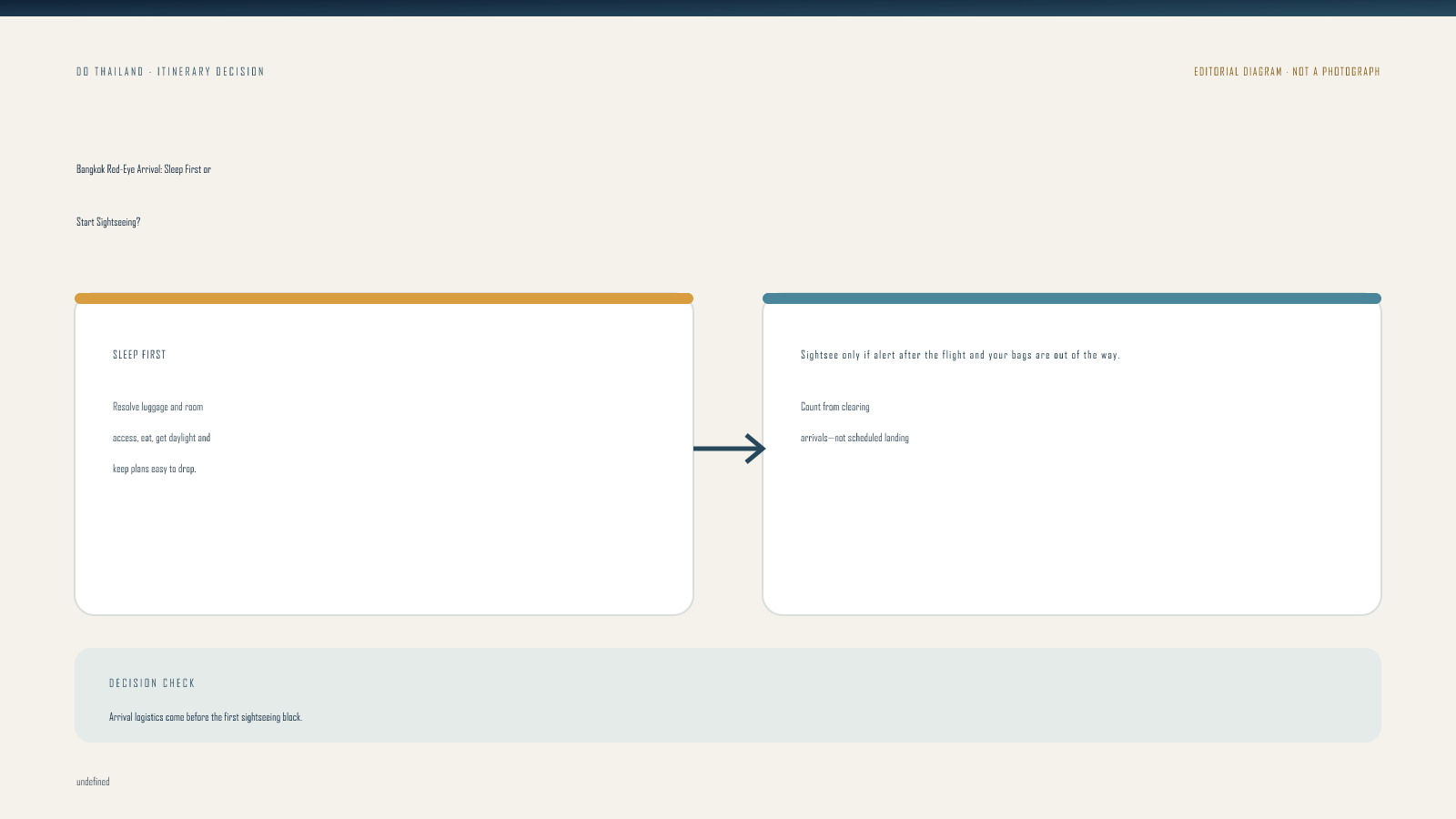
Do not spend your best Bangkok energy before you have a room.
Default: airport → hotel or confirmed luggage drop → breakfast and a short local walk → room/check-in → proper first-day plan. The exception is not “I landed at 5 a.m.” The exception is “I am alert, my bags are securely stored, I have washed up, and the next thing is genuinely low-stakes.”
Count from the moment you clear arrivals, not the scheduled landing time
A flight scheduled to land at 4:55 a.m. does not put you on a Bangkok street at 4:55. Taxiing, immigration, baggage delivery, customs, finding your transport and the journey into the city all sit between the timetable and your first coffee. Build the morning around the time you actually leave the terminal.
Get yourself and your bags to a stable base
Suvarnabhumi Airport currently lists the Airport Rail Link on Level B1, operating from 05:30 to midnight. If you clear the terminal before rail service begins, plan your transport to the hotel first; if rail service is closed, skip pre-dawn sightseeing. The airport also lists metered taxi and Grab among its ground-transport options. If you are staying around Sukhumvit, the BKK to Sukhumvit Airport Rail Link vs taxi guide is the useful comparison.
Make the hotel useful even before the room is ready
Ask the property in advance about luggage storage, reception hours, changing or washroom access and paid/complimentary early check-in. Do not design the morning on the assumption that a room will be ready just because you arrive early. If the hotel cannot hold luggage, solve that before adding any attraction.
Use the local morning, not the whole city
Breakfast, a staffed cafe, a short daylight walk, a convenience-store stop or one easy shopping errand can absorb time without locking you into anything. A temple circuit, a long river crossing, a timed tour or a cross-town restaurant mission belongs after you know how functional you actually feel.
The five-question gate before you start sightseeing
- Are the bags completely solved? “I can carry them” is not the same as solved. Your passport, valuables and travel documents should be under your control; the suitcase should not dictate every decision.
- Do you have a bathroom, change of clothes and somewhere to sit? A city feels very different after a night flight when you are still wearing airport clothes and cannot freshen up.
- Are you alert enough to navigate without forcing it? If you are rereading directions, snapping at simple problems or struggling to stay awake, use the morning for recovery rather than memory-making.
- Can you cancel the next thing with zero consequence? Before room access, flexibility is worth more than a “perfect” itinerary. Avoid prepaid, fixed-time or geographically awkward commitments.
- Does the plan stay near the hotel? Your first morning should normally orbit the place where the room will eventually become available. If you are crossing Bangkok twice before check-in, the plan is working against you.
Your best move changes with the time you actually exit Suvarnabhumi
Solve transport first
The Airport Rail Link is not yet inside its published operating window. Use a ground-transport option that fits your luggage and hotel, or wait for rail service if that genuinely makes sense for you. Do not treat the quiet pre-dawn city as bonus touring time.
Go directly toward the hotel
This is the cleanest window for dropping bags and establishing your base. If you chose Phaya Thai instead of Siam partly for Airport Rail Link access, this is exactly the kind of arrival where that trade-off becomes tangible.
Let energy decide, not the clock
Later does not automatically mean you should start touring. If you slept well on the flight and the hotel has your luggage, one local block can work. If you are exhausted, protect the reset. Bangkok will still be there after check-in.
What belongs before check-in — and what usually does not
Good arrival-morning choices
- Breakfast close to the hotel
- A short, shaded neighbourhood walk
- Buying water, toiletries or a transport card
- Sorting connectivity if your phone setup is not ready
- A quiet cafe where you can sit with valuables
- Returning to the hotel the moment the room becomes available
Save these for later
- A prepaid day tour
- A long temple sequence across the Old Town
- A market that requires a special cross-city trip
- A spa booking with a cancellation penalty
- Shopping that leaves you carrying extra bags
- Anything whose success depends on you being energetic at a fixed time
Connectivity is one exception worth solving early because it reduces friction everywhere else. If your phone is not ready when you land, use the Suvarnabhumi Airport eSIM check rather than improvising at the terminal, or compare a Thailand eSIM with an airport SIM.
Jet lag is a planning constraint, not a challenge to “push through.”
The CDC Yellow Book 2026 notes that jet lag can involve daytime sleepiness, impaired daytime function and general malaise. Its current guidance favours getting onto destination-time routines, daylight exposure and avoiding long daytime naps that make local-night sleep harder; short naps can help alertness when needed.
For itinerary planning, the useful takeaway is simpler than a medical protocol: do not build your most complicated Bangkok morning around the assumption that you will feel normal after an overnight flight. If you need individual advice about sleep aids or medication, speak with a healthcare professional rather than treating a travel itinerary as medical guidance.
Your hotel area changes how easy a gentle first morning can be
For solo women, the first morning should reduce decisions rather than multiply them
Set up five practical things before the flight lands.
- Confirm the exact hotel entrance and reception hours. A hotel name is not enough if the actual drop-off is inside a side street or building complex.
- Ask about luggage storage before arrival. Do not assume a policy that the property has not confirmed.
- Save the hotel name and address offline. If connectivity fails, you still need something clear to show a driver or airport staff member.
- Keep passport, money, phone and medication in one small bag you do not surrender with stored luggage.
- Choose a first waiting place that is staffed and easy to leave. A hotel lobby, cafe or mall near the hotel is usually more useful when tired than wandering quiet streets with luggage simply because the city has woken up.
If you are still choosing the airport itself rather than only the arrival plan, the BKK vs DMK guide compares the two airports by hotel connection rather than by airfare alone. The arrival airport changes the first transfer; it should not force you to redesign the whole trip.
Three realistic first-morning shapes
The exhausted red-eye
Clear arrivals → go straight to the hotel → store bags → eat nearby → sit somewhere calm → get the room when available → shower and reset → begin a light afternoon. This is not a “wasted” morning. It protects the hours you are more likely to remember.
The surprisingly functional arrival
Clear arrivals → hotel luggage drop → breakfast → one short neighbourhood loop → back to the hotel around room availability. The key is that the loop is optional. If your energy collapses after breakfast, nothing else breaks.
The airport-rail optimiser
Clear arrivals after rail starts → take Airport Rail Link toward the chosen base → solve the last transfer and bags → stay local until check-in. Do not add a major attraction simply because the train got you into central Bangkok efficiently. Efficient transport is a reason to make the morning easier, not busier.
What if the hotel will not hold your luggage?
Ask the property first, because hotel policies vary. If you need a separate fallback, Suvarnabhumi Airport currently lists a 24-hour Bellugg luggage-storage service in the terminal. That does not automatically mean leaving bags at the airport is a good idea: if your hotel is in central Bangkok, returning to BKK later can create exactly the kind of backtracking this plan is designed to avoid. Use it as a contingency, not as a default first-day itinerary.
The bigger principle is the same one behind Bangkok hotel-location decisions. A technically good option can still be wrong if it forces repeated movement. That is why the near-BTS vs deep-soi decision matters beyond commute time: small bits of friction are most expensive when you are tired, carrying bags or returning late.
Final answer
Arriving in Bangkok early after a red-eye? Sleep and reset first in the sense that you protect recovery, room access and flexibility — not necessarily that you immediately take a long daytime sleep. Go toward the hotel, solve your luggage, eat, get daylight and keep the pre-check-in block local and disposable. If you feel genuinely alert, one easy neighbourhood loop is enough. Save Bangkok's high-value sightseeing for the part of the day when your bags are gone and your brain has arrived too.
Continue with the Bangkok decision hub, or browse the Thailand itinerary guides if you are building the wider trip.
Sources checked
Airports of Thailand, Suvarnabhumi Airport — transportation guide: Airport Rail Link location/hours and ground-transport options.
Thailand Government — Airport Rail Link guide: Suvarnabhumi–Phaya Thai City Line route and published operating hours.
Airports of Thailand, Suvarnabhumi Airport — Bellugg: current terminal luggage-storage listing.
CDC Yellow Book 2026 — Jet Lag Disorder.
Tourism Authority of Thailand — Bangkok destination overview.
Transport schedules, hotel early-check-in and luggage policies can change. Reconfirm the airport service and your hotel's own policy for your travel date.