
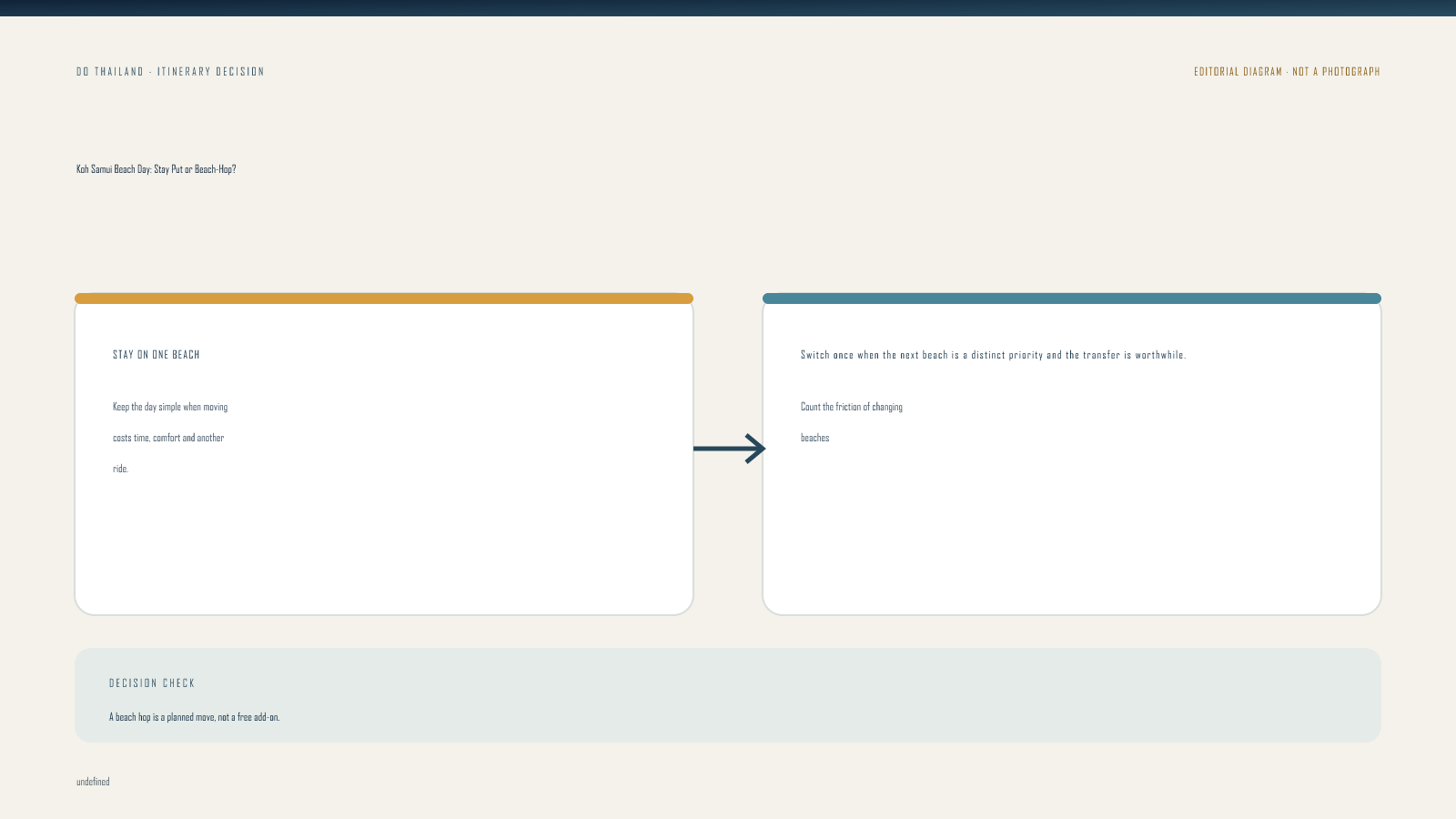
A Koh Samui beach day itinerary looks deceptively easy on a map. Pick three attractive names, save them in your phone and move between them whenever you feel like it. In practice, every switch means drying off, packing valuables, finding the pickup point, confirming the fare or app ride, arriving somewhere unfamiliar and starting the beach-day routine again.
That does not mean beach-hopping is a bad idea. It means the useful comparison is not “one beach versus more beaches.” It is continuous beach time versus the value created by one deliberate change of scene.
The four things a beach switch quietly costs
If you are already using a short trip for a major marine excursion, this matters even more. The Koh Samui 3-day itinerary treats an offshore day as a major allocation, not a free extra. Your protected beach day should feel different from that: fewer transitions, less clock-watching and more room to stay when the day is going well.
Keep the whole day on one beach when…
- your hotel already gives you easy beach access;
- you want swimming, reading, lunch and a slow afternoon more than sightseeing;
- you are recovering from a boat day, early flight or active land route;
- you do not ride a scooter and the second stop would require a separate outbound and return ride;
- you cannot name a distinct experience the second beach adds.
One beach switch is worth it when…
- the second stop is on the same logical corridor rather than across the island;
- you can name the benefit: a different coastline feel, lunch area, sunset direction or evening neighbourhood;
- you can move before the day becomes a late-afternoon transport scramble;
- you already know how you will get back to the hotel;
- the switch replaces part of the day rather than becoming an extra task squeezed into it.
The one-switch rule: a beach day that still feels like a beach day
- Morning: choose the easy beach first. If your hotel is in Chaweng, Lamai, Bophut or another beach base, start where access is already simple. Do not pay the transport tax before you even know whether you want to leave.
- Early afternoon: make the only decision that matters. If you are comfortable, stay. If you have a specific reason to move, switch once while you still have daylight and energy.
- Late afternoon onward: stop collecting beaches. Turn the second stop into the end of the day—late lunch, sunset, dinner or an easy return—not the starting point for another transfer.
This is deliberately different from the final-day repeat-versus-new-coast decision. That guide asks whether your last full day should open another side of the island at all. This guide assumes you have already protected a beach day and asks how much movement belongs inside it.
Same corridor beats famous-name hopping
Koh Samui Municipality currently describes Chaweng as a roughly six-kilometre east-coast beach zone divided into north, central, south and Chaweng Noi sections. That is useful planning information: even a single named beach area contains different stretches, so you do not always need a cross-island transfer to create a change of scene.
If you are based around Chaweng
First decide whether you even need to leave the Chaweng zone. The central Chaweng vs north Chaweng guide shows how much the daily rhythm can change inside the same larger beach area. If you genuinely want to continue south, keep the plan linear rather than bouncing back and forth.
If your shortlist is Chaweng Noi, Coral Cove and Silver Beach
Treat these as a sequence to simplify, not three trophies to collect. Use the existing Chaweng Noi vs Coral Cove and Coral Cove vs Silver Beach comparisons to choose which contrast actually matters to you. Then visit one, not all of them by default.
If Lamai is the natural finish
The municipality places Lat Ko viewpoint between Chaweng and Lamai, which reinforces the usefulness of thinking in corridors instead of random pins. If Lamai is where you want dinner or your evening to finish, a southbound beach switch can make sense. The Silver Beach vs Lamai and Chaweng Noi vs Lamai guides help separate quieter-beach appeal from the practical value of a larger beach-town base.
Lamai itself is not one uniform swimming promise either. The municipal beach page notes that some stretches can be deeper and experience stronger waves. That is a useful reminder to judge the water you actually see on the day rather than assuming a second beach will automatically be “better.” Conditions change; a saved itinerary should never override what is in front of you.
Do not confuse beach-hopping with a beach-club decision
If what you really want is a lounger, service, music, a pool or an easy place to spend money without thinking about lunch logistics, the decision is not “one beach or two.” It is closer to beach club vs independent beach day. Solve that first. A paid venue can make a stay-put day feel more structured; an independent beach day gives you more freedom but also asks you to manage your own shade, food and belongings.
Likewise, if you realise halfway through the trip that what your body wants is recovery rather than another beach, the massage vs spa-day guide is a better branch than forcing a second beach because it was on the plan.
Solo women and no-scooter travellers: make the return boring
The best transport plan for a relaxed beach day is the one you barely have to think about. TAT's current Ko Samui guidance advises travellers to agree taxi or tuk-tuk fares before departure, warns about motorbike accident risk, and recommends particular care walking or swimming on beaches at night when alone.
For a one-switch day, that translates into simple habits: keep the hotel address saved offline, know where the second beach pickup point is before you swim, carry only the valuables you can keep with you, and do not let sunset become the first moment you start working out how to get home. If your beach plan has several separate rides, compare the logistics in private driver vs taxis before assuming ad-hoc transport will still feel relaxed.
If the water or weather is not cooperating, cancel the hop
A beach itinerary is one of the easiest plans to simplify on the day. If the sea looks rougher than you expected, rain is settling in, or the first beach is already giving you everything you wanted, do not preserve a second stop just because it is written in your notes. The point of the protected beach day is flexibility.
If you still have a full sightseeing block to allocate elsewhere in the trip, keep that decision separate. The temples vs south-island nature itinerary is designed for a land-sightseeing day, not something to bolt onto a beach afternoon.
Three quick examples
Four nights in central Chaweng: spend the morning and lunch on your easiest Chaweng stretch. Move south once only if you specifically want a quieter-feeling second stop or Lamai evening. Otherwise, enjoy the rare day when nothing needs to happen.
Four nights in Lamai: Lamai can already fill the role of beach plus independent food and evening options. A second beach should add a real contrast, not simply move you north for another swim. If your actual question is whether a different coast would make a better hotel base, use Maenam vs Lamai instead of solving an accommodation decision with a day trip.
Quiet resort outside a walk-out centre: staying put has unusually high value because the hotel location is part of what you paid for. If you leave, make the second stop do double duty—beach plus dinner area, for example—rather than paying for a separate return journey after every small activity. If that sounds unlike the holiday you want, revisit the broader Chaweng vs Bophut base decision for a future trip.
The final rule
One beach is the default. Two beaches are a plan. Three beaches are usually a checklist. On a short Koh Samui trip, protect the part of the day you came for: swimming, shade, lunch, conversation, reading and the option to stay longer because the place feels good.
For the broader trip, return to the Koh Samui destination hub or the Thailand itineraries hub.