
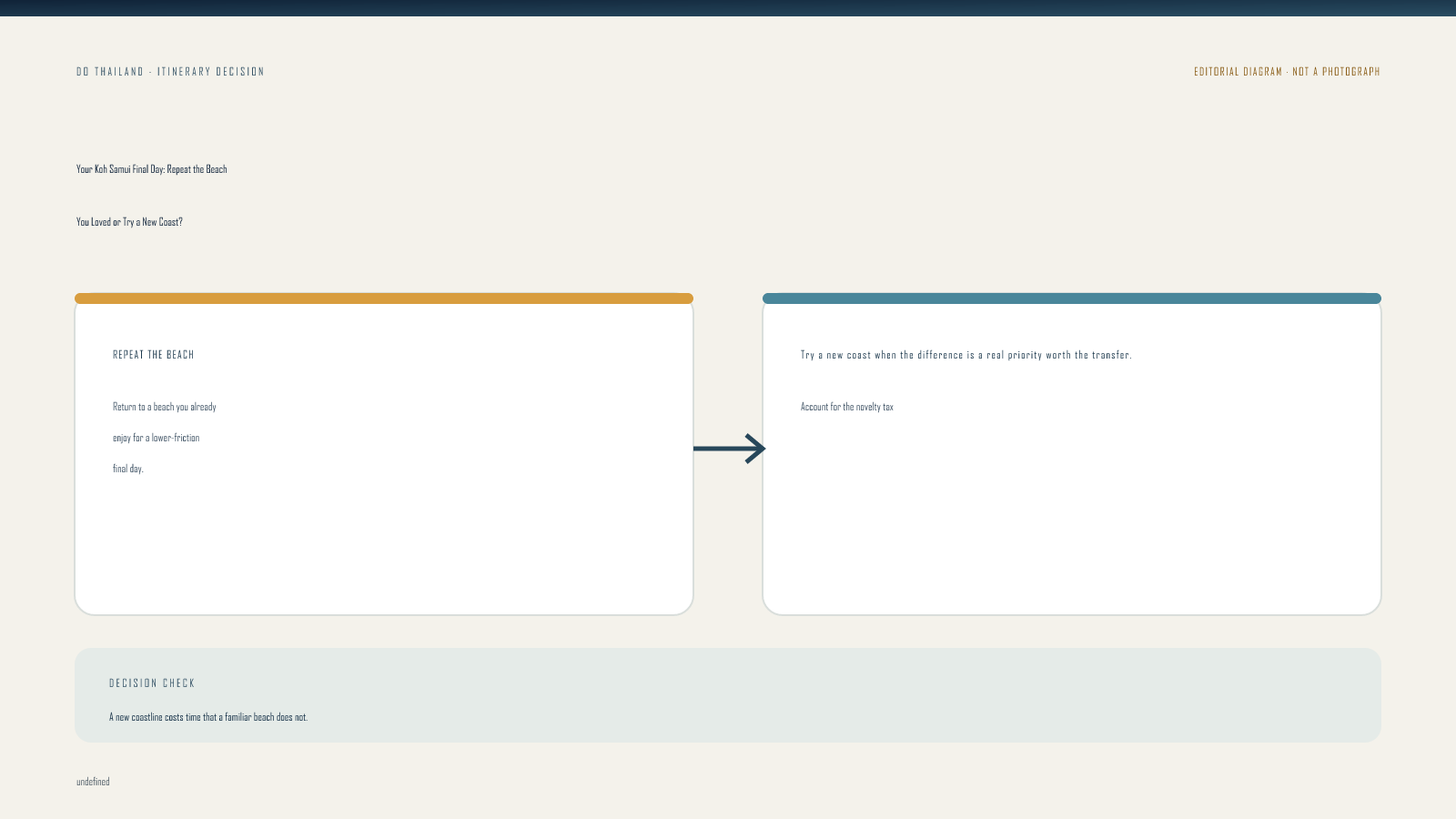
A good Koh Samui final day itinerary is not a test of whether you covered the island. By the last full day, you finally have information that no pre-trip spreadsheet could give you: which beach you actually enjoyed, how much cross-island movement feels annoying, whether you still want another active day, and how much energy you have after the boat trip or sightseeing route you already chose.
Tourism Authority of Thailand currently highlights very different sides of Samui in the same destination guide—Chaweng and Lamai among the major beaches, quieter west-coast options such as Taling Ngam, and the old-world character of Bo Phut. Use the coast contrast to choose an outing that changes your day; skip transfers that add only another beach name.
The hidden cost is the novelty tax
A new coast is rarely just “one more beach.” It means a new pickup or taxi plan, a new arrival point, a new place to store your things, another round of deciding where to eat, and a return journey that may happen after you are tired. None of those costs are dramatic on their own. Together, they can turn the most relaxed day of the trip into another logistics day.
This matters especially if you already gave one day to a substantial offshore plan. The existing Koh Samui 3-day itinerary treats a boat day as a major allocation rather than a harmless extra. If you also used another day for the temples-versus-south-nature land decision, the last full day is your first real chance to react to the trip instead of executing the plan you made before arrival.
Koh Samui final day itinerary: the five-question scorecard
| Question | Repeat what worked | Try a new coast |
|---|---|---|
| Did you already find a beach you actively want more time on? | Strong yes. Repetition is the point. | Only if the alternative solves a different desire. |
| Are you physically tired after boats, heat or a land route? | Usually the better use of the day. | Choose only a low-friction new coast. |
| Would the new coast change the experience? | If not, stay put. | Yes when you are adding a different evening, sunset, town texture or coastline rhythm. |
| Do you have a clear return plan without riding a scooter? | Easy if you already understand the area. | Essential before you leave the hotel. |
| Would you regret not seeing the other side? | If the answer is vague, repeat. | If the answer is specific, go. |
What actually counts as a different coast?
Judge a coast change by how it changes your day; compass direction alone says little. Samui Municipality and TAT describe enough contrast across the island to make some cross-island swaps meaningful.
East: Chaweng
Chaweng is on the east side and is described by the municipality as the island's busiest major beach, with shops, restaurants, pubs and bars around it. If your current stay is quiet and resort-led, a Chaweng day can create a genuinely different combination of beach time and walk-out evening options. If you already stay in Chaweng, going to another busy east-coast beach just to say you did may add little.
North: Bophut
Bophut brings the Fisherman's Village texture: older Chinese-style buildings, shops and seafood dining along the north coast. That makes it more than a sand swap. If your trip has been mostly resort-and-beach, Bophut can be a sensible final-day contrast without pretending it is another “must-see” beach checklist.
South-east: Lamai
Lamai is one of Samui's major beach areas but has a different scale and rhythm from Chaweng. If you are already considering it as a base, the Maenam vs Lamai and Lamai centre vs Hua Thanon edge guides explain the practical difference better than treating “Lamai” as one single pin.
West: Lipa Noi or Taling Ngam
West-coast value is clearest when the slower rhythm and sunset direction are what you want. The municipality describes Lipa Noi as quieter and more natural, while Taling Ngam is specifically associated with west-facing sunset views. If your trip has been east- or north-coast heavy, that can be real contrast. If you are only chasing another beach, it may not justify the extra movement.
Three ways people waste the last full day
“We have not seen the west coast yet” is not a reason by itself. Ask what you intend to do there. Sunset, a deliberately slow lunch, a quieter beach afternoon or a different town atmosphere are answers. A coloured pin on a map is not.
If your body is asking for a slower day after a boat excursion or inland route, accept the information. You can still make the day feel intentional: return to the beach at a different time, book a long lunch, swim, read, or use the massage vs spa-day decision if wellness is what you actually want.
The attractive part of a new coast is the arrival. The practical test is how you get back after dinner, sunset or a long beach afternoon. If you do not ride a scooter, compare point-to-point rides with a more structured day in the private driver vs taxis guide before turning the last day into an improvised transport chain.
Three final-day scripts that avoid overplanning
If you are based in Chaweng or Bophut
Repeat if you already like the combination of beach and evening life. You finally know which part of the beach works for you, where you want lunch and how easy the return to your room is. If you want contrast, choose one clear reason to go elsewhere: a Lamai beach-town day or a west-coast sunset. Do not combine both.
If you are still deciding how these two bases differ, Chaweng vs Bophut is the useful comparison; the narrower central vs north Chaweng guide explains why even one named beach can create different daily friction.
If you are based in Lamai
Repeat if Lamai has already given you the balance you wanted between beach time and independent meals. Try another coast only if the new day has a strong identity—for example Bophut for a north-coast village-and-dinner finish, rather than another beach chosen at random.
If the temptation is really to change hotels rather than take a day trip, separate the decisions. The one resort vs split-stay guide deals with whether moving luggage is worth it. A final-day excursion does not require a new checkout.
If you are based on a quieter north or west coast
Repeat when quiet resort time is why you booked there. Open a second coast when you feel you have missed a type of evening or town life, not simply a famous beach name. For west-versus-north trade-offs, Lipa Noi vs Maenam shows how ferry direction, sunset and repeated routes change the choice, while Bang Por vs Lipa Noi is useful if quietness is already non-negotiable.
For women travelling solo or without a scooter: design the return before the novelty
TAT's current Samui guidance specifically advises agreeing taxi or tuk-tuk fares before departure, warns about motorbike accident risk, and says to take particular care walking on beaches or swimming at night when alone. That does not mean one coast is automatically “safe” and another is not. It means the final-day decision should include the exact hotel entrance, your return transport and how much of the walk back happens after dark.
For a new coast, save the destination and hotel pin while you still have good signal, keep enough phone battery for the return, and decide whether you are leaving before or after dinner. The point is not to make the day anxious. It is to remove the one piece of uncertainty that tends to become annoying only when you are tired.
Use local weather to decide whether to keep the nearby plan or switch coasts
Check local conditions before changing coasts; a long ride may bring no meaningful improvement. If your preferred beach is still usable and the alternative requires a long ride for an uncertain improvement, repeat the known plan. If the new coast is already a genuine priority and conditions look suitable, that is a reasonable tie-breaker.
This is also why a final day should remain lightly booked. The point of leaving one full day flexible is that you can use information from the trip itself.
The better final day is the one you would choose without a map
Imagine the island map disappears. You remember only two things: the beach or neighbourhood you already enjoyed, and the specific new experience that another coast could give you. Which sounds better?
If you immediately want another slow morning in the same place, repeat it. That is not wasted travel. It is using the trip to learn what you like and then giving yourself more of it.
If the other coast has a clear pull—Fisherman's Village and dinner in Bophut, a west-coast sunset, a Lamai day that feels different from your current base—go. The key is that the new coast has to win on experience, not on completion percentage.
Final rule
Repeat what worked unless the second coast can finish this sentence: “I want to go there because the day will feel different in this specific way.”
If you are still building the whole trip rather than only the last day, go back to the Koh Samui decision hub or the itinerary hub. Keep the final day flexible until the earlier days tell you what deserves repeating.