
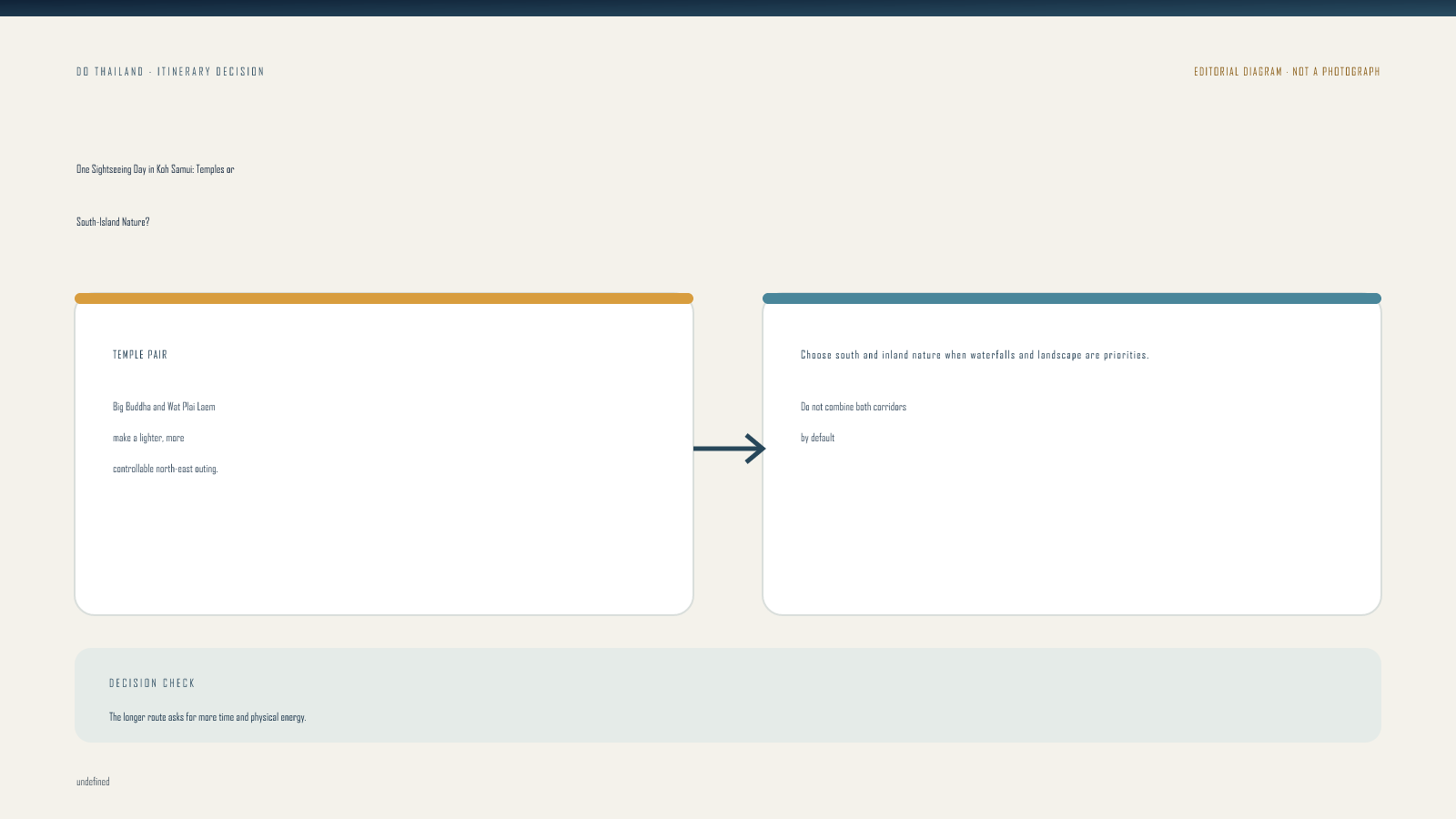
This decision sits one level above choosing a tour. You are not yet deciding between a taxi and a guide, or between Na Muang independently and a 4x4 safari. You are deciding what your one land-sightseeing day is for.
That matters on a short island trip because the two versions spend your energy differently. The north-east version concentrates culture into a compact pocket. The south/interior version turns the day into a route, where the landscape between stops and the amount of driving are part of the experience.
Choose the temples
Best when: you want culture, architecture and a low-friction sightseeing block that can still leave room for lunch, beach time, a spa treatment or a flexible evening.
The core pair is Big Buddha (Wat Phra Yai) + Wat Plai Laem. Koh Samui Municipality places Wat Plai Laem on the north side of the island, on Road 4171 between Big Buddha and Choeng Mon. This is why the pair works as one focused corridor rather than an island-crossing project.
Choose south/interior nature
Best when: your trip needs greenery, a waterfall and a stronger sense of Samui beyond the resort coast, and you are willing to spend more of the day moving through the island.
Use Na Muang as the anchor, then add only one south-side stop that genuinely matters to you. Koh Samui Municipality describes Na Muang 1 as the easier-access waterfall, reached by paved road; Na Muang 2 requires a different level of commitment and is described as roughly a 30-minute walk from its access point.
The question is not “which side has more attractions?”
Both sides can generate a long list. That is exactly the trap. The useful comparison is what each side costs you in movement, heat, recovery time and evening flexibility.
Tourism Authority of Thailand's current Samui–Surat Thani planner illustrates the broader geography: its Samui sightseeing day combines Phra Yai with south-side stops such as Hin Ta Hin Yai, Laem So and Lamai. That shows the island can be crossed in a sightseeing circuit. It does not mean a short-trip traveller should copy the entire circuit. Official itineraries are inspiration; your limited day still needs a priority.
What the north-east day actually feels like
The temple version works because it is easy to keep the objective narrow. Big Buddha sits at Koh Fan on the northern side of Samui, while Wat Plai Laem is nearby on the same north-east side. The municipality's visitor information explicitly places Wat Plai Laem between Big Buddha and Choeng Mon. You can see both without turning the day into a tour of every landmark on the ring road.
If those two temples are the whole point, read the dedicated Big Buddha and Wat Plai Laem: independent visit or tour guide next. It handles the experience-format question after you have already chosen the cultural corridor.
The strongest benefit is what happens after the temples. If you are based in Chaweng, Bophut or Choeng Mon, you can still treat the second half of the day as holiday time rather than as the continuation of a sightseeing circuit. This can matter more than adding a third attraction.
Big Buddha → Wat Plai Laem → stop.
Add lunch, your own beach or a return to the hotel only if you still want it. Do not automatically bolt on a south-island stop just because the car is already moving.
Na Muang → one deliberately chosen south-side landmark or Lamai-side stop → return.
The point is a coherent land route, not collecting every rock, shrine, viewpoint and waterfall that appears in a search result.
What the south/interior day gives you that the temples do not
Na Muang changes the texture of the trip. The municipality describes Na Muang as a waterfall descending from the island's central highlands into a large pool, with the surrounding area shaded by large trees and local orchards. It also warns visitors to take care around rocks in the pool. The value is not that it is objectively “better” than the temples; it is that it gives a beach trip a different landscape.
But “Na Muang” is not one uniform commitment. Na Muang 1 is the lower-friction option. Na Muang 2 is described by the municipality as roughly 80 metres high and requiring about a 30-minute walk from its access point. If your fantasy is a quick green stop in sandals before lunch, do not casually plan the higher waterfall as if it were the same visit.
Once the nature side wins, use the existing Na Muang independently vs 4x4 safari guide to decide how structured you want the route. That page compares experience format. This page only decides whether the southern/interior side deserves your one sightseeing block in the first place.
The stop-count trap: combining both sides can make both worse
A common planning mistake is to read two sensible half-day ideas and merge them into one “efficient” island tour. You start with Big Buddha and Wat Plai Laem, then add Hin Ta Hin Yai, a waterfall, a south-side temple, lunch and perhaps a sunset stop because they are all technically on the same island.
The result can be a day where every place becomes a transition to the next one. If you genuinely enjoy broad island circuits, that can be fun. If you chose Samui partly for a beach-resort rhythm, it is usually a poor trade.
The private driver vs separate taxis guide is useful only after you decide how many stops survived this edit. Transport should solve your itinerary, not become the excuse for making the itinerary larger.
Your hotel base should break a tie, not make the whole decision
The temple pair usually creates the lower-friction land block. If your evenings matter, compare the micro-location trade-off in central Chaweng vs north Chaweng rather than choosing a hotel for one sightseeing day.
Culture is still the easier corridor, especially when you want to return for a walk-out dinner. The broader Chaweng vs Bophut decision explains why evening style often deserves more weight than one daytime route.
The south/interior version becomes more natural because your base already points toward Lamai-side and southern roads. If you have chosen Lamai, the Lamai centre vs Hua Thanon edge guide shows how a south-facing itinerary can change the value of your exact hotel location.
Do not reverse-engineer a four-night hotel stay around one temple morning or one waterfall day. If you are still choosing the overall base, use the Koh Samui destination hub and solve the stay question on its own terms.
What each choice asks from your body
Temple day
Expect sun, stairs and respectful clothing choices, but the day can remain relatively compact. Carry a light layer or clothing that covers shoulders and knees appropriately for temple spaces, and choose footwear you can manage comfortably while entering religious areas.
The main planning risk is treating “compact” as “instant.” Give yourself permission to look rather than rush.
Nature day
Expect more time outside, potentially wet or uneven surfaces and a bigger penalty for poor footwear. At Na Muang, natural water and rocks are not a hotel-pool environment; the municipality specifically cautions about rocks in the pool area.
If recent rain has changed conditions, do not treat swimming or a particular walking segment as mandatory simply because it was in the plan.
For women travelling solo: reduce the awkward handoffs
Neither corridor should be labelled “safe” or “unsafe” as a blanket statement. The practical difference is how many moments require you to solve the next step while hot, tired or standing away from your hotel.
For the temple pair, set your return pickup point before you finish the second stop and keep enough phone battery and data to change the plan. For the nature side, sort out the return vehicle before you walk deeper into an attraction area, carry water, and use footwear you trust on wet ground. If your plan extends toward evening, know how you are getting back before daylight starts disappearing rather than improvising the last ride.
If you are relying on a commercial tour pickup, check your exact hotel rather than assuming a beach name guarantees door-to-door service. The Samui tour-pickup hotel-location guide explains that last-mile issue.
What you give up when you choose well
Choose the temples and you give up the feeling of a big cross-island land adventure. Your day may look less impressive on a checklist. In exchange, you keep control of the afternoon and can spend longer at the two cultural stops you actually selected.
Choose south/interior nature and you give up some spontaneity. Once you are committed to the route, the day is less compatible with “we will see how we feel after lunch.” In exchange, Samui becomes more than a beach-town-and-resort trip.
That trade is especially important if you also have an offshore day. The Koh Samui 3-day itinerary treats every full day as a scarce resource. If one day already goes to Ang Thong, Koh Tao or another marine plan, your land day should create contrast without becoming a second endurance event.
Four traveller types, four clean answers
You are in Chaweng or Bophut, hate checklist tours and want dinner energy: choose Big Buddha + Wat Plai Laem.
You are in Lamai, waterfalls are a genuine priority and you enjoy a route day: choose the south/interior side, anchor it at Na Muang, and keep the extra stops selective.
You mainly want photographs of temples and architecture: choose the temple pair and do not dilute it with an all-island circuit unless you also want the other stops.
You already have several beach/resort days and want the island to feel physically different: choose nature, but plan the road and walking commitment honestly.
The booking rule
First choose the corridor. Then choose the transport or tour format. For most first-time short trips based on the north or east visitor areas, the temple pair is the lower-friction default. Switch to south/interior nature when Na Muang and the inland landscape are themselves priorities.
Keep the rest of the trip modular through the Thailand itinerary guides, and let the day you did not choose remain a reason to come back rather than a reason to rush.