
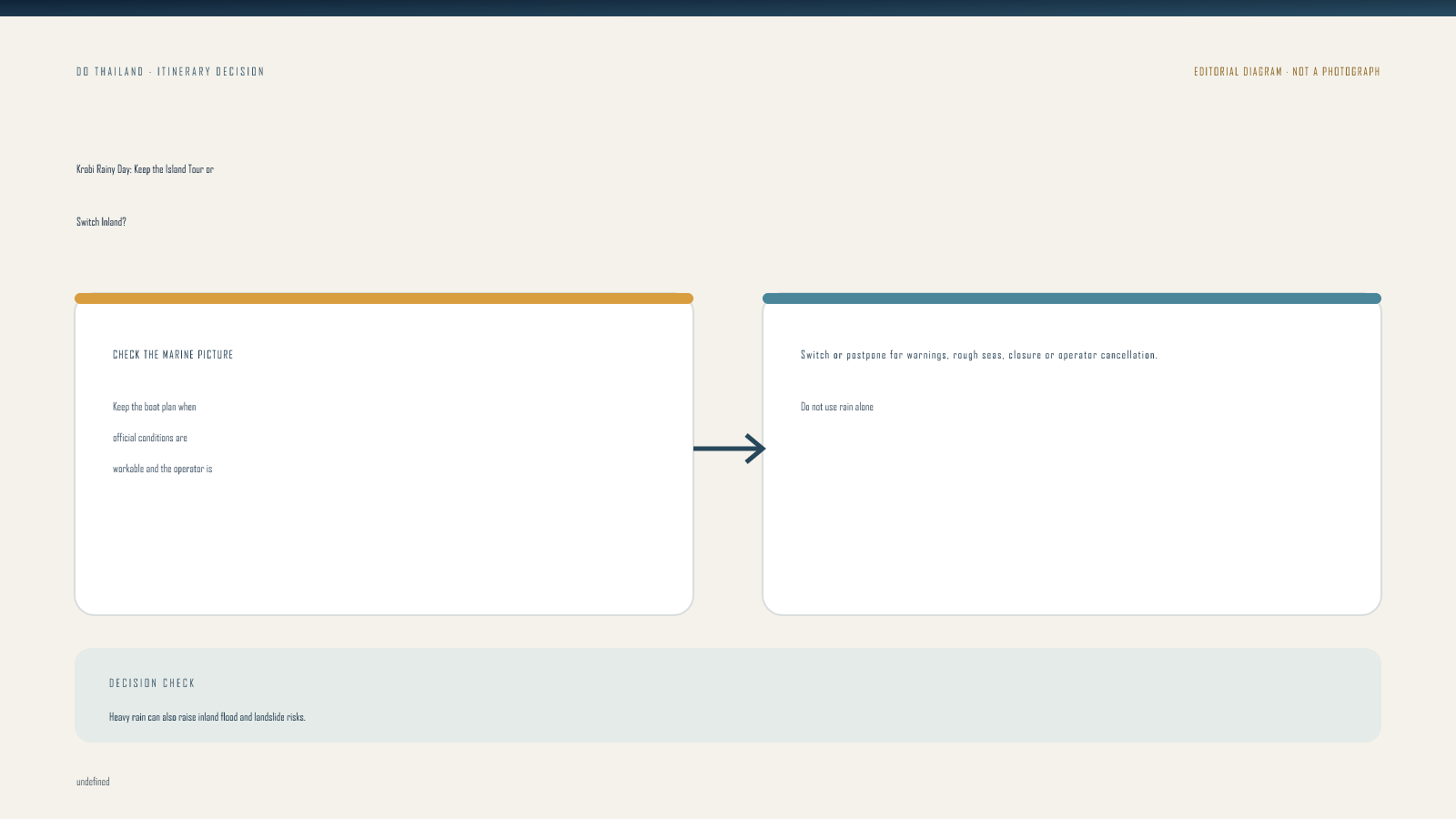
The decision is not “rain or no rain”
Krabi weather creates a planning trap because the same grey forecast icon can describe very different days. One version is intermittent tropical rain with workable sea conditions. Another is a stronger southwest-monsoon pattern with rougher Andaman water and thunderstorms. A third is widespread heavy rain where moving inland simply swaps marine exposure for slippery trails, low-lying roads or foothill risk.
The Thai Meteorological Department separates ordinary forecasts from shipping forecasts for a reason. Its current shipping service reports wind, wave height and thunderstorms for the Andaman Sea, and recent 2026 advisories have told ships to keep away from thundershowers and, during stronger periods, told small boats to remain ashore. Those are stronger decision signals than the little rain percentage beside your breakfast alarm.
If your trip is only three or four full days, this is where flexibility becomes useful. The broader Krabi four-day islands-vs-inland guide deliberately keeps one land day movable. This page tells you when to use that swap.
Rain forecast, sea still workable
The operator confirms normal operation, there is no relevant park restriction, and the marine forecast does not show a condition that should push you off the water. Keep the island day if it is a priority, but accept that visibility, beach comfort and photos may not be perfect.
Mixed or deteriorating picture
Thunderstorms, stronger wind or changing wave guidance are appearing, but no final cancellation has been issued. Keep the day movable. Ask the operator what they are actually doing, not whether the tour is “usually fine in rain.”
Official warning, closure or cancellation
Do not argue with a safety gate because you already paid or because yesterday looked calm. Switch the itinerary, follow refund/rebooking terms for the exact booking, and re-check whether the inland alternative has its own heavy-rain risks.
Use three signals, in this order
When keeping the island day still makes sense
A forecast of showers alone is not a cancellation instruction. If the marine forecast remains moderate, the operator confirms the trip, and there is no applicable park restriction, keeping the marine day can be the right use of a short Krabi itinerary — especially if the following days look less flexible or the offshore experience is one of your main reasons for visiting.
That does not mean pretending rain has no cost. Cloud can flatten the colour of shallow water, snorkelling visibility can be less satisfying, wet transfers feel colder after repeated stops, and a long speedboat day can become tiring faster. If the experience is still worth those trade-offs, go. If your entire reason for booking was postcard-clear water and long dry beach stops, an operational tour can still be a poor personal choice.
Different marine days also carry different commitment levels. If you have not settled what the sea day should be, compare Phi Phi day trip vs overnight or decide whether Railay and Four Islands belong together or on separate days. Weather flexibility works better when the itinerary has one clear marine priority rather than three interchangeable bookings.
When switching inland is the cleaner move
Switch when the sea-specific risk has clearly become the weak link: a TMD warning materially worsens, small-boat guidance applies, the operator cancels or changes the route, or an official park or beach instruction removes the experience you were actually trying to have. The point is not to “save the day at any cost”; it is to move your best weather-tolerant plan into the slot.
Krabi has real non-island options. Tourism Authority of Thailand material highlights Khao Khanap Nam, Ko Klang, Wat Tham Suea (Tiger Cave Temple), Klong Thom hot-spring areas and other inland or town-side experiences. But they are not one universal rainy-day bucket. Choose the backup according to the same weather event that disrupted the sea.
Use the day you wanted anyway
An Emerald Pool or hot-spring day may still make sense if the site is operating and local conditions are suitable. The separate Emerald Pool vs Hot Springs guide helps decide which one is actually the priority, while group tour vs private driver handles transport flexibility.
Reduce exposure rather than chasing a dramatic viewpoint
This is not the time to treat Tiger Cave Temple as a compulsory substitute. A steep outdoor climb, forest access and wet surfaces may be exactly the wrong response to a severe-rain day. If Tiger Cave remains on your trip, use the independent vs jungle-tour guide on a suitable day rather than as an automatic storm backup.
Use a lower-commitment urban block
Krabi Town can absorb a flexible half-day better than a forced adventure. The Krabi Town half-day guide explains when the river and town-side contrast are worth leaving Ao Nang, and the Walking Street vs Ao Nang night-market guide can shape the evening if the date fits.
Four “rainy-day alternatives” that are not automatically rain-proof
Tiger Cave Temple: a land attraction, yes; a severe-weather shelter, no. Wet steps, exposed sections and fatigue change the risk profile.
Emerald Pool and forest attractions: being inland does not cancel flash-flood, overflow or slippery-trail risk. Check the site and local weather rather than using the word “forest” as reassurance.
Ao Thalane kayaking: it is not an island-hopping day, but it is still a water activity exposed to weather. If kayaking is the backup you had in mind, compare morning vs afternoon at Ao Thalane only after the conditions are appropriate.
Railay: it can be a more flexible coastal day than a multi-stop island tour, but it is still boat-accessed from common Krabi bases. If your first full day is the affected one, Railay vs an island tour after a late arrival covers that specific sequence.
Do not let a non-refundable feeling make the weather decision
The worst weather logic is sunk-cost logic: “we already booked it, so we should go unless they physically stop the boat.” A tour can be operating and still offer a version of the day that you personally no longer value; it can also be cancelled under terms that differ by operator and booking channel. Read the exact booking conditions rather than assuming a platform-wide refund rule.
This article therefore does not tell you to buy a replacement tour. First decide whether the day should remain marine, become inland, or simply become lower-commitment. Only after that decision should a booking page matter. If no new purchase is needed, the correct next action is to rearrange the itinerary, not add another CTA.
A 24-hour reordering playbook
- The evening before: check TMD shipping guidance and any relevant warning, then read the exact operator message rather than a screenshot from another traveller.
- Keep two columns: one marine day and one land/town day. Do not pre-fill both with non-refundable commitments if weather flexibility matters to you.
- At breakfast: confirm what changed overnight. If the sea day is still operating safely and you still want the experience under cloudy or showery conditions, keep it.
- If the sea day moves: check whether the same weather system creates heavy-rain, flash-flood or landslide risk inland. Choose the least exposed worthwhile backup, not the most famous attraction left on your list.
- After the swap: protect one later marine slot rather than automatically pushing every remaining day back by one. A short trip works better with one deliberate weather buffer than a chain reaction.
For women travelling solo or with friends: plan the wet return before the wet activity
A rainy day becomes more annoying when the final transport is vague. Keep your phone and payment method dry, carry one dry layer in a sealed bag, and know the last step from the drop-off point to the hotel before leaving. If your Ao Nang base already makes every return depend on an improvised ride, the Ao Nang without a scooter guide shows why walk-out location can matter more than a prettier room on short trips.
Do not compensate for a cancelled sea day by pushing yourself into an isolated hike or exposed viewpoint simply because it feels more “productive.” Weather changes the value of an activity as well as its safety. A café, massage, town meal or quiet hotel block can be the rational middle of a trip if it protects tomorrow's better window.
If you are still arriving into Krabi when the weather turns, keep airport logistics separate from sightseeing pressure. The Krabi Airport to Ao Nang guide handles the transfer; do not build a complicated rescue itinerary before you have even reached the base.
A June 2026 reminder: official local restrictions can be more specific than the forecast
In June 2026, Thailand's Department of National Parks reported Portuguese man-of-war findings in Krabi marine-park areas and used red-flag/no-swimming measures at affected locations while increasing monitoring around Phi Phi. That was a specific June event, not a claim about conditions today. The planning lesson is broader: an official local safety instruction can override an otherwise acceptable-looking weather forecast.
Do not assume a calm sky means every beach stop is open, and do not assume a rainy sky means every boat is cancelled. Check the actual restriction that applies to the place and date you are using.
The simplest Krabi rainy-day rule
Rain alone: reassess. Marine warning or cancellation: switch. Heavy-rain land warning: soften the backup too.
That rule keeps the itinerary responsive without turning every cloud into a cancellation. For the whole trip, return to Krabi in four days: islands vs inland; for everything currently live around the province, use the Krabi destination hub or the itinerary index.